Refined Products, Crude Oil, LPG, Diesel-Gasoil
June 17, 2025
Syria’s Banias refinery exports first cargo since regime change
HIGHLIGHTS
Syria's largest refinery exports refined product for the first time in over six months
Refinery was taken offline late 2024 due to supply disruption, restarted in April
Officials aim to restore oil exports, though refined product likely to stay domestic
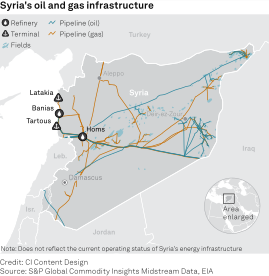
Syria resumed fuel shipments from its largest refinery, Banias, for the first time in over six months on June 16, its authorities announced, in a sign of further normalization for the country's troubled energy sector.
The 120,000 b/d Banias refinery was taken offline late 2024 when the fall of President Bashar al-Assad saw Iran suspend the crude shipments that fed its operations.
However, in April, new crude deliveries from Russia, another backer of the old regime, helped the refinery to restore some production. Now, sanctions waivers from the US and EU have paved the way for the site to potentially forge new supply links, and Syrian officials have set their sights on reviving a once lucrative oil export business.
A statement on the Banias Facebook page announced that State-backed Syria Trading Oil Company (Sytrol) shipped 30,000 mt of petroleum product from the Banias terminal on June 16, marking the first export from the site since it was shut for four months.
"This step is an honorable beginning of Syria's return to the map of oil export and oil derivatives," said a statement from Gayath Diab, Director of the General Administration of Oil in the Syrian Ministry of Energy.
Velos Fortuna, a Marshall Islands-flagged Medium Range tanker, became the inaugural cargo to lift product from the newly-restarted refinery, according to the statement and S&P Global Commodities at Sea shipping data.
CAS data showed the tanker arriving at the port from Libya on June 11, before loading unspecified clean oil products and departing six days later.
The tanker signal currently shows the vessel as 'for order' without disclosing a final destination, CAS data showed.
Export plans
As Syria's new Hayat Tahrir al-Sham (HTS) regime works to stabilize the war-torn country, precedent suggests that crude oil, and not refined products, will be the focus of future export activity.
Before the country was thrown into civil war in 2011, Syria was a significant crude exporter to the Mediterranean market, contributing some $3 billion to the national economy, according to data from the US Energy Information Administration.
However, even at full capacity, the country's two refineries -- Banias and Homs -- lacked the scale to fully meet local demand, leaving a net fuel import deficit of roughly 70,000 b/d before the civil war. In the time since, infrastructure damage has further dented domestic refining capacity, making the shortfall even more acute.
With a combined nameplate capacity of around 230,000 b/d, Banias and Homs were once capable of serving roughly three-quarters of pre-war Syrian oil demand, according to EIA figures. Before the regime change in 2024, Energy analysts estimate that actual throughput was closer to 70,000 b/d, partly due to damage and a lack of maintenance.
As a result, the country is likely to focus on directing scarce domestic supplies of gasoil and LPG to local consumers to power generators and cookstoves, analysts say, calling energy access a critical first step to get the country running again.
In a sign of lasting fuel shortages, Syria's Ministry of Petroleum and Mineral Resources has continued to issue public tenders for LPG, gasoline, diesel and crude, in some cases with an appeal for product at "utmost urgency".
Most recently, the department issued a call for some 25,000 mt of monthly LPG supplies July – September, in a widely distributed tender that closed June 17.
According to sources and ship-tracking data, Turkey has emerged as a prominent LPG exporter to Syria over the last year, while Russia has also been spotted supplying the country with gasoil and crude.
As the country faces a long and capital-intensive road to rebuild its refining infrastructure, energy partnerships will prove vital to keep the country afloat, market watchers have said, while sweeping sanctions rollbacks could encourage new players into the market.

Editor: