


Coal, Metals & Mining Theme, Metallurgical Coal, Ferrous, Non-Ferrous
July 11, 2025
TRADE REVIEW: Smelter cuts support China copper concs TC/RCs in Q3

By Lu Han
HIGHLIGHTS
Smelters reducing production in Q2 ease downtrend in TC/RCs
Spot purchases by smelters rise as TC/RCs stabilize
Cathode demand slows as copper prices increase
This report is part of the S&P Global Energy Metals Trade Review series, where we dig through datasets and digest some of the key trends in iron ore, metallurgical coal, copper, alumina, cobalt, lithium, nickel and steel and scrap. We also explore what the next few months could bring, from supply and demand shifts to new arbitrages and quality spread fluctuations.
Production cuts at smelters starting in the second quarter have supported Chinese clean copper concentrate treatment and refining charges, which have fallen since the end of 2024 due to tighter concentrate supply from expanding capacities.
Smelters have expanded capacity amid growing demand for refined copper, fueled by the energy transition and electrification goals.
Shortages in concentrate supply and mounting losses -- highlighted by the treatment charge hitting a record low of minus $50.5/mt on June 6 -- forced smelters to curtail production more extensively in the second quarter, according to market sources.
Several smelters resorted to purchasing increased quantities of off-grade concentrates -- characterized by lower copper content and higher impurities -- at reduced costs as substitutes to cut losses.
Spot copper concentrate treatment and refining charges have remained rangebound since May, following production curtailments.
Platts, part of S&P Global Energy, assessed CIF China clean copper concentrate treatment and refining charges at minus $42.80/mt and minus 4.28 cents/lb,respectively, on July 10.
Miners pay treatment and refining charges to smelters to process ore into refined metal, with the agreed rate significantly influencing profitability for both parties. These charges typically decrease when the supply of copper concentrates is limited and rise when the supply improves.

Tighter supplies
Copper concentrate supply is projected to remain tight for the rest of 2025, with a global shortfall of 381,000 mt, as refined smelting capacity in China, the world's largest copper producer, is expected to grow by 830,000 mt to 35.56 million mt, according to Energy analysts.
Supply remains tight, particularly for high-grade copper concentrates, after mining operations at Ivanhoe's Kamoa-Kakula mine in the Democratic Republic of the Congo were suspended from May 25 to June 11 due to seismic activity. This incident is expected to result in an estimated 28% production loss of copper concentrates, equivalent to 155,000 mt in 2025.
US tariffs of 50% on copper imports from Aug. 1 are not expected to impact smelter operations in China, as it consumes most of its production domestically.
Spot purchases rise
Copper concentrate spot purchases by smelters in China rose by 37% quarter over quarter to 2.2 million mt in the second quarter, according to Platts data, as the slide in treatment and refining charges slowed.

Meanwhile, Chilean miner Antofagasta agreed to pay zero copper processing fees to major Chinese smelters for mid-year term contracts in June, a significant improvement from its initial treatment charge offer of minus $15/mt in May.
Copper concentrate treatment and refining charges have also been supported by scheduled maintenance at several Chinese smelters over September-November, as well as a shift from spot shipments to term deliveries, both of which have dampened spot concentrate demand.
In the first half of 2025, increased competition among traders for spot volumes and expectations of a wider backwardation led traders to lower their bids to copper concentrate producers.
Platts assessed the producer-to-trader differential at $43.5/mt on June 19, the widest on record. The differential improved to $42.2/mt on July 10.
Cathode import premium falls
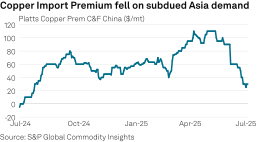
The copper cathode import premium in China fell in the second quarter as demand slowed while copper prices rose.
Energy analyst Wang Ruilin anticipates copper consumption weakening in China in the third quarter, as the country phases out subsidies for new solar power installations. Projects completed after June 2025 will transition to "market-based bidding" instead of relying on fixed subsidies.
The Platts Copper Cathode Premium on a CIF China basis fell to a one-year low of $30/mt on June 27, before rebounding to $40/mt on July 10.
Even though the copper arbitrage window between the COMEX and the London Metal Exchange widened to a record high following the announcement of 50% US tariffs on copper imports from Aug. 1, traders have been more cautious about spot purchases.
Chinese smelters were observed exporting cathode in June, with import losses reaching Yuan 1,500-2,000/mt ($209-$279/mt).
US imports of copper cathodes reached a historical high in April of 203,051 mt, surging 335% year over year in anticipation of the tariff announcement.

Editor: