Crude Oil, Maritime & Shipping
September 18, 2025
Argentina builds more oil takeaway capacity for Vaca Muerta as output surges

HIGHLIGHTS
Target is to reach 1.3 million b/d
Shale play is producing 500,000 b/d
All the new output will be for widening exports
Argentina's oil production is booming after years of decline, and pipeline operators are busily building more takeaway capacity for the Vaca Muerta shale play to feed new and expanded export terminals.
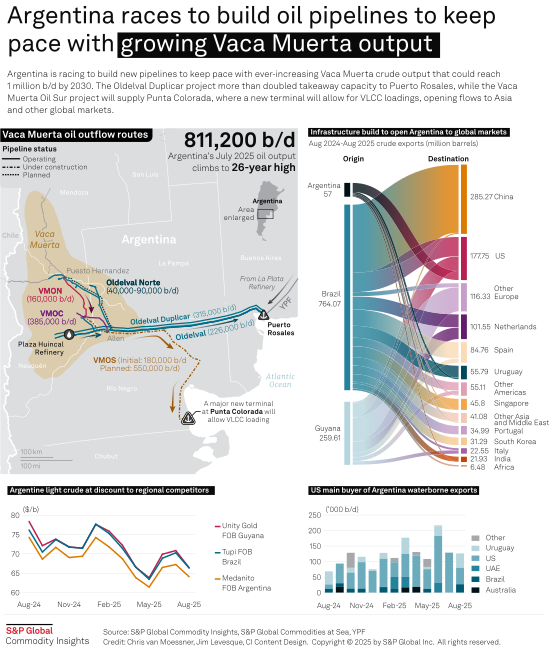
The country's total crude output shot up 18.5% to a 26-year high of 811,200 b/d in July from the year-earlier month, bolstering expectations that Argentina's total production could increase to 1.5 million b/d by 2030, as forecast by the Argentine Chamber of Hydrocarbons Exploration and Production.
"With the majority of investments going towards increasing production out of the Vaca Muerta and increasing pipeline capacity, Argentina will likely have the ability to have crude output surpass 1 million b/d by 2030," said S&P Global Energy analyst Stephanie Rivera. "While 1.5 million b/d isn't necessarily far-fetched, it does seem rather high. Near-term factors like decreasing oil prices will have ripple effects on production."
YPF, Argentina's biggest oil and natural gas producer, has said that the breakeven Brent price to continue developing and increasing production from Vaca Muerta is $45/b. According to Energy data, that is roughly on par with onshore shale project breakevens in the US.
Most of Argentina's production gains have and will come from Vaca Muerta, a huge play in Patagonia that has gone from testing its first wells in 2012-13 to growing in production at a year-over-year rate of 30% to reach a record 508,300 b/d in July.
This is helping offset declines in the mostly maturing conventional fields around the country and fueling expectations that exports will surge, given that the country consumes about 500,000 b/d.
Argentina exported an average of 180,000 b/d in the first half of 2025, up 17% from 154,000 b/d in 2024, according to Energy Secretariat data. Of this, most of the exports were of Medanito, a light, sweet crude produced in Vaca Muerta and conventional fields in the Neuquén basin. Medanito exports rose 12% to 131,000 b/d in the first half of this year from an average of 117,000 b/d in 2024.
In response to the growth, oil pipeline projects have become a big focus for the industry. A 115,000 b/d trans-Andean to Chile and the Pacific was put back into operation in 2023 after more than a decade of disuse. Oleoductos de Valle, or Oldelval, recently plowed $1.4 billion into a project to more than double the capacity of a pipeline to the Atlantic to 540,000 b/d, inaugurated in April.
Oldelval CEO Ricardo Hösel told S&P Global Energy on Sept. 10 that these projects have removed all the bottlenecks in Vaca Muerta's production for several years.
Yet more must be done to keep up with the expected production growth, he added.
Hösel said two such projects are underway. The first is being led by his company to invest $400 million to build a new feeder pipeline for fields in the north of Vaca Muerta, given that the oil development so far has been focused on central and southern fields. The 24-inch diameter Duplicar Norte pipeline will start operations at the end of 2026 and reach 220,000 b/d by March 2027. With additional investments, Oldelval plans to add pumping power to take capacity to 300,000 b/d and then to as much as 500,000 b/d as demand for capacity increases, Hösel said.
The other project is Vaca Muerta Oil Sur, a $3 billion investment to build 550,000 b/d of capacity for moving crude to Punta Colorada in Río Negro province for export via Very Large Crude Carriers. That project, which is being led by Argentina's state-run YPF through a consortium of oil producers called VMOS, is due to start operations at 180,000 b/d in 2026 and reach 380,000 b/d in March 2027 and full capacity in July 2027.
With the two projects, "we will reach 1.3 million barrels" per day of takeaway capacity for Vaca Muerta, Hösel said. "In other words, transportation will not be a problem for a long time."
A potential glitch
Even so, there is a potential bottleneck in 2026 and 2027. If Vaca Muerta's production continues to grow briskly and reaches 770,000 b/d before the VMOS pipeline comes online, this could lead to a potential slowdown in growth, Hösel said.
If this happens, Oldelval may have to do "bridge" works to sustain production until VMOS completes its project, he added.
That may not be necessary. At the Sept. 8-11 Argentina Oil & Gas Expo in Buenos Aires, VMOS CEO Gustavo Chaab said the project is not only on track but could be completed faster than planned.
"We are confident that we will meet the deadlines, and we even expect to be ahead of schedule," Chaab said.
VMOS started the $3 billion project in January. It includes a 437 km dedicated pipeline from Vaca Muerta to the Atlantic coast of Río Negro province, where storage tanks and a facility for loading VLCCs will be located in the deep, near-shore waters of the San Matías Gulf.
The use of VLCCs, which have some 2 million barrels of capacity, will make it possible to sell at more competitive prices in the global market, Chaab told S&P Global Energy.
"This will make us competitive in reaching Asia," he said.
Chaab added that demand for oil is rising in Asia, but so far Argentina hasn't been able to readily compete with other global suppliers in that market because of the lack of capacity for loading VLCCs, which cut freight costs by carrying more crude per voyage. Most of the crude is exported from Argentina in smaller Panamax, Aframax, and Suezmax carriers.
There are expectations that more takeaway capacity will be needed for Vaca Muerta. Ernesto López Anadon, president of the Argentina Oil and Gas Institute, an industry group, said this is the big challenge for the industry, as well as export capacity at ports and providing sand and other inputs to the fields for fracking.
"To reach 1.5 million b/d, we must think about infrastructure equivalent to that of a new industry," he said at the Argentina Oil & Gas Expo. "If today we exceed 800,000 b/d, we would double that. It's a second industry."

Editor: