Crude Oil
August 28, 2025
France, UK, Germany trigger Iran sanctions ‘snapback’ process threatening oil supplies
By Rosemary Griffin and Aresu Eqbali
HIGHLIGHTS
Iranian crude exports, output holding up despite growing pressure
Iranian officials vow response if sanctions hit oil exports
US welcomes snapback move
France, Germany and the UK have agreed to start the process of reimposing some UN sanctions on Iran, in a move that ramps up pressure on OPEC's third-largest crude producer.
Iran has managed to maintain crude output and exports in recent months, despite fresh restrictions on its oil operations being imposed by Western countries, and US President Donald Trump vowing to drive its oil exports to zero.
Analysts forecast that restrictions could hit supply later in 2026 if UN sanctions are snapped back and the US continues to pursue a policy of maximum pressure.
France, Germany and the UK, known as the E3, said on Aug. 28 that they will notify the UN Security Council that Iran has failed to comply with the Joint Comprehensive Plan of Action (JCPoA), thereby engaging the "snapback" mechanism that could see some UN sanctions reintroduced, the foreign ministers of the three countries said in a joint statement.
This mechanism opens a 30-day period before the restrictions are reintroduced.
"We will use the 30-day period to continue to engage with Iran on our extension offer, or on any serious diplomatic efforts to restore Iran's compliance with its commitments," the statement said.
In July 2025, the E3 offered Iran an extension of UN resolution 2231 that set out an inspection procedure and prepared for the removal of sanctions against Iran.
Conditions for this included resuming negotiations, complying with IAEA obligations, and taking steps to address concerns over the highly enriched uranium stockpile.
The E3 said that these conditions were not met, and sites of major nuclear proliferation concern in Iran are outside of monitoring of the International Atomic Energy Agency (IAEA).
"Its nuclear programme, therefore, remains a clear threat to international peace and security," the statement said.
Iranian officials threatened to respond and called on the international community to reject the decision to trigger the snapback.
Iranian foreign minister Abbas Araghchi told the three European foreign ministers that Iran "will respond appropriately to this illegal and unjustified action of the three European countries in order to protect and secure its national rights and interests," in a phone call following the snapback announcement.
A senior Iranian official quoted by state-run students' news agency ISNA said that Tehran is considering various options, including withdrawing from the Nuclear Non-Proliferation Treaty (NPT).
Iranian officials previously vowed to seek support from other members of the UN Security Council to block the reimposition of sanctions and threatened to respond in kind if the country is unable to sell its oil.
"If, for example, no oil is exported from Iran, it should not be exported by others too. And it will happen," a prominent MP and member of the parliament's national security and foreign policy council Alaeddin Boroujerdi said on state television before the E3 announcement.
US pressure
The E3 move comes days after the US imposed fresh sanctions targeting a Greek shipbroker and other companies and vessels, including in China, involved in Iranian oil trading.
The US withdrew from the JCPoA in May 2018, during Trump's first term in office.
US Secretary of State Marco Rubio welcomed the E3's move and said that the US will work with the group and other members of the UN Security Council to complete the snapback in the coming weeks.
"At the same time, the United States remains available for direct engagement with Iran – in furtherance of a peaceful, enduring resolution to the Iran nuclear issue. Snapback does not contradict our earnest readiness for diplomacy, it only enhances it," he said in a statement.
To date, Iran has managed to soften the blow of Western sanctions by continuing to supply significant crude volumes to China.
Iranian crude exports have been rising steadily from 400,000 b/d in 2020 to 1.6 million b/d in 2024 and 1.7 million b/d in Q2 2025, according to data from S&P Global Commodities at Sea.
There are signs that the latest US sanctions may be disrupting some of this trade, however.
Sources told Platts that they have disrupted operations at the Yangshan Shengang International Petroleum Storage & Transportation Co. Ltd., one of the operators listed in the sanctions.
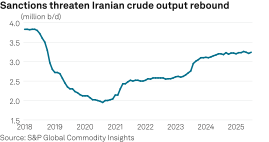
Despite rising sanctions pressure, Iranian crude output has so far held up. The country produced 3.24 million b/d in July, according to the Platts OPEC+ crude output survey by S&P Global Energy. Output averaged 3.23 million b/d from January to July 2025, up from 3.15 million b/d in the same period of 2024.
National Iranian Oil Co. Managing Director Hamid Bovard said that production jumped to its highest level in seven and a half years in August, the oil ministry's news service Shana reported on Aug. 25. South Oil Fields Co., West Karun and Arvandan Oil and Gas Co. have led these gains.
Analysts anticipate that production may decline until the end of 2025 if sanctions pressure continues to escalate. S&P Global Energy forecasts output will fall to around 3 million b/d in the second half of 2025.