


NGLs, Refined Products, Natural Gas, Crude Oil
March 18, 2025
Chevron eyes maintaining 1 million boe/d of Permian output out to 2040: CFO

HIGHLIGHTS
Efficiencies mean less capital spent in Permian
Company uses 40% fewer rigs than envisioned in 2020
Eyes three regions of international production growth
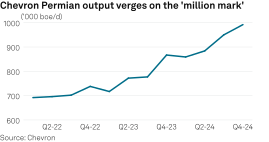
Chevron, which is rapidly approaching a steady 1 million b/d of equivalent oil production from the Permian Basin, intends to maintain that level of output from the giant West Texas/southeast New Mexico basin through 2040, a top company executive said March 18.
The company, which averaged 992,000 boe/d of output from the Permian in the fourth quarter and hit the 1 million b/d mark in December, has said for a while that its plan was to plateau at the 1 million boe/d level over the long term.
"We intend to hold [Permian production] flat right through to 2040," Eimear Bonner, Chevron vice president and chief financial officer, said at the 25th Piper Sandler Energy Conference in Las Vegas. Bonner's remarks were also webcast.
Efficiencies and technology breakthroughs in recent years have made Chevron confident that it cannot only hold production at that level but can do so with less effort and less capital, Bonner said.
Five years ago, Chevron was producing just over 500,000 boe/d from the Permian. To produce achieve and maintain the 1 million boe/d level the company was aiming for, it is taking 40% fewer rigs than the company expected it would five years ago.
In addition, the well drilling and completion efficiencies the company has achieved since 2020 have been greater than it had imagined several years ago.
A number of technologies developed since then have allowed these efficiencies. For example, Simulfrac and TrimulFrac -- simultaneously completing two and three wells respectively – as well as secondary oil recovery technologies and natural gas lift, have been widely used to maximize output from wells, and have helped Chevron attain the 1 million-boe/d mark in the Permian.
As a result, the company will spend less money in 2025 in the Permian than it did in 2024 -- and expects to spend even less in 2026 than it is spending there this year, she added.
"That's why we've been confident that with the growth plan we have for the Permian going forward, which has moderated relative to the last few years, we can [achieve the 1 million boe/d plateau] with reduced capital" over time, Bonner said.
Moreover, the Permian is not Chevron's only US shale asset. It has a 400,000 boe/d operation in the DJ Basin in the Rocky Mountains, which provides the financial ballast to invest in other asset classes around the world, Bonner said.
Eastern Med, Cyprus are growth areas
Outside the US, the company has three other major operations that are likely to drive expanded production in the coming years.
One is the Eastern Mediterranean, where Chevron has ongoing projects at the Tamar and Leviathan fields offshore Israel that will increase production by an anticipated 20% over the next few years, Bonner said. Chevron acquired interests in that region through its 2020 acquisition of Noble Energy.
Also, it has agreements with the governments of Cyprus and Egypt on how to develop the Aphrodite natural gas field offshore Cyprus – the gas will flow to Egypt via pipeline -- as well as ongoing exploration in Egypt itself.
The third major area of upstream expansion is Argentina, where the company is producing from the Vaca Muerta unconventional basin.
"There's a lot of potential in the subsurface there, so that could feature more in our future," Bonner said. "And on the exploration side, we have significant efforts underway to build acreage. So we can not only produce exploration wells within the tieback distance of existing facilities, but we also have 20% of our portfolio looking at frontier exploration prospects."
In addition, the US Trump administration's efforts to impose tariffs on materials imported from Canada and Mexico won't affect Chevron much, she said.
"If you look at feedstock for our refineries, less than 10% comes from Canada and Mexico, so we don't think we're particularly exposed there," Bonner said.
"And on the supply side, in our US drilling and completions operations we use a lot of tubulars [pipes], but much of it is sourced in the US, so we're not materially impacted there," she added. "We're not very exposed."