


Agriculture, Meat
October 28, 2025
Brazilian beef exports hold firm despite US tariffs, but increased supply weighs on pricing

By Renan Araujo
HIGHLIGHTS
Overseas demand supports exports despite US tariffs
Chinese buyers put pressure on Brazilian beef prices
The escalation of US tariffs on Brazilian beef has reshaped trade flows between the two countries but has not slowed Brazil's overall export momentum.
In April, Washington imposed an additional 10% duty on shipments above the annual quota, raising the total tariff to 36.4%. Three months later, in July, a much higher rate of 76.4% effectively halted beef trade between Brazil and the US.
Before the tariff escalation, trade was thriving. In the first half of 2025, Brazil exported 156,000 mt of fresh, chilled, and frozen beef to the US, a 132% rise compared with the same period in 2024 and a record for the semester, according to the Brazilian Foreign Trade Agency, or Secex. However, from July to September, volumes fell sharply to 26,900 mt, down 47% year over year, showing the immediate impact of the tariff hike.
Despite the absence of the second-largest beef buying market, Brazilian shipments have remained strong, driven by China, Southeast Asia and the halal market.
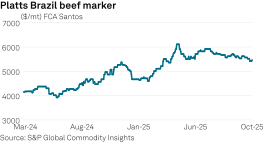
The Platts Brazil Beef Marker shows, however, that the withdrawal of US demand has weighed on prices. After two consecutive quarters of growth — Q1 averaging $5,317/mt, up 7%, and Q2 at $5,724/mt, up 8% — the index fell 2% in Q3, averaging $5,621/mt FCA Santos.
The Brazil Beef Marker slid to $5,470/mt on Oct. 24, the lowest in six months, pressured by an oversupplied market and buyer resistance.
According to an exporter, foreign buyers seized the opportunity to push prices lower amid a greater supply of Brazilian beef on the global market.
"The Brazilian exporting beef industry had forecast nearly 400,000 mt of beef sales to the US this year, a record projection," the exporter said. "But after the tariffs hit, those volumes were halved. With production already in motion, the industry had to redirect the product quickly, often at discounted prices."
The combination of higher production and increased supply of forequarter cuts, a beef category not usually in demand by the domestic market, led buyers, particularly the China-based importers, to negotiate for lower prices.
Despite record monthly shipments so far this year, Brazilian exporters are reporting shrinking margins due to exchange rate volatility and rising processing costs at current price levels, raising concerns about the 2026 outlook.
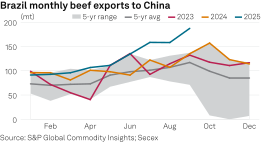
China remains the key export market, absorbing record volumes. In September, exports to China reached 187,232 mt, up 38% year over year, while total shipments from January to September increased by 22% to 1.13 million mt, according to Secex data. However, importers began pushing for lower prices due to ample domestic stocks and high recent arrivals.
Adding to uncertainty, China's ongoing safeguards investigation into beef imports, expected to conclude in November, could introduce quotas or new tariffs, according to market participants.
Exporters also report tighter customs inspections on Brazilian beef, raising fears of non-tariff barriers and possible plant-specific restrictions — similar to March's suspension of three beef plants in São Paulo, Minas Gerais and Goiás.
As a result, many exporters have taken a more cautious approach, anticipating a challenging price environment through year-end. While Brazil is on track for record export volumes in 2025, trade policy headwinds, cost inflation and regulatory tightening in key markets indicate a more complex path ahead for the world's leading beef exporter.

Editor: