


Agriculture, Rice
September 11, 2025
Flooding threatens Pakistan's rice exports as supply tightens
By Ayushi Baloni and Tanya Rana
HIGHLIGHTS
Extent of flood damage uncertain until floodwaters recede; Sindh unaffected for now
Limited crop arrivals push up prices for Sept, uncertainty over upcoming deliveries
Exporters rely on alternative WR origins to meet short-term contractual obligations
Flooding threatens Pakistan's rice exports as supply tightens, rising competition
Severe flooding in Pakistan's Punjab province has cast uncertainty over the country's rice crop, raising concerns about limited supply, shipment delays, and rising prices, market sources told Platts Sept. 11.
Punjab is Pakistan's largest rice-producing province, while Sindh province is the second largest. Sindh's crops have not been affected so far, but traders are closely monitoring the situation as floodwaters could flow downstream in the coming days.
"The crop in Sindh hasn't been affected yet. The Punjab floodwaters are mainly flowing into the Indus, and no spillovers yet. Let's see this week as these unusual rains are supposed to be over by [Sept. 12]," a Karachi-based trader said.
Punjab is upstream of Sindh, and during heavy monsoon rains, floodwaters in Punjab often swell the Indus River, Pakistan's main river. This excess water flows downstream into Sindh, posing a risk to fields in the province.
For the rest of this month, the Pakistan Meteorological Department forecasts normal to slightly above normal rains across most regions, particularly in the northeastern parts of Punjab and southern Sindh.
Paddy arrivals expected to remain limited
Market arrivals in September are expected to remain constrained, with some exporters saying that shipments for October and November may also face disruption.
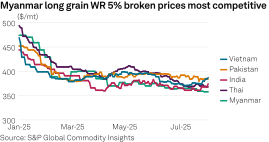
"Currently, we are unable to make any offers. Even if we did, our availability is low, and the status of the next crop is still uncertain. Moreover, we are competing closely with Thai rice, which is of better quality, and the prices for it are currently very competitive. No buyer will be willing to make any purchases even at $370/mt FOB for 5% WR today when Thai rice is available at approximately $350/mt FOB for this variety," a Karachi-based exporter said.
On Sept. 11, Platts assessed Pakistan white rice (WR) at $365/mt FOB, Thai 5% broken WR lower at $355/mt FOB, and Myanmar 5% WR at $319/mt FOB FCL.
Another Karachi-based exporter added, "My local purchase arrivals seem to be delayed. Consequently, I am going to request my buyers to expect delays in shipments from the end of September to mid-October, as of now. Let's hope it doesn't get delayed further."
Exporters turn to Myanmar to cover deals
With domestic availability tight, Pakistani exporters have turned to alternative origins to meet contractual commitments. Sources said exporters based in Singapore and Dubai were actively sourcing white rice from Myanmar at competitive prices to cover shipments originally planned from Pakistan.
Last week, Pakistani exporters made deals at approximately $330/mt FOB for 5% WR and $280/mt FOB for 25% WR (reasonably well-milled variety) from Myanmar.
Market participants noted that 5% WR was bought to cover shipments to Malaysia and other buyers, while 25% WR was purchased for deliveries to Tamatave, Madagascar.
According to traders, some shipments for Malaysia that were originally scheduled for October have now been rescheduled for December, as exporters struggle to balance contracts amid tight supplies and delayed crop arrivals.
Forward outlook
The extent of flood damage in Punjab remains unclear and will only be fully assessed once floodwaters recede. If crop losses prove significant, Pakistan's exportable surplus could shrink further, tightening supplies into the fourth quarter of 2025.
At the same time, competition from Thai rice, which is priced lower and considered higher quality, is expected to weigh on Pakistan's ability to secure new sales in key Asian markets.
For now, exporters are relying on Myanmar to cover near-term commitments, but continued shipment delays and uncertainty over the domestic crop could test Pakistan's competitiveness in the months ahead.
The most recent forecast by S&P Global Energy projected that Pakistan would produce 9.35 million mt of rice in the marketing year 2025-26, a decline of 3.8% compared to the previous year.
Exports were forecast at 5.20 million mt of rice in MY 2025-26, down about 9% year on year.
