Agriculture, Refined Products, Biofuel
August 22, 2025
US EPA fully grants 63 petitions from small refiners seeking exemptions from RFS
By Kate Winston and Guadalupe Nunez
HIGHLIGHTS
EPA partially grants 77 petitions
EPA to propose reallocating volumes
Ethanol RINS rally following waivers
The US Environmental Protection Agency fully or partially granted 140 petitions from small refiners seeking exemptions from requirements to blend biofuels into their products under the Renewable Fuel Standard program Aug. 22.
The EPA acted on 175 petitions from 38 refineries. The agency fully granted 63 petitions and partially granted 77 petitions. The agency denied 28 petitions and declared seven of the petitions ineligible for a waiver.
Small refineries -- classified as having a capacity less than 75,000 b/d -- are eligible for waivers to the RFS if meeting the biofuel-blending requirements would create "financial hardship."
The EPA granted a 50% exemption if a refinery showed it faced a partial hardship, reversing a prior stance that provided no exemption in this situation, the EPA said in a statement.
"EPA is getting the SRE program back on track with an approach that recognizes some small refineries are impacted more significantly than others," the agency said in the statement.
The EPA decided to implement the waivers by returning the RFS compliance credits, known as Renewable Identification Numbers, back to the refiners. Since RINs have a two-year window for use, pre-2023 RINs have expired and are of little value to refiners, the agency said in its decision
"Ultimately, this means that the 2022 and earlier vintage RINs will not impact the number of RINs available to meet 2024 and future compliance obligations and are not expected to impact demand for biofuels," the EPA statement said.
EPA also said that it will soon propose to reallocate volumes covered by waivers in 2023 and later.
"The proposed adjustments will help ensure that refineries blend the intended volumes of renewable fuel into the nation's fuel supply," the statement said.
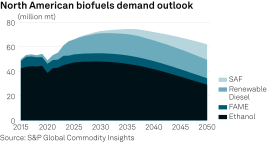
North American biofuels demand is projected to increase to 1.3 million b/d by 2050, with the total blend rate in the transportation fuel pool hitting 15%, according to S&P Global Energy analysts.
RIN impact
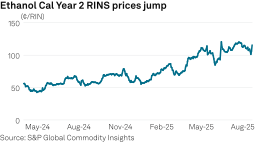
At the start of the week, as rumors of SREs began to flood the market with speculation about EPA actions, RIN prices became volatile, swinging up and down more than 4% in a day. On Aug. 22, before the EPA's decision, D6 RIN prices traded as low as $1/RIN, but after the news, and traded as high as $1.17/RIN, up 17%. During the afternoon session, prices dipped.
Platts, part of S&P Global Energy, assessed D6 RINs at $1.15/RIN Aug. 22, up 8.2% from yesterday's settlement.
RINs are highly reactive to SREs because they directly influence the supply and demand dynamics within the renewable fuel market. EPA plans to return 5.34 billion RINs to the refineries; however, only 2023 and 2024 RINs can be used for compliance, which account for 1.39 billion, leaving the remaining with little or no value.
Industry reaction
The SREs have been controversial. Some refiners have argued that they are disproportionately harmed by RFS rules, with RINs requirements cutting into profits, in contrast to large oil companies that export fuel or generate significant excess RINs and then sell them into the RIN market to meet their obligations.
In reaction to the EPA's announcement, the American Fuel and Petrochemical Manufacturers said that it is inexplicable that the EPA is considering reallocating volumes covered by the SREs, noting that the 2026 and 2027 RFS cannot be met with domestic feedstocks alone.
"Piling on more than a billion gallons in additional, reallocated mandates will do nothing other than increase imports, harm US energy dominance and cost consumers," AFPM President and CEO Chet Thompson said. "This is akin to your neighbor getting a tax break and the IRS showing up at the doorstep with the bill. It is simply wrong."
But biofuels groups have consistently argued that SREs hurt the EPA's ability to administer the RFS.
The Renewable Fuels Association said the EPA's approach to this batch of waivers was reasonable and should not disrupt the marketplace or reduce renewable fuel consumption.
"While RFA continues to doubt that the small refineries receiving exemptions today truly experienced 'disproportionate economic hardship' due to the RFS, we are pleased to see EPA taking an approach to implementation of these exemptions that is minimally disruptive to the marketplace and affirms the agency's intent to reallocate renewable fuel volumes lost to SREs," RFA President and CEO Geoff Cooper said in a statement.
The American Coalition for Ethanol said it is good news that the EPA is proposing to reallocate volumes. However, the group plans to monitor how the RIN market reacts to the news, because past SREs have led to depressed RIN values, which discourage blending of E15 and higher blends, ACE CEO Brian Jennings said in a statement.
The Advanced Biofuels Association similarly raised concern about RIN prices.
"When RIN values drop, the entire advanced biofuels market is destabilized and put at risk, significantly impacting consumers downstream. ABFA looks forward to reviewing the proposed rule for reallocation and forecasting adjustments that can strengthen the market for all parties," ABFA President Michael McAdams said in a statement.
