


Agriculture, Energy Transition, Refined Products, Biofuel, Renewables, Jet Fuel, Gasoline
August 22, 2025
Ireland launches first-ever SAF roadmap to meet EU green targets

HIGHLIGHTS
SAF Policy Roadmap outlines four pathways for decarbonizing aviation
Co-processing, advanced biofuels, synthetic fuels among production opportunities
Government support, airline commitments, address cost challenges seen as crucial
Ireland has published its first SAF Policy Roadmap, setting out a long-term strategy to decarbonize the aviation sector and align with ambitious EU climate mandates.
Transport Minister Darragh O'Brien unveiled the roadmap Aug. 21, calling it "the realization of a clear commitment in our Programme for Government" and a critical step in reducing aviation emissions.
The roadmap, developed with input from the Sustainable Aviation Fuel Task Force established in 2023, outlines four policy pathways: supporting production, providing market certainty, fostering collaboration, and driving SAF uptake.
Rising demand and supply gap
Ireland's aviation sector, dominated by Dublin and Shannon hubs, faces a steep climb to meet EU's ReFuelEU Aviation requirements. The bloc's SAF mandates start at 2% in 2025, rising to 6% in 2030, 20% in 2035 and 70% by 2050.
According to government projections, Irish demand could hit 88,000 mt by 2030 and soar to 318,000 mt by 2035 -- a volume exceeding two-thirds of global SAF output in 2023.
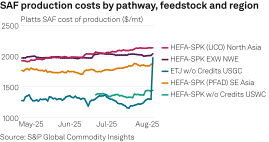
But the roadmap warns of major cost and supply challenges. SAF currently costs two to seven times more than fossil jet fuel, with future synthetic e-fuels projected to be even higher. Meanwhile, global supply lags far behind the EU's 2030 requirement of 2.8 million mt.
Production Opportunities
Ireland sees a three-tiered opportunity to develop domestic SAF production:
Short-term: Co-processing at existing refineries using waste oils such as used cooking oil and tallow.
Mid-term: Advanced biofuels from agricultural and forestry residues.
Long-term: Synthetic fuels, or eSAF, powered by Ireland's vast offshore wind capacity, with 37GW targeted by 2050.
The government has already earmarked Eur750 million in 2025 budget for grid infrastructure to support renewable expansion, which could underpin large-scale eSAF production.
Airline commitments and next steps
Irish carriers have begun aligning with the roadmap. Aer Lingus has pledged to use 10% SAF by 2030, while Ryanair has set a 12.5% target. Fuel accounts for nearly a third of airlines' operating costs, making price support crucial to uptake.
The Department of Transport said the roadmap will evolve with "future iterations," identifying barriers to SAF imports and domestic production while aligning with EU and ICAO frameworks.
"This roadmap recognizes the important contribution that Sustainable Aviation Fuel can make toward decarbonizing the aviation industry and provides the building blocks for its deployment in Ireland," O'Brien said.
Ireland's new roadmap fits into a fast-evolving global race to scale up sustainable aviation fuel.
In Europe, the EU's ReFuelEU Aviation law sets binding blending targets of 2% SAF by 2025, 6% by 2030, 20% by 2035 and 70% by 2050. France has already introduced a 1% SAF requirement, while countries such as Germany and the Netherlands are backing refinery expansions and subsidies to secure supply for their airlines and airports.
The US is taking a different approach, relying on incentives under the Inflation Reduction Act.
A federal blender's tax credit of up to $1.75 per gallon runs through 2027, after which a new clean fuel production credit will take over.
This has spurred multibillion-dollar offtake deals between airlines such as United, Delta and American and producers like World Energy, Gevo and Neste.
In Asia, Japan has set a national target of 10% SAF use by 2030, while Singapore is positioning itself as a regional hub through Neste's Singapore refinery, which at 1 million mt a year is the largest dedicated SAF facility in the world.
China is testing SAF through Sinopec and PetroChina, but has yet to mandate blending at the national level.
On the technology side, most of today's SAF is produced via the HEFA pathway using waste oils and animal fats, but supply is constrained.
Longer-term hopes rest on power-to-liquid synthetic fuels made from hydrogen and CO2, alcohol-to-jet pathways from ethanol, and Fischer-Tropsch fuels derived from waste. All remain significantly more expensive than conventional jet fuel, with SAF costing between two and seven times more on average.
Airlines are gradually signing up to the transition despite the costs. Aer Lingus has pledged 10% SAF use by 2030, Ryanair 12.5%, Lufthansa has backed synthetic e-fuel projects in Germany, and Japan Airlines has signed offtake deals with Neste in Singapore. Even so, feedstock scarcity and high prices remain the biggest hurdles globally, leaving policies like Ireland's crucial to providing both market certainty and investor confidence.
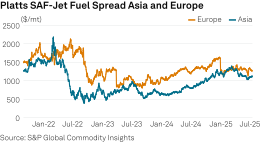
Platts, part of S&P Global Energy, assessed European SAF-jet fuel spread at $1,322.44/mt Aug. 21, down $8.29 day over day.
