Agriculture, Grains, Meat
August 21, 2025
New EU trade regime imposes stricter conditions, restricting Ukraine’s agricultural exports

By Lalita AVD
HIGHLIGHTS
New regime less liberal for Ukraine than autonomous trade measures
Ukrainian grain shipments to EU drop sharply since ATMs expired
Ukraine shifts focus to Asia, Middle East, Africa for grain exports
The EU and Ukraine are working to finalize a long-term, predictable, and reciprocal trade regime under Article 29 of the Deep and Comprehensive Free Trade Area, the pre-war trade agreement between the two partners. On June 30, the European Commission concluded negotiations with Ukraine on the main principles of a revised agreement—often referred to as DCFTA 2.0—following the expiration of the temporary autonomous trade measures (ATM).
The proposed deal aims to modernize the existing framework, expand market access, and deepen economic integration. According to the European Commission, the new regime is intended to boost agricultural trade beyond pre-war levels by removing or easing remaining trade barriers.
While it offers broader access than the original DCFTA, the updated agreement remains more restrictive than the ATMs, particularly for Ukraine's key agri-food exports. The proposal now awaits formal approval from the commission.
The EU's new agreement sets conditions for Ukraine's market access that are less liberal and flexible than previous ATMs. Despite Ukraine's efforts to negotiate more liberal trade rules by eliminating many tariff rate quotas—except for the most sensitive products—the agreement strikes a balanced compromise addressing concerns from both Ukrainian and EU producers.
Sensitive products like corn, wheat, sugar, eggs, poultry, and honey will face tighter market limits, with quotas set below recent trade volumes under the ATMs, potentially reducing some Ukrainian agricultural exports to the EU.
For moderately sensitive products such as butter, skimmed milk powder, gluten, oats, and barley groats, import quotas will increase to the highest levels seen in recent years.
Less sensitive goods, including fermented milk and grape juice, will have full access to the EU market.
The agreement also includes safeguard clauses enabling both sides to act if imports disrupt domestic markets. Regular reviews will monitor the agreement's impact, and final approval from EU member states is still required.
As part of the deal, Ukraine will also open its market to EU poultry, pork, and sugar, and commit to aligning with EU agricultural standards—including animal welfare and pesticide regulations—by 2028.
ATMs boost EU-Ukraine's agriculture trade
In 2022, the EU temporarily suspended duties and quotas on Ukrainian goods through its ATMs to support Ukraine's trade and economy, which were severely impacted by the Russian invasion. The EU's duty-free measures drove growth in Ukraine's grain exports during the war, particularly to the bloc. According to the Ukrainian agriculture ministry, the nation exported 48.99 million mt of grain and legumes in the marketing year 2022-23 (July-June) against 48.35 million mt in the previous year, of which corn exports were 27 million mt, almost stable on year, and wheat 17 million mt, down 3% on year.
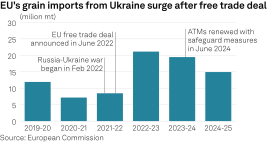
The EU is traditionally a key buyer of Ukrainian agricultural products, particularly grains, and its import volumes saw a jump since the EU-Ukraine free trade agreement was signed in June 2022.
According to the Directorate-General for Agriculture and Rural Development, EU corn imports from Ukraine surged by 84% year over year in MY 2022-23, while wheat inflows jumped over 1,600% and barley by 736%.
In the following years, too, the bloc's share of grain imports from its neighboring country remained significantly high compared to pre-war levels. Spain, Italy, the Netherlands and Poland remained the largest importers of Ukrainian grain in this period.
Ukraine's grain exports to EU drop after ATMs expire
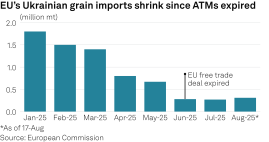
After granting Ukraine two additional years of unrestricted trade access, the EU reverted to its pre-war agreement on June 6, 2025, reintroducing quotas and tariffs that triggered a sharp decline in Ukrainian grain exports to the bloc.
Agriculture ministry data showed that Ukraine's total grain exports—including wheat and corn—fell 30% during June–July, 2025 compared to the same period last year.
Similarly, European Commission data indicated that the EU's share of Ukraine's grain exports in MY 2025-26 dropped by 33% as of Aug. 17 compared to the same period last year.
While discussions on a new trade deal are underway, sources say the agreement is unlikely to be as beneficial for Ukraine as the previous autonomous trade measures.
Ukraine to divert EU-bound grain to Asia, Middle East
Following the reintroduction of EU tariffs and quotas, Ukrainian exporters are focusing on diverting their grain shipments bound for the European market to alternative buyers in Asia, the Middle East, and Africa, according to sources.
Nikolay Gorbachev, president of the Ukrainian Grain Association, stated that if Ukraine can no longer export grain to Europe at a reasonable profit, it will redirect shipments to alternative markets. "We will export [wheat] to other destinations where we will compete with European producers," he said, adding that such a shift would not significantly alter the overall dynamics of Ukraine's grain trade.
A couple of Ukrainian companies applied to take part in grain tenders in Jordan a month ago — one was denied approval, while the other managed to supply milling wheat successfully, a trade source said.
While Ukrainian grain traders are targeting the Middle East and Africa, Russia's strong presence in these markets poses a challenge.
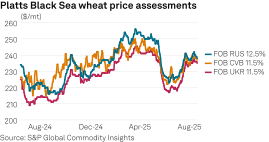
Platts, part of S&P Global Energy, assessed Ukrainian wheat 11.5% FOB Black Sea at $235/mt on Aug. 20, down $1/mt day over day, while Ukrainian corn FOB Black Sea was assessed at $228/mt on Aug. 21, down $5.75/mt day over day.