Crude Oil, Refined Products
August 01, 2025
BTC issues force majeure on Azeri crude loadings after contamination incident
By Kelly Norways and Luke Stuart
HIGHLIGHTS
BTC declares force majeure on Azeri crude loadings from Turkish terminal
Organic chloride contamination issue impacts oil deliveries
BTC is unable to provide duration timeline for force majeure
The BTC Pipeline Company has declared force majeure on its Azeri crude exports from its Turkish terminal in Ceyhan in response to an oil contamination incident.
In a letter seen by Platts dated July 29, the pipeline company said it was "materially affected" by a contamination incident in the BTC system, including Ceyhan storage tanks, preventing it from supporting timely transhipment of on-spec crude.
BP, a BTC stakeholder, first reported a contamination incident July 23, when it declared it had discovered corrosive organic chloride in storage tanks at Ceyhan.
After detecting contaminated crude in the BTC system, including Ceyhan storage tanks, the pipeline company reviewed potential remediation actions and concluded that no options were available to treat organic chlorides in the system.
The statement said that one or more shippers tendered higher-than-acceptable levels of organic chlorides for transportation, which had impacted both BTC's transportation and non-transportation services.
The company was not immediately available to comment on the status of oil flows through its 1,800-km pipeline system, which links the Ceyhan terminal on the Mediterranean Sea to Azerbaijan's oilfields.
In its notice of the decision, the company said it was not able to provide timelines on the expected duration of the force majeure event.
"BTC Co. is continuing testing the quality of crude oil across the BTC system facilities with a view to return to normal operations as soon as possible," the statement said.
Azerbaijan's state-owned company, Socar, was not immediately available for comment.
As a staple feedstock for Mediterranean refiners, the light sweet grade is widely distributed across the European continent, and contamination has already spread to pipelines, storage tanks, and crude-processing units.
Italian refiner Eni was the first to report that it had detected contaminated crude in its refining system. Austria's OMV and Czech refiner Orlen Unipetrol also had planned deliveries affected by the incident.
On July 31, the operator of the Transalpine Pipeline System, which runs from the Italian port of Trieste to Germany, confirmed it found organic chlorides in its system, which were then sent to the Czech Republic through the IKL pipeline.
Like other affected refiners, Orlen Unipetrol has said it plans to store and dilute the affected crude to quantities safe to run in its refineries.
None of the refiners or affected pipeline operators have reported damage to their facilities due to interaction with the contaminated crude.
The BTC, or Baku-Tbilisi-Ceyhan, pipeline system is owned by a consortium of companies, including Azerbaijan's AzBTC with a 32.97%, BP with a 30.1% share, Hungary's MOL group, and others, including Eni and TotalEnergies.
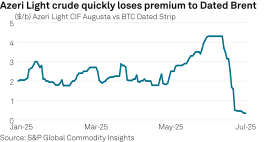
As buyers have avoided risking deliveries of contaminated crude, the value of Azeri Light has tumbled, sending prices to three-year lows relative to the Dated Brent benchmark.
However, market sources noted little sign of support for alternative Mediterranean sweet crude grades, such as Libya's Es Sider or Algeria's Saharan Blend.
Platts, part of S&P Global Energy, last assessed Azeri Light CIF Augusta at a premium of just 35 cents/b to Dated Brent July 31, reflecting a slide from a recent differential of $4.30/b July 10.

Editor: