Agriculture, Meat
July 31, 2025
Indian buffalo meat exports show resilience amid supply challenges
By Ayushi Baloni and Muskan Agarwal
HIGHLIGHTS
India's buffalo exports expected to rise by 4% in 2025; challenges persist
Limited availability, supply disruptions hinder export capabilities: sources
Exporters may seek diversification due to inadequate policy-led support in India
Supply issues and insufficient government support represent challenges to India's buffalo meat export hopes, according to market players in the sector, who nevertheless added that shipments could see steady growth if these issues can be tackled.
Buffalo meat exports from India have undergone significant fluctuations over the past decade, peaking in 2017 before a downturn in 2020, as per data released by the Agricultural and Processed Food Products Export Development Authority of India.
However, they are on the rise again, with exports reaching 1.24 million mt in 2024, with an increase of 17% in the last five years.
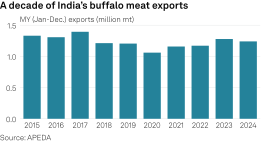
In 2024, the total valuation of buffalo meat exports reached $3.91 billion, a 9.5% increase on the year. For the first five months of 2025, exports have totalled $1.75 billion, reflecting a 14% rise against the same period of 2024.
USDA projections from Nov. 22 estimate that India's carabeef exports will grow nearly 4% year over year in 2025, reaching approximately 1.65 million mt, driven by rising demand from the Middle East, Southeast Asia, and Africa.
The market, however, estimates the current export figures to remain stable amid ongoing challenges, especially supply chain disruptions and a lack of government intervention to support this sector.
Restricted local supply
In 2025, the slaughter numbers for both bovine cattle and Asian domestic water buffalo are estimated to increase to 41.41 million head, up from 40.96 million head in 2024, according to the USDA. This is primarily being driven by increased availability of slaughter-ready cattle and growing global demand. Despite this slight rise over the past few years, however, local markets still perceive a shortage, trade sources said.
"The production of meat has dramatically decreased in recent years. According to global trends, the supply of raw materials is lower than in previous years, which has impacted India's meat exports, resulting in a significant reduction in quantity. While our meat exports are increasing, the profit margins have reduced tremendously due to the scarcity of raw materials. The main issue lies in breeding; there are fewer buffaloes available compared to previous years," a prominent exporter based in Uttar Pradesh said.
Market sources said that availability is also inconsistent, as farmers typically sell buffalo only after they cease milking, usually after the rainy season, when the animals are heavier and yield better profits. Consequently, buffalo availability is largely seasonal.
In addition to availability issues, the exporter noted that supply chain disruptions further reduce the buffalo meat supply.
"Transportation of livestock has also become increasingly difficult over the last two years due to cultural issues surrounding beef and buffalo in India. There are also challenges in the transportation of buffalo to abattoirs due to high costs and unpredictable supply issues," he added.
Limited government intervention
"Cattle and buffaloes are not reared in India for meat. Hence, there are no government policies that support bovine animal rearing for slaughter. However, the Government of India has various programs in place that are focused on strengthening dairy production in the country, which supports cattle herd size and animal health," the USDA said in its latest livestock and products annual report for India.
Market sources echoed this view, highlighting insufficient government support to address buffalo meat sector challenges.
Consequently, exporters are contemplating diversification into other industries, such as petrochemicals.
"The government is not particularly supportive of carabeef exports from India, permitting only the export of frozen and chilled buffalo meat. Consequently, there are no existing government policies to promote buffalo meat exports, and this sector is not given priority. Buffalo meat is our main business; however, we are on the lookout to diversify to other sectors too," a Delhi-based exporter said.
Evolving buyer interest
Demand for India's buffalo meat exports has evolved over the last decade. As per APEDA data, Vietnam, Malaysia, Indonesia, Egypt, and Iraq have remained top importers over the past five to six years.
Far-East buyers form a major share of exports, with Vietnam and Indonesia showing consistently high imports, and Malaysia maintaining stable demand.
There has been fluctuating interest from Iraq and Saudi Arabia, indicating growing competition in the Middle East.
India's 2025 beef production -- mostly carabeef -- is forecast at 4.64 million mt carcass weight equivalent, a 2% increase from 2024, according to USDA data.
As global demand for buffalo meat evolves, particularly in emerging markets, it remains to be seen how Indian exporters adapt to these challenges and pursue diversification strategies to stay competitive.

Editor: