Agriculture, Meat, Livestock
July 17, 2025
US, Australian beef prices rise amid tariff concerns for Brazilian imports
HIGHLIGHTS
Australian and New Zealand beef demand expected to increase
Domestic US beef supply remains constrained in 2025
Brazil's beef shipments halted due to tariff uncertainties
US and Australian prices for 90CL lean beef trim, for a 30- to 60-day shipment period, have climbed since US President Donald Trump announced on July 9 that 50% tariffs on all items shipped to the US from Brazil would be effective Aug. 1, amid concerns that tariffs would limit US supplies going forward.
The 50% tariffs would be in addition to the 36.4% US tariff already in place on Brazilian beef imports. Brazil beef exports to the US had faced a 26.4% tariff, and this increased by another 10% when the Trump administration imposed a 10% tariffs on beef from Brazil, Australia and New Zealand.
"At the moment, the market hopes [the tariffs] are a bluff, but no one knows for sure," a US source said. "It has ended trading on all Brazilian meat except for spot."
Despite the shipment period being out of the high summer demand window, beef prices were supported after the US tariff announcement.
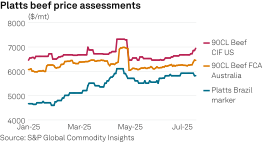
Platts, part of S&P Global Energy, assessed FCA Australia 90CL lean beef trimmings prices at $6,451/mt for 30- to 60-day shipment period on July 17, up $181/mt, or 2.9%, from July 10. This level of high prices has not been seen since April 29, when uncertainties among the market participants were caused by the announcement of US tariffs on Australian beef.
Platts assessed 90CL beef CIF US at $6,945/mt, or $3.15/lb, for a 30- to 60-day shipment period July 17, up $221/mt, or 3.3%, from July 10, the highest value since April 28.
Despite the higher CIF US values for August-September shipments, FOB US port of entry market for October deliveries remained quiet, as concerns grew that the current 10% tariffs in other countries would increase further.
In contrast to US and Australia, Platts' Brazil Beef Marker assessment, FCA Santos front forequarter 90% visual lean, was at $5,820/mt on July 17, down $100/mt, or 1.7%, from July 10.
Beef supply for exports has been limited in Australia, the main US supplier, so prices reacted quickly to the announcement of the US tariffs on Brazil, the second-ranked US beef supplier.
According to a market source in Australia, offers for Australian 90CL trimmings were heard at $3.20-$3.25/lb CIF Philadelphia on July 15, up sharply from a bid of $3.06/lb on July 11.
"The higher offer prices were mainly driven by the US tariff on Brazilian beef entering the US," an Australia-based beef trader said.
A Japanese trader who deals in Australian and New Zealand 90CL trimmings said some US importers have canceled their orders from Brazil.
"I expect higher demand from the US for Australian and New Zealand lean beef trimmings if the tariff is implemented, thereby driving prices upward," he said.
Australia's National Processor Cow Indicator -- which reflects the market price for cows sold to meat processing plants mainly for lean beef production for export market -- was at 312.44 Australian cents/kg live weight on July 15, reflecting a 1.1% increase week over week, according to National Livestock Reporting Service data. This was 17.8% higher than the level reported a year ago, the data showed.
A gap hard to fill in US
On the US side, domestic supply has been tight, so far in 2025, around 2.721 million head of bulls and cows have been slaughtered up to June 28, down 12% from the same period in 2024, the US Department of Agriculture said in its last Cattle Weekly Slaughter report.
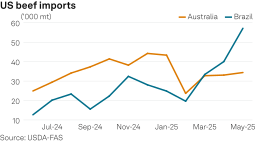
US frozen beef imports in May rose 16% from April and 60% from a year ago to a record monthly volume of 185,310 mt, the USDA showed on its Global Agricultural Trade System Online data on July 3. USDA used official trade data from the US Census Bureau.
Constrained domestic supplies and strong demand supported imports. USDA data showed that Brazil was the main supplier of imports, with 57,102 mt, followed by Australia with 34,381 mt, Canada with 24,267 mt, Mexico with 18,792 mt and New Zealand with 18,598 mt.
In 2024, approximately 15% of total US imports came from Brazil. Up to June 27, around 23% of total US lean beef trimmings imports were sourced from Brazil, USDA data showed.
If the 76.4% announced US tariff on Brazilian beef is set in place on Aug. 1, Australia, New Zealand and other sources of lean beef trimmings would not be able to fill the gap left by Brazil, necessitating supply rationing through price increases, even if demand volumes fell, sources added.
"Australia [beef production] is pretty well maxed out, and New Zealand does not have the numbers to increase much," Kevin Coburn, director of meat and livestock analysis for Energy, said. "So, the only option would be to take supply away from another major destination. Think you could do that in a limited capacity, but not at full replacement [of the gap left by Brazil]."
The supply situation could become more complicated if US cattlemen begin retaining heifers.
"The lean beef trimmings market was expected to strengthen due to a lack of cows in the US, and if cattlemen began retaining heifers, the supply situation would become more complicated," a CIF US market participant said.
Despite the higher CIF US values for August-September shipments, the FOB US port of entry market for October deliveries remained quiet, as concerns grew that the current 10% tariffs in other countries would increase further, a US source added.
30,000 mt of Brazilian beef were in transit.
"Approximately 30,000 mt of beef were processed and were in transit to the US market, but all shipments have been halted since July 10," a source from the Brazilian Association of Beef Exporters, or ABIEC, told Platts. "Concerns grew over the volume in transit that would arrive at US ports after Aug. 1 and would be subject to a tariff of 86.4%, or at least 76.4%."
In addition to the beef in transit, Brazilian beef already in the US has not yet been sold.
"Despite a significant amount of Brazilian beef already in-bond in US warehouses, replacement costs posed an issue for resellers, which made offers to rise," a USmarket participant said.
According to ABIEC, the 30,000 mt of beef were valued at $150 million, representing the estimated impact thus far. All Brazilian beef plants capable of exporting to the US have suspended their beef processing for the US, the group said.
The Brazilian government tried to negotiate with the US government to postpone the tariff implementation date, even by 30 days, to allow Brazilian exporters time to shift volumes to other markets. However, this also poses a significant challenge, as the standards for products imported by the US differ greatly from those of other buyers.

Editor: