


Agriculture, Maritime & Shipping, Grains, Dry Freight
July 08, 2025
COMMODITY TRACKER: 4 charts to watch this week

By Staff
Commodity markets continue to watch developments in the Middle East amid attacks in the Red Sea that are causing some ship operators to avoid the region. Meanwhile, S&P Global Energy editors and analysts also continue to monitor updates to US tariff announcements.
1. Red Sea attacks pose renewed threats to commercial shipping...
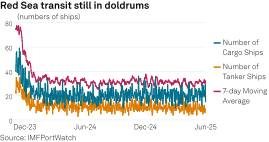
What's happening? Since the Israel-Hamas war in Gaza started, Houthi militants have claimed to attack over 130 ships in the Red Sea and Gulf of Aden, including a Greek dry bulk carrier that sank on July 7 after being attacked on July 6. Another ship was attacked just a day later on July 7, according to the UK Maritime Trade Operations. Most ship operators have diverted routes to avoid the region, increasing bunker consumption and freight rates. The IMF PortWatch data shows daily ship transits via the Bab al-Mandab Strait dropped to 24 by late June, compared with the normal level of over 70. Insurance premiums for Red Sea transits remain high due to ongoing geopolitical instability.
What's next? While the Houthis agreed to a ceasefire deal with Washington on May 6, tensions remain high, especially after the US launched strikes against Iranian nuclear targets. The Houthis warned of targeting US ships if the US joins Israel against Iran. Following the recent attack on the Greek vessel, Israel Defense Forces retaliated against Houthi targets at strategic ports. The maritime industry faces continued high risks, with operators closely monitoring geopolitical developments. Reduced transit numbers and high insurance costs are expected to persist as the situation remains volatile, affecting shipping operations and freight rates.
2. ... but production and exports from the Black Sea region could boost activity
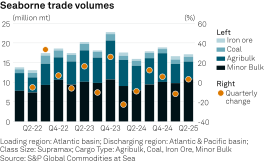
What's happening? The Atlantic Supramax market witnessed minimal change in the second quarter, with strong minor bulk shipments offsetting weaker coal, agribulk and iron ore volumes. Trade from the Atlantic Basin to both Atlantic and Far East destinations increased by 3% quarter on quarter and 7% year on year. The North Atlantic and US Gulf Coast saw more transits through the Panama Canal, impacting ton-mile demand. Overall, USGC seaborne volumes decreased by 11% quarter on quarter, despite coal cargoes nearly doubling. Spot rates for the New Orleans to Kashima 50kt grains route rose by 6% from Q1 but fell 34% year on year, reflecting cautious market sentiment.
What next? Geopolitical events, particularly in the Middle East, along with uncertainties related to trade tariffs, are likely to have a significant impact on trade dynamics and pose a direct risk to commercial shipping in the second half of the year. Sources said that higher production volumes and exports from the Black Sea region could provide a glimmer of hope for the segment. Volumes are anticipated to rise following extremely low shipment levels in 2025, although challenges persist due to rising logistics costs and constraints.
3. US tariff pause extended after a 90-day period of volatility in soybean exports, prices


What's happening? US combined exports of soybeans between April and June fell 21.22% year on year to 3.6 million mt, while supplies to China plunged 19.5% year on year to 704,560 mt, according to S&P Global Commodities at Sea and US Census Bureau Trade Data. Platts assessments showed Soybeans CIF New Orleans at $416.86/mt on July 3, up $10.66/mt from April 2 when US President Donald Trump announced a new set of tariffs. The assessment was up $15.71/mt since the April 9 announcement of a 90-day pause on tariffs, and up 83 cents/mt since the May 12 negotiations day with China. Platts is part of S&P Global Energy.
What's next? Trump's 90-day tariff pause was previously set to end July 9, with US reciprocal duties on key agricultural partners starting Aug. 1 and on China beginning Aug. 12. Markets will be watching out for potential trade flow changes following a period of uncertainty since the April 2 announcement that brought about shifts in US soybean outflows and origin-prices.
4. Corn EXW Spain price rises amid potential delay in arrival of Brazilian corn

What's happening? The Platts Corn EXW Spain price assessment soared by Eur11/mt in three days, reaching Eur231/mt on June 27 amid uncertainty on whether new volumes of Brazilian corn -- which typically arrive by early August -- will reach Tarragona port on time. The market believes it is likely to arrive by the end of August or even at the beginning of September. Furthermore, supply at the port is low and limited offers for July, specifically for mycotoxin-free corn, which some buyers are willing to pay higher prices to secure.
What's next? Most market participants are well-covered for July, so it is unclear whether these levels are sustainable, especially considering that corn priced for August is offered in the mid Eur200s/mt. However, those purchasing on a hand-to-mouth basis and those who cannot consume French or national corn due to quality issues will have to continue paying the higher prices.
Reporting and analysis by Claudia Carpenter, Rosemary Griffin, Max Lin, Konstantinos Frentzos, Shivam Prakash, Juliet Stevenson Brown
