Electric Power, LNG, Natural Gas
August 25, 2025
China embraces LNG spot market for new trading opportunities
China's LNG import landscape has significantly transformed in recent years.
The pivotal moment occurred in early 2024 when spot LNG prices fell below those of long-term contracts, highlighting a renewed interest among second- and third-tier importers who had previously depended on Chinese national oil companies for their LNG imports. This solidified China's position as the world's largest LNG importer and catalyzed a strategic shift among importers toward direct procurement in the spot market.
Even as the import parity turned unfavorable in 2025, with higher domestic gas output and pipeline gas imports weighing on LNG import appetite, Chinese companies retained their interests in spot trading and optimization of term contract volumes.
2025 sees a changing landscape of LNG spot trading
With an abundant supply of pipeline gas and increased domestic production this year, the cost of imported LNG in China remained consistently higher than domestic trucked LNG prices and alternative gas sources. This dampened the enthusiasm for LNG imports. However, rather than exiting the market, many importers adapted their strategies.
Second- and third-tier importers in China pivoted toward optimizing their existing long-term contracts through the spot market. Some players chose to cash out on their existing in-the-money positions from term contracts.
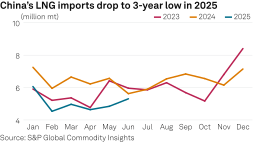
As Chinese importers chose to sell their contracts in the seaborne market to other countries, LNG imports declined 20.7% year-on-year from January to June to 30.3 million mt.
A Chinese city gas company said 40% of its term contracts are currently traded in the spot market due to unfavorable import parity and abundant domestic gas supply.
Increased participation in MOC process
As Chinese companies began exploring trading opportunities in the international market, many Chinese market participants have ramped up their participation in the Platts Market-on-Close (MOC) process. Along with the three Chinese NOCs, some Chinese city gas companies, like ENN and Beijing Gas, have also started participating in the MOC.
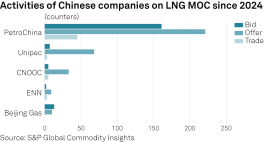
Participants noted that the uptick in MOC activity in recent years have significantly improved market transparency and facilitated spot trading for both buyers and sellers.
Chinese buyers seek greater destination flexibilities
With imports becoming uneconomical in China, importers started to prefer signing DES JKTC contracts instead of those with stricter destination clauses, such as DES China or a specific receiving terminal.
More Chinese downstream users are seeking opportunities to sell the cargoes to South Korea and Japan with higher price acceptance to make more profit from their in-the-money term contracts.
Additionally, some Chinese importers and traders who signed strip deals with pricing linked to Platts JKM had initially intended to explore import opportunities in China. However, many of these cargoes have been heard sold on the seaborne market due to unfavorable import parity, according to market sources. Chinese importers have noted that the optionality provided by Platts JKTC offers greater flexibility in managing seasonal demand fluctuations. City gas companies in China often sell their cargoes to other countries during periods of low demand or shoulder seasons when domestic demand is insufficient.
Amid US-China trade tensions after China imposed a 25% tariff on US LNG imports, Chinese importers with US FOB term contracts began selling US cargoes to Europe or swapping with other Northeast Asian countries. Such contracts have increased diversion flexibility and Chinese firms' trading activity within the Atlantic basin.
Although the market remained cautious about shipping US cargoes to Asia amid strong European injection demand in the first half of 2025, the dynamics of arbitrage trading have changed significantly.
"We forecast that mainland China will add 90 GW of gas-fired capacity from 2025 to 2030, as gas-fired power becomes increasingly critical due to rising renewable penetration," said Eric Yep, Energy principal analyst for gas. "Given the role of gas in balancing the power system, gas generation could face bigger swings in the future when more extreme weather occurs."
Fluctuations in power demand and gas-fired generation will require active spot trading capabilities from the Chinese NOCs and second-tier gas companies.
Therefore, Chinese buyers are likely to remain active in the spot market in the coming years. China's strategic shift toward LNG spot trading not only reflects the changes in the market landscape but also enables it to optimize resource management. Meanwhile, this transition will also open up more trading opportunities for other participants.
