


Energy Transition, Natural Gas, Maritime & Shipping, Emissions, Renewables
August 18, 2025
FuelEU abatement methodologies driving a new market in compliance surplus trading

By Chris To
Maritime stakeholders face challenges in pricing clarity for a new and emerging FuelEU compliance surplus pooling and trading, bringing forth a need for new pricing discovery methods as the market forms.
The EU's FuelEU Maritime is targeting a 2% reduction in greenhouse gas intensity this year from 2020 levels, and a further reduction to 80% by 2050, by capping ships above 5,000 gross tonnage calling at European ports. Ships that generate a surplus for being compliant can bank or pool this surplus, allowing them to sell it to non-compliant vessels, creating a marketplace as a result.
According to Albrecht Grell, managing director of analysis at German analytics firm Oceanscore, the market is currently small, with an estimated compliance deficit of around 2.1 mtCO2e and only a few hundred thousand tons of biobunkers needed for global fleet compliance.
However, assessing surplus market length is challenging, and a lack of clear supply/demand data hampers transparent price formation and effective trading. But as trading compliance develops, pricing methodologies focusing on abatement calculation are emerging as solutions to improve transparency in this increasingly commodified space.
Abatement helps calculate surplus costs
While many participants say there is no universal consensus on pricing methodology, many agree that abatement provides a solid framework for calculating compliance surplus costs.
CO2 abatement involves the costs of eliminating marine fuel emissions with lower GHG intensity fuels. It offers market participants clear metrics to compare low-GHG fuel blends with conventional bunker fuel.
Platts will launch a series of assessments focused on carbon dioxide abatement costs using biodiesel over conventional bunker fuels, pertaining to FuelEU maritime regulatory requirements, from Sept. 1, 2025.
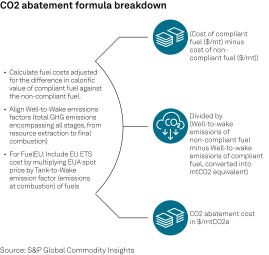
From a shipowner's perspective, abatement presents the base level price at which they can leverage a sale, known as a "technical approach," Grell said. However, as the market continues to create clearer lines of supply/demand, a "market-based approach" will eventually emerge as surplus units change hands more frequently.
"Unfortunately, this market is neither liquid nor transparent yet, and demand and supply can play it out and let the market set the price," Grell told Platts, part of S&P Global Energy.
In this emerging space, more platforms are offering digital exchange services that help buyers and sellers of compliance coordinate more efficiently and transparently to make their balances compliant.
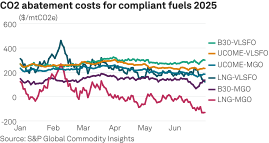
Abatement costs for very low sulfur fuel oil are higher than those for marine gasoil mainly due to the cost-competitiveness of 0.5% fuel versus 0.1% and the higher tank-to-wake emission factor -- or the GHG produced from burning fuel onboard -- of marine gasoil, leading to increased EU Emissions Trading System costs for CO2 abatement. This widens the gap between compliant alternative fuels and VLSFO, raising abatement costs.
Notably, abatement overheads decline when combusting expensive biobunker blends, such as used cooking oil methyl ester, compared to cheaper fossil-LNG fuel. As compliance surpluses may not always match fuel types, this could cause market expectation variations for surplus and deficit owners.
Compliant fuels
Under the abatement approach, compliance surplus valuations vary widely, depending on the compliant fuel's cost-competitiveness. LNG, the leading alternative fuel, with an estimated 648 LNG-fueled ships as of end-2024 and 87 ships ordered in the first half of 2025, exemplifies how owners in pools may push for lower-cost surpluses to secure margins.
"Since surplus prices are driven by demand and supply, LNG surpluses can fetch the same prices as others, and benefit from extra margins," Grell explained.
Bio-LNG is gaining traction due to its lower carbon footprint, with deals such as Finnish Gasum selling 150,000 mtCO2e of compliance surplus to Wilhelmsen through the digital exchange platform Hecla Emissions, a joint venture between Wilhelmsen Shipping and Affinity. However, bio-LNG markets remain mostly contractual with limited trading volume and interest may be sparse in the short term.
"Prices for lower-carbon products are rising due to overcompliance, but buyers still race to the bottom, likely requiring subsidies for costlier fuels," a trader told Platts.
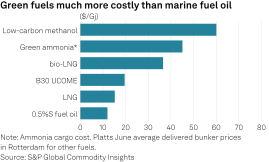
Biobunkers like UCOME could witness an upward trajectory in uptake as 2025 progresses. Q1 biobunker sales in Rotterdam fell 72% year over year for bioblended VLSFO. While it bounced back in Q2, H1 sales totaled 33,063 mt, a sharp drop compared to the same period in 2024 when sales reached 61,539 mt.
But forthcoming changes in the Netherlands' ticketing system for Annex IX B fuels -- defined by the EU Renewable Energy Directive (RED) as fuels produced from waste or residue materials -- create uncertainty for UCOME as a delivered biobunker.
In June, the Netherlands published a draft proposal for the implementation of the revised RED III, noting Annex IX-B fuels will not generate emission reduction units (ERE)when supplied for maritime bunkering.
Despite this, some market participants support the longevity of trading Annex IX B fuels in maritime, citing availability, engine compatibility and familiarity among procurement teams that could sustain demand as the market expands for compliance.
Pricing-wise, Platts Biobunker B30 Rotterdam assessments averaged $758.39/mt in Q2, lower than the Q1 average of $794.85/mt. Platts updated the BiobunkerB30 Rotterdam UCOME assessment from a calculated to a market-based assessment effective Aug. 4.
Compliance systems overlap?
In these early stages, various methodological approaches to pricing transparency in compliance will likely converge toward a market driven by traditional supply and demand fundamentals. Amid this, the potential looming changes enforced by the International Maritime Organization's Net-Zero Framework could have a significant impact.
The possibility of a two-tiered compliance system by 2028, involving mandatory payments of $100/mtCO2e below a direct compliance target tier and $380/mtCO2e below a base target tier could boost demand for biobunkers and other alternative fuels, as burning compliant blends could become more cost-effective than paying penalties.
A study conducted by Lloyd's Register indicates that financial penalties for burning VLSFO and ULSFO under the IMO Net-Zero Framework are harsher than those for FuelEU until 2045, due to the more aggressive staircasing across the years of both base and direct compliance targets within IMO's system.
However, uncertainty persists on whether and how these compliance systems might overlap, with LR suggesting that if the extraordinary session of the Marine Environment Protection Committee in October 2025 ratifies the IMO framework, it could impact the FuelEU system.
"FuelEU has a potential self-destruct mechanism, which could revert two regimes back to one. Recital 69 and Article 30 of the FuelEU regulation state that a global approach by the IMO to limit GHG ship intensity would be preferable and more effective due to its broader scope," LR said in the study published in July.
Should IMO's Net-Zero Framework be entrenched as the global standard, GHG intensity reduction will have to accelerate as the viability of fossil fuel bunkering rapidly loses economic traction from the early 2030s onward.
"Moving forward, the success of the regulation will depend on the sector's ability to mobilize investment in zero-emissions technologies, overcome financial and operational challenges -- particularly for smaller operators -- and develop the requisite fuel infrastructure," S&P Global Energy analysts said.
Even with the transition from FuelEU to IMO, the benefits of CO2 abatement calculations remain relevant: providing shipowners with clear cost implications for GHG reduction efforts as the market balances options for maritime decarbonization.
As stakeholders seek clearer methodologies and pricing mechanisms, successfully navigating this evolving market will be crucial for ensuring compliance and promoting sustainability in maritime operations.
