


Energy Transition, Electric Power, Renewables
August 11, 2025
Renewables tender in India: Energy storage dominates awarded capacity
India's renewable energy installed capacity reached 185 GW at the end of June, with about 22 GW of new additions in the first half of 2025. Capacity additions during this period are about 60% higher year on year, as developers rushed to complete projects before the end-June deadline expiration of full waiver on inter-state transmission system, or ISTS, charges for wind and solar projects.
An ISTS charge of 25% will be applied for projects commissioning from July. This will further increase to 100% in a graded manner annually until June 2028. On the other hand, full ISTS charge waivers are extended for pumped hydro and renewable projects with collocated energy storage components until June 2028.
The focus on energy storage to supply firm and dispatchable renewable energy has increased over the last few years, with demand for storage projects increasing in competitive tenders.
India has set a target to reach more than 500 GW of renewables with about 74 GW of planned energy storage capacity by fiscal year 2032. To achieve this target, India plans to tender about 50 GW of renewable capacity annually through a competitive bidding mechanism. While India surpassed this target by awarding more than 60 GW of renewable projects in 2024, H1 2025 started slowly, with demand for new projects dipping.
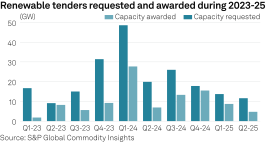
Muted tender volumes
Both the tender capacity requested and closed continued a downward trend in Q2. Tender capacity requested fell by 40% in Q2 compared to the same period in 2024. About 12 GW of new tenders were recorded as opened during Q2, compared with 20 GW in Q22024.
Furthermore, only about 5 GW of new projects were awarded in Q2, down about 30% year over year and about 45% quarter over quarter.
Technology requested
In H1, 25 GW of total renewable capacity was requested, of which about half has been closed. During this period, about a fourth of the capacity awarded was for vanilla solar PV and onshore wind projects, while the rest is for hybrid renewable tenders with or without storage and standalone energy storage.
Solar PV historically dominated tenders, with more than half of the capacity awarded, but its share fell in H1 due to emerging supply chain constraints and a shift toward hybrid renewable projects.
Tariff trends
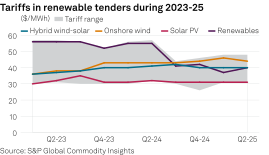
Onshore wind tariffs remain at a premium over other renewables in Q2. Average wind tariffs were quoted at about $44-$47/MWh, which was higher than the tariffs quoted in a tender for renewable projects with storage during this period at about $ 31/MWh.
This indicates that, depending on the storage capacity and duration requirement, optimally configuring the size of the renewable component can lead to lower annualized tariffs compared to vanilla wind projects.
No vanilla solar and hybrid wind-solar capacity was awarded in Q2 tariffs, which were in the range of $31/MWh and $40/MWh, respectively, in the previous quarter.
Demand for energy storage dominates in competitive tenders
About half of the total capacity requested and awarded in H1is with an energy storage component, including an equal share of hybrid renewables with storage and standalone energy storage.
The particulars of each tender vary with different technologies, storage capacity and duration requirement, annual average availability, and demand fulfillment.
Storage duration requirement to rise
The majority of the standalone energy storage tenders closed in Q2 were for projects with two-hour storage duration requirements, with the exception of the tenders by NHPC Ltd for Kerala state and the Bihar State Power Generation Co.'s for Bihar state, that requested 125 MW/500 MWh capacity each with four-hour storage duration requirements.
As a result, both tenders closed at double the capacity charges compared to the projects awarded for tenders with a two-hour duration storage. Going forward, more storage tenders with higher duration batteries may become the norm as the share of variable renewable energy increases in the generation mix.
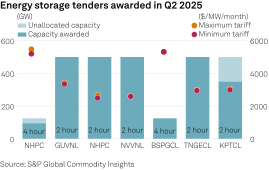
Stringent availability conditions for supplying guaranteed power during peak demand hours and demand following for dispatchable renewables supply have led to an increase in tariffs quoted for such projects.
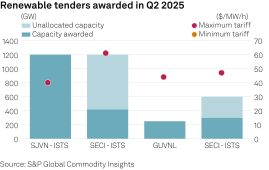
In May, Solar Energy Corp., or SECI, closed the 1.2 GW round-the-clock renewables tender with a four-hour energy storage requirement and a demand fulfillment ratio requirement of at least 80% annually and 90% during peak hours.
Due to these stringent conditions, the tender was 65% undersubscribed. The tender also resulted in about $61/MWh tariffs, about 50% higher than the tariffs in other hybrid tenders with storage.
Federal agencies lead demand
More than 60% of the capacity awarded in competitive tenders in H1 was through federal implementation agencies.
Among the state-specific tenders, Uttar Pradesh, Rajasthan and Gujarat constituted about a third of the renewable and storage capacity awarded. The capacity awarded in state tenders was mainly for solar PV projects. Moreover, standalone energy storage tenders are largely driven by state-specific demand in H1.
Even the federal agencies that tendered energy storage projects have identified the consumer state in the bidding stage, unlike the solar and wind tenders, as the storage tenders require matching offtaker demand and load profile.
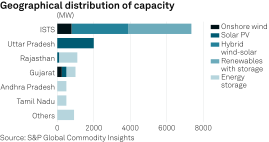
Despite a target to tender 50 GW of renewable capacity annually, until the first half of 2025, about 25 GW of capacity has been requested and 13 GW has been awarded, with a drop in the new market activity both from the implementation agencies and the participating developers. As the market anticipates uncertainty due to costs of key components in the solar supply chain, and constraints in the availability of domestically manufactured solar cells and modules, this muted demand is expected to continue in the rest of 2025.
