Energy Transition, Carbon, Emissions
July 28, 2025
Fragmented policies hinder Asia’s Article 6.2 carbon market from scaling up

Asian countries have adopted distinct pathways to implement the Paris Agreement's Article 6.2, making it challenging for industry stakeholders to find "compatible" projects and carbon credits that can be traded across different jurisdictions.
This was the view of project developers and corporate buyers speaking to Platts on the sidelines of the Asia Climate Summit, held in Bangkok on July 8-10. Platts is part of S&P Global Energy
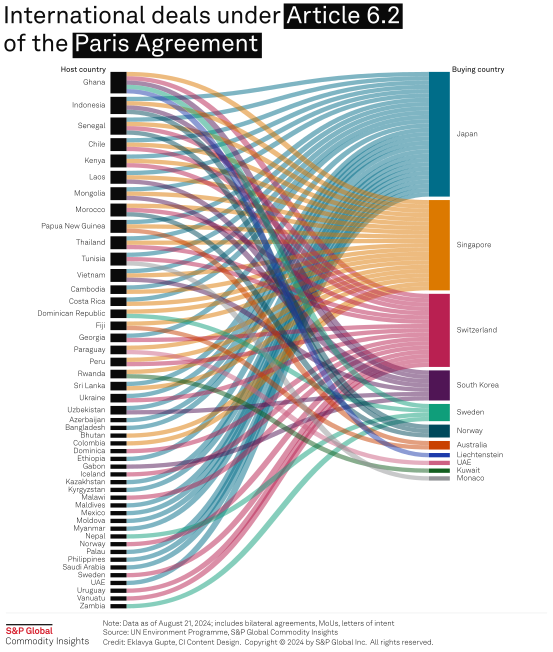
The Article 6.2 market is decentralized in nature. The UN has given countries the flexibility to formulate bilateral agreements on how a buyer country works with a project host country. This flexibility includes the type of projects, carbon crediting methodologies, and carbon credits that can be used for Article 6.2 purposes. But a decentralized market also needs a certain level of harmonization, market participants emphasized.
One of the biggest groups of Article 6.2 credit buyers is companies with compliance obligations under either carbon taxes or emission trading schemes. However, many of these corporate buyers are multinational companies that operate and have carbon liabilities in more than one country.
Multinational corporate buyers told Platts that, ideally, they hope to optimize their compliance costs, identifying carbon assets that can settle compliance obligations in more than one country, but it is very difficult to find such compatible carbon credits.
In Asia, Singapore and Japan are the two pilot buyer countries for Article 6.2 credits.
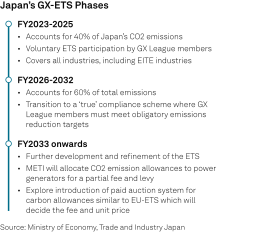
Singapore currently has a carbon tax at S$25/mtCO2e ($19.46/mtCO2e), which will increase to S$45/mtCO2e in 2026 and 2027, and S$50-S$80/mtCO2e by 2030. Starting from FY2026, Japan's GX-ETS will also enter the mandatory phase.
Jay Mariyappan, head of carbon and renewables with PetroChina International, said his company has compliance obligations under both Singapore's carbon tax and Japan's upcoming mandatory GX-ETS.
With the two countries' different approaches to Article 6.2, it is unlikely to buy one credit that has the optionality to use across different jurisdictions, he told Platts during the ACS conference.
Varied approaches
Singapore is leveraging existing voluntary carbon market methodologies, such as those under Verra and Gold Standard, to issue Article 6.2 carbon credits.
Such policies provide VCM project developers a chance to align their existing VCM projects with the UN's Article 6.2 framework, but the challenge is getting government letters of authorization.
"We are now traveling around the world to get the LOAs from individual governments," a VCM project developer told Platts. "It is indeed an exhausting task. Some governments are clearly hesitant, especially when the request is not G2G [government-to-government] but from project developers like us".
"After all, issuing an LOA means that you agree to give up a certain amount of your country's emission mitigations and transfer them to a foreign country," the project developer added. "It is reasonable for the developing countries, especially the least developed countries, to think twice."
Moreover, different countries also use different formats of LOAs despite the UN providing a standardized format, the developer said.
"Even though there is a recommended, standardized format of LOAs provided by the UN, countries nowadays are using different formats. Some countries, like Cambodia, have well-organized LOAs, but some countries are yet to build such a level of competency," the developer shared.
Conversely, under the upcoming mandatory GX-ETS, companies will not be allowed to use any VCM credits to meet their compliance obligations, an official from Japan's Ministry of Economy, Trade and Industry (METI) told Platts during the ACS.
The METI official reaffirmed that only international carbon credits generated under Japan's own Article 6.2 mechanism, called the Joint Crediting Mechanism, would be accepted.
A senior Japanese policy advisor told Platts that, under JCM's arrangement, private sector actors did not need to worry about winning host countries' authorization -- all the JCM projects and the respective credits issued would already be considered as having the government authorization.
"But for us, the pain is to scale up the JCM market," the policy advisor said. "Currently, we are far behind the 2030 target. We need both the public sector and the private sector's capital to invest in JCM projects."
The Japanese government aims for a cumulative supply of 100 million mtCO2e JCM credits by 2030, yet only 0.82 million mtCO2e of such credits have been issued so far, according to statistics on the JCM's official website.
A JCM project developer told Platts that, under the JCM, for each project host country, Japan adopted a different set of JCM methodologies, which could complicate the project development process and delay the delivery of JCM credits.
"We are evaluating the opportunities for developing JCM cookstove projects," the developer said. "However, we found that, for the same kind of cookstove projects, the Japanese government approves an individual methodology for each host country. This will significantly increase our workloads to understand these individual methodologies and develop tailor-made projects."
Finding in-between solutions
The government of Thailand, as a key supplier of Article 6.2 credits, is trying to leverage its Premium T-VER methodologies to create an in-between solution that may work in both Singapore and Japan.
T-VER is Thailand's jurisdictional program to certify emission reductions within its territory. The Thai government has developed two types of T-VER carbon credits: Standard T-VERs and Premium T-VERs.
Compared to standard T-VERs, Premium T-VERs adopted more conservative estimations of emission reductions and are considered to have higher environmental integrity.
In 2024, Switzerland and Thailand completed the world's first transfer of Article 6.2 carbon credits, and the transferred credits were Premium T-VERs from an E-Bus project in Bangkok.
Also in 2024, the Thai and Japanese governments signed their Article 6.2 Memorandum of Cooperation, which allowed the Premium T-VER methodologies to be transferred and used as JCM methodologies, but it will need an additional layer of approvals by the two governments.
Singapore has also signaled its interest in T-VERs.
"While we are quite happy to leverage on the independent standards that are in existence out there, but if a country tells us that their own national standard, like Premium T-VER, for example, is important, I think we are quite happy to work with them to see how we can ensure that we leverage on it," Benedict Chia, Director General of Singapore's National Climate Change Secretariat, said during ACS.
Chia told Platts that Singapore and Thailand are still in the process of discussing the ways of collaboration, so neither a memorandum of understanding nor an implementation agreement has been signed as of now.
Meanwhile, Chia told Platts that, despite Singapore's openness to the possibility, it is crucial to ensure the environmental integrity of all the Article 6.2 credits used by the city-state.
Project developers also highlighted that, if Thailand's Premium T-VER methodologies can be adopted as regional methodologies, it could also unlock more opportunities for other Southeast Asian project host countries, like Malaysia and Indonesia.