Electric Power, Energy Transition, Renewables
May 16, 2025
US tariffs cloud Vietnam's energy transition
Southeast Asia takes the center stage amid rising geopolitical tensions following the US reciprocal tariffs announced on April 2.
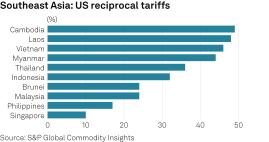
Since the first wave of tariffs targeting China in 2018, the region has become a key destination for Chinese exports reaching the US, benefiting from the "China+1" strategy. But now, reciprocal tariffs ranging from 10% to 49% would apply across the region if implemented in the current form, raising concerns about supply chain disruptions and a wave of manufacturing reshoring to lower-tariff jurisdictions.
The 90-day pause may offer room for negotiation, and China's push to bolster regional ties could shift the outlook. The recent deal between the US and China on May 12 -- reducing reciprocal tariffs from 125% to 10% for 90 days -- also offers a glimmer of hope that Southeast Asia might follow suit. But what if the worst-case scenario unfolds?
Beyond trade, the heightened uncertainty also cast a shadow over Southeast Asia's energy market, delaying new investment for energy transition and straining the financial stability of state-owned utilities.
Exposure to additional tariffs
Among Southeast Asian countries, Vietnam stands out as the most vulnerable to US reciprocal tariffs, facing one of the highest rates at 46%. The country's economic growth has been fueled by exports, with the US accounting for nearly 30% of its shipments.
The presence of major multinational companies underscores Vietnam's role as a global manufacturing hub. For instance, Vietnamese factories supply the US with $70 billion worth of computers and electronic products annually, supported by competitive labor costs and easing restrictions on foreign ownership.
Apple has 35 suppliers in Vietnam, according to the 2023 Apple Supplier List, churning out around 90% of Apple's wearable products and 20% of iPad global output. Samsung uses Vietnam as its largest production base for smartphones and mobile devices, making up over half of its global production and about 15% of Vietnam's exports. Investment has also surged in other sectors, with Nike manufacturing half of its global footwear and 28% of its apparel in Vietnam, according to the company's annual report.
Impact on Vietnam's energy transition
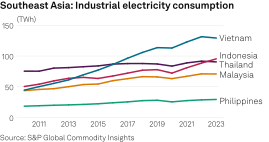
The influx of foreign direct investment into Vietnam has accelerated industrialization and more than tripled electricity consumption since 2010. It is now outpacing Malaysia and the Philippines combined.
Historically, much of this demand has been largely met by coal. However, multinational manufacturers are increasingly driving clean energy deployment, propelled by ambitious corporate renewable commitments.
Apple aims for its suppliers to become 100% renewable-powered by 2030, while Nike targets 100% renewable energy for its operations by 2025. Samsung also seeks to sign Direct Power Purchase Agreements to buy power directly from solar and wind power producers.
If tariffs are enforced in their current form, all these clean energy initiatives could face significant setbacks. Electricity demand growth is likely to downshift.
Vietnam's total exports could fall by up to 40% this year if the tariff persists, according to estimates by the OCBC Bank. The "China+1" strategy may no longer be viable for multinational firms. Instead, the region risks being inundated with cheaper imports from China, further suppressing manufacturing output.
The recent US antidumping and countervailing tariffs of up to 3,521% on solar cells and modules from Cambodia, Malaysia, Thailand and Vietnam further complicate the energy transition in Southeast Asia.
If ratified by the US International Trade Commission in June, exports of solar products to the US from the region could halt entirely. As a result, cheap Chinese modules, bound initially for the US, are likely to flood Southeast Asia, destabilizing domestic solar manufacturing jobs.
On a positive note, lower module prices could reduce the cost of solar power projects, offering a short-term boost to deployment and spurring the energy transition. Pakistan's recent solar boom, driven by cheap imports and high retail electricity prices, underscores how rapidly such conditions can accelerate renewable adoption.
Additional Chinese module imports could help Southeast Asia reach 13.5 GW of new solar capacity by 2030, according to S&P Global Energy. Still, the deteriorating investor sentiment under the uncertain trade environment could eclipse the upside from reduced photovoltaic capital expenditures.
As the market shifts from government-led auctions to corporate renewable procurement, corporate consumers' willingness to invest in clean power projects becomes increasingly important.
A factory facing 46% tariffs might delay rooftop solar installations or new PPA agreements because it is unsure where to locate its manufacturing plants. Project financing will also become more difficult as lenders may raise risk premiums due to heightened offtake risk.
Vietnam expects DPPAs to make up 30%-60% of electricity generation from renewable energy in the long term, but this ambition may be significantly undermined if the current trade and investment environment persists.
Mounting pressure on state utilities' balance sheets
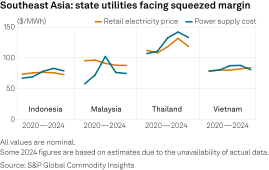
The US reciprocal tariffs add another layer of complexity to power pricing in Southeast Asia. A weaker local currency, coupled with increased reliance on US LNG imports, could make fuel imports more expensive and exert upward pressure on power supply costs.
The Vietnamese dong fell to a record low against the US dollar on tariff concerns in February, raising coal and LNG costs for state-owned Vietnam Electricity, or EVN, for fuel imports priced in dollars. Any further LNG supply deals with the US as part of trade concessions, in addition to the cooperation agreements on sourcing LNG signed with Excelerate Energy and ConocoPhillips in March, could lead to elevated power supply costs if pricing terms are not competitively priced for Vietnam.
If tariffs hit the export-dependent economy, the government will be more hesitant to allow retail electricity price hikes. Keeping electricity affordable is critical for economic and political stability -- an approach mirrored by Thailand's new government under Prime Minister Srettha Thavisin, which intervened to curb electricity rates twice since 2023 despite the massive losses of state-owned Electricity Generating Authority of Thailand.
Across the region, the gap between rising power supply costs and stagnant retail electricity prices is squeezing state utilities. Rather than passing costs on to factories already reeling from trade disruptions, governments may choose to absorb the losses -- placing further strain on the utilities.
Financial strain on state utilities could hinder the investments needed to meet future electricity demand.
Vietnam anticipates domestic electricity demand to nearly double by 2030, according to the latest Power Development Plan (PDP8) revision, with more than twice the installed capacity across all technologies, targeting 73.4 GW of solar, 38 GW of wind and 37.4 GW of gas power.
These high ambitions would require $136.3 billion in new power sources and transmission grids -- much of which must be mobilized through EVN as the country's sole power purchaser. With the cumulative loss of nearly $ 2 billion due to escalating power supply costs, the potential for EVN to deploy substantial capital toward Vietnam's energy transition remains in question.
Tariffs' potential impact on supply chains
The disruption in Southeast Asia's solar supply chain offers a stark preview of what could unfold if the US reciprocal tariffs are enforced in their current form.
In response to antidumping duties in late 2024 on crystalline silicon solar cells from Cambodia, Malaysia, Thailand and Vietnam, major Chinese solar manufacturers -- including LONGi Green Energy, JA Solar, Jinko Solar, and Risen Energy -- have already shuttered or scaled back operations across the region.
Unlike previous sector-specific measures, the proposed reciprocal tariffs this time would span virtually all industries, amplifying the risk of widespread economic dislocation.
Vietnam is expected to exhaust all diplomatic channels before the July 9 deadline to avert these tariffs. Yet, the damage to investor sentiment might be unavoidable regardless of the outcome. Whether it's building new solar farms, acquiring operational assets, or signing long-term power purchase agreements, the current environment of policy and trade uncertainty is making it increasingly difficult to mobilize new capital.
Learn more: Tariff Turmoil: Assessing the Impact on Southeast Asia's Power Market
