Crude Oil, Refined Products
June 24, 2025
Canadian oil sands optimization projects to increase production, even in lower price track of 2025
Canadian oil sands production is expected to reach a record annual average production of 3.5 million b/d in 2025, 5% higher than 2024, according to an S&P Global Energy outlook. By 2030, production could top 3.9 million b/d, 500,000 b/d higher than 2024 and 100,000 b/d higher than Energy outlook released in 2024.
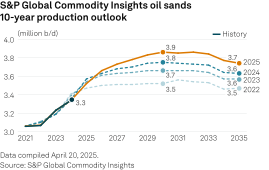
Optimization projects have dominated oil sands growth for nearly a decade. From 2019 to 2025, oil sands output is expected to increase by over 600,000 b/d, more than offsetting the heavy crude production decline in Latin America during this time. With more than 3.8 million b/d of existing installed capacity brought online between 2001 and 2017, companies are looking at ways to increase the productivity of existing assets -- decreasing downtime and increasing throughput -- and identifying debottlenecking opportunities.
One of the greatest misconceptions about oil sands, defined as synthetic crude oil and undiluted bitumen, continues to be the cost of supply. The challenge that oil sands producers face has always been the large up-front, out-of-pocket expenditure over multiple years required to bring new projects online. However, that is not the cost structure required to continue to maintain and even optimize existing production.
In 2025, Energy estimates that the half-cycle breakeven for oil sands range from $18/b to $45/b on a West Texas Intermediate basis. Half-cycle break-even costs include operating cost, the cost to purchase diluent (if needed), as well as an adjustment to enable a comparison to WTI -- specifically, the cost of transport to Cushing, Oklahoma, and quality differential between heavy and light oil. The cost range spans steam-assisted gravity drainage (SAGD) facilities, integrated mines that market SCO (mined SCO) and unintegrated mines that market diluted bitumen. Energy estimates the overall average breakeven at $27/b in 2025.
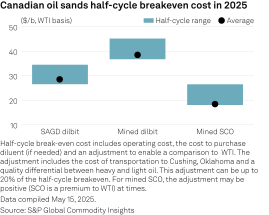
Analysts at Energy do see downside risk associated with the lower price path that has emerged in 2025. Oil sands production, however, has proven capable of withstanding extreme price volatility in the past, which has been far greater than what might result from the current Canada-US trade exchanges.
Moreover, because optimizations often contribute to efficiency gains, many companies would likely see them through to completion, even in a more challenging price environment. For oil sands output to be impacted, prices would likely have to fall well below $40/b WTI and remain there for a protracted period. At this price, Energy analysts would also expect more pronounced reductions in US tight oil and other key sources of supply.
Other important risks remain, including the adequacy of pipeline export capacity. With even more production growth expected, without further incremental pipeline capacity, export constraints have the potential to reemerge as early as next year. Should this occur, western Canadian prices could be negatively impacted, leading to slower and lower growth than currently anticipated.
