Crude Oil, Natural Gas
May 19, 2025
Trinidad and Tobago 2025 bid round: A new chapter in deepwater exploration
Trinidad and Tobago is setting the stage for a new chapter in its offshore exploration with the launch of its 2025 deepwater bid round. With 26 offshore blocks that collectively cover approximately 29,177 sq km, the country's 2025 deepwater competitive bid round is poised to be the largest auction of oil and gas exploration areas in Trinidad and Tobago's history.
The government is aiming to unlock untapped hydrocarbon potential in some of the country's least explored frontier areas. This move signals a strategic effort to attract international investment and revitalize upstream activity in a region that still holds significant promise.
Unlike many mature basins worldwide, Trinidad and Tobago's deepwater acreage remains largely underexplored. While global exploration trends have slowed, the country is positioning itself as a competitive and geologically attractive option for energy companies seeking new offshore opportunities.
If successful, the bid round could bolster new hydrocarbon resources, drive innovation, and support long-term energy security for the nation.
Trinidad and Tobago's Ministry of Energy and Energy Industries launched the 2025 bid round in January and the bidding period will remain open until early July. Results are expected by early October 2025. The awarded blocks will feature a 10-year exploration period divided into three phases. Additionally, there is a potential 25-year extension contingent upon a commercial discovery.
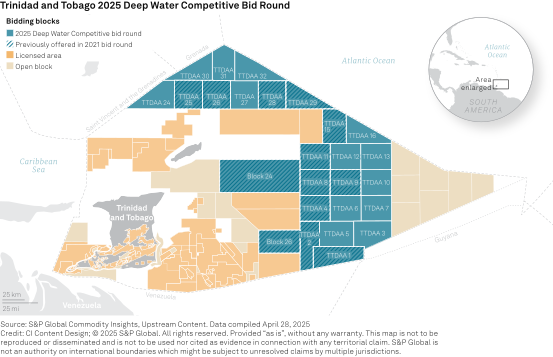
Notably, half of the blocks in this round did not attract any bids when they were previously offered in 2021/2022.Most blocks are situated in the Northeast Caribbean Deformed Belt, a recognized frontier basin with gas discoveries and ongoing development plans, specifically on Woodside Energy's Bongos 2, Bele 1, Boom 1, Hi Hat 1, and Tuk 1 fields as part of the company's Calypso project.
Additional blocks are located in the emerging Tobago Basin and the more developed Columbus Sub-basin region of the Trinidad Basin.
Among the most significant blocks in this round are the TTDAA 5 block and several adjacent blocks, where Woodside discovered the Le Clerc gas field in 2017, with a reported potential resource of up to 5 Tcf of gas.
Several blocks adjacent to the Calypso project in Block 23 (a) and TTDAA 14, which is projected to reach a final investment decision by late 2025 or 2026 with a potential resource of 3.5 Tcf, are also included.
The deepwater region of Trinidad and Tobago has been the focus of several extensive seismic programs to improve the understanding of its hydrocarbon potential. Woodside conducted a substantial 20,977 sq km 3D seismic project that spanned several blocks between 2014 and 2015, marking it the most extensive 3D marine seismic survey in the western hemisphere.
To support the 2025 bid round, the government commissioned a multiclient 6,500 sq km 3D seismic acquisition project in the Tobago Basin trough with Searcher Seismic in August 2022. However, the project has been delayed and is expected to occur by mid-2025.
The bid evaluation process for the 2025 bid round will utilize a comprehensive point system assessing various factors critical to the bidding process. Key components of this evaluation will include production profit-sharing, signature bonuses and proposed geophysical programs. Additionally, studies and commitments related to exploratory well drilling will be assigned varying weights based on geographic location.
Overall, the government of Trinidad and Tobago is committed to attracting new investments in the upstream oil and gas sector, having launched multiple licensing rounds each year since 2021.
While the process of awarding contracts has faced delays -- taking over a year in both the 2021 deepwater round and the 2022 onshore and nearshore bid round -- there have been signs of improvement. The 2023 shallow water round showcased a more efficient process, resulting in the timely awarding of four blocks to prominent companies, such as Shell, B, and EOG Resources, within just four to seven months. This reflects a positive shift toward enhancing investment opportunities in the country's oil and gas landscape.
To effectively seize these opportunities in the oil and gas sector, it is essential to establish competitive fiscal terms that attract investors, such as favorable tax incentives and royalty structures. Additionally, improving regulatory efficiency through streamlined processes and enhanced communication can significantly lower the time and costs associated with obtaining permits. Lastly, outlining a clear development pathway with defined timelines and milestones will give investors the confidence to commit to long-term projects.
By focusing on these elements, stakeholders can create an environment that not only attracts but also sustains investment in the industry.
