Chemicals
July 18, 2025
Pyrolysis oil: A circular solution to plastic waste

By Hui Heng
As the global community confronts the mounting crisis of plastic waste entering the environment, innovative solutions such as converting mixed plastic waste into pyrolysis oil are gaining traction.
Mixed plastic waste is the feedstock for the production of pyrolysis oil. Pyrolysis oil is produced by thermally decomposing mixed plastic waste in an oxygen-free environment at temperatures between 300°C and 900°C. The resulting synthetic fuel can be refined into chemicals or fuels or used as an industrial feedstock. This process offers a promising route to reducing plastic waste and reliance on virgin fossil fuels.
Global developments in mixed plastic waste
Europe
In Europe, chemical recycling is advancing rapidly, supported by strong policy frameworks and established infrastructure.
In the Netherlands, for example, Sabic is jointly developing with chemical recycler Plastic Energy and will have an input capacity of 20,000 mt/year of mixed plastic waste in Geleen, Limburg, while Shell is developing a pyrolysis oil upgrader at its Moerdijk facility, which purifies plastic-derived oil for use in petrochemical crackers.
In Germany, LyondellBasell is constructing an advanced recycling plant in Wesseling with a planned capacity of 50,000 mt/year, set to be completed in 2026.
In the UK, Mura Technology is launching a hydrothermal liquefaction plant in northern England that will process 25,300 mt of end-of-life plastics annually.
Meanwhile, Neste is expanding its Porvoo refinery in Finland to process liquefied recycled materials, including plastic waste, by the end of 2025.
US
The US is experiencing a significant expansion in advanced recycling capacity.
In Texas, ExxonMobil is investing $200 million to expand its Baytown and Beaumont advanced recycling facilities, aiming to reach a total capacity of 500 million lb/year.
In Tennessee, Eastman Chemical operates a molecular recycling facility in Kingsport with a capacity of 110,000 mt/year. However, plans for a second facility in Texas were recently impacted by the loss of a significant federal grant.
Other companies, such as Brightmark, Braven Environmental and Freepoint Ecosystems, are also developing pyrolysis facilities with financial backing from major petrochemical firms.
Asia
Asia is emerging as a key region for chemical recycling, although progress varies by country.
In Malaysia, Petronas is constructing what is expected to be Asia's largest pyrolysis oil unit, scheduled to begin operations in the first half of 2026.
Supply-demand dynamics
In Europe, the waste management infrastructure is well-developed, allowing for the sorting of mono-polymer streams. However, chemical recyclers still face difficulties sourcing clean, film-rich bales that meet strict quality standards.
The supply of suitable feedstock in the US is fragmented, and low gate fees discourage investment in high-quality sorting.
In Asia, the supply of mixed plastic waste is limited by import bans and underdeveloped domestic collection systems, although some countries are working to improve their infrastructure. Countries like India, Japan and South Korea are making strides through national recycling mandates.
Chemical recyclers that operate in the pyrolysis process seek feedstock rich in mixed polyolefins. They also set strict limits on contaminants as well as moisture, adhering to their process's tolerance level. For this reason, chemical recyclers in Europe would target film-rich bales, such as those that are collected at store fronts for flexible recycling, as these are not usually picked up by mechanical recyclers. Materials could include candy wrappers and crisp packets.
Currently, the specification and market for chemical recycling-fit mixed plastic waste bales are still under development. One major issue is the disconnect between waste managers' and chemical recyclers' pricing expectations.
"Chemical recyclers often share their bale specification with us, which requires very clean materials, but this could not be met," said a waste manager in Europe.
Meanwhile, demand for mixed plastic waste in Europe is driven by regulatory mandates and corporate commitments to sustainable packaging.
UK chocolatier Cadbury said May 19 it will transition its chocolate wrappings into 80% post-consumer recycled plastics for the UK and Ireland markets. The move will use about 600 mt/year of post-consumer plastics made from chemically recycled flexible packaging.
Domestic demand is growing in the US as the country shifts away from exporting waste and toward building local recycling capacity. In Asia, demand is inconsistent; while some countries are advancing recycling initiatives, others are hindered by economic and regulatory challenges.
Trading mechanisms
In Asia and the US, mixed plastic waste is primarily recycled domestically due to strict import regulations. In Europe, cross-border trade of waste bales is possible but incurs significant transportation and compliance costs.
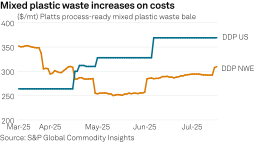
Mixed plastic waste in June averaged Eur248.81/mt DDP Northwest Europe, up Eur23.81/mt month on month, and $360/mt DDP US, up $32/mt month on month, according to Platts assessments. Platts, part of S&P Global Energy, launched European and American advanced recycling mixed plastic waste assessments in March. Sources said the long-term trend of processing waste would likely see increased costs.
Challenges and opportunities
The mixed plastic waste market faces several challenges. Contamination from food residues, moisture and incompatible plastics, such as polyethylene terephthalate, complicate recycling efforts. Infrastructure gaps, particularly in Southeast Asia and parts of the US, limit processing capacity. Market volatility, influenced by crude oil prices and demand for virgin plastics, affects the competitiveness of recycled materials. Additionally, inconsistent policy support, especially in the US and Asia, creates uncertainty for investors and recyclers.
Despite these challenges, there are significant opportunities. Governments and businesses are increasingly investing in circular economy initiatives, such as the EU's Green Deal and US state-level Extended Producer Responsibility (EPR) laws. Technological advancements, including pyrolysis oil upgrading and molecular recycling, are improving the quality and usability of recycled outputs. Legislative reforms, such as the UK's kerbside collection of flexible packaging and Germany's carbon tax incentives, are expected to boost the supply of recyclable materials.
The global mixed plastic waste market is at a pivotal juncture. While challenges persist, particularly in supply consistency and policy support, the momentum toward circularity is undeniable.
With Europe leading in infrastructure and policy, the US scaling up investment, and Asia gradually aligning through national mandates and industrial initiatives, pyrolysis oil stands as a promising solution. The path forward requires coordinated global action, investment in technology and robust policy frameworks to turn plastic waste into a valuable resource.
