Agriculture, Energy Transition, Refined Products, Biofuel, Renewables, Jet Fuel
August 07, 2025
INSIGHT CONVERSATION: Marie Owens Thomsen, IATA
This is the third of a seven-part Insight Conversation interview series where leaders and stakeholders in the biofuels space share their thoughts on the opportunities and challenges in Asia's biofuels sector.
Aviation is not just a climate challenge, says International Air Transport Association Chief Economist Marie Owens Thomsen. The future of sustainable aviation fuel hinges on aligning economic viability with policy, especially amid geopolitical friction, softening oil prices, and uneven global climate priorities.
Thomsen joined IATA in 2022 as chief economist. Since 2023, she has also been vice president for sustainability and environment. Her three-decade career spans roles across global financial institutions, including HSBC, Merrill Lynch, Indosuez and Lombard Odier, alongside experience with IKEA and an entrepreneurial stint in the equine industry.
In this Insight Conversation, Thomsen speaks with S&P Global Energy Editor Samyak Pandey about policy recalibration, co-processing, trade frictions, SAF pricing and why aviation's decarbonization should be viewed as a whole-of-government economic development strategy.

How are geopolitical uncertainties, low oil prices and policy recalibration affecting SAF investments and mandates?
The energy transition has lost momentum, especially with the recent shifts in US policy and broader geopolitical volatility. Climate priorities are slipping, even in advanced economies, and developing countries never placed them at the top to begin with -- understandably so, as they wrestle with poverty, energy access and infrastructure gaps.
But aviation remains unique. In 2021, IATA committed the global airline industry to net-zero by 2050. ICAO (International Civil Aviation Organization) followed in 2022. We're still the only sector with alignment at both the UN and industry levels on such a long-term goal. The commitment is there, but the investment environment has shifted.
Trade friction is also intensifying, with the EU and UK scrutinizing biofuel imports from Asia. How could this impact SAF supply chains and pricing?
It's misguided. We're talking about a tiny, emerging market, and already we see trade barriers, antidumping investigations and regional fragmentation.
Europe's SAF-for-Europe approach favors domestic production and certain airports. That creates inefficiencies, raises costs and disadvantages European airlines globally. Instead of growing the pie, we're slicing it too early.
On one hand, they want scale. On the other, they block cost-effective Asian feedstocks. This kind of policy inconsistency hinders global SAF growth. We should prioritize affordable feedstocks, not penalize them.
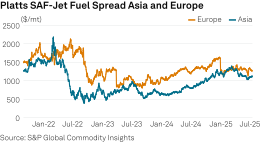
With jet fuel around $85/b and SAF still two to five times more expensive, does the spread threaten SAF adoption?
It definitely does. Cheap oil weakens SAF's economic case. Historically, clean energy boomed -- wind and solar, for example -- when oil was expensive. We're in an oversupplied oil market that could last into 2026, further lowering incentives.
Refineries also complicate matters. Jet fuel is only 8% of total output. It competes with diesel internally, and diesel itself competes with gas externally. But with the diesel market shrinking due to electrification, jet fuel -- and SAF by extension -- may gain more room long-term.
Given SAF's cost, can airlines feasibly insource fuel production to manage long-term compliance costs?
That's my fantasy: that every airline could produce its own SAF. But realistically, most airlines can't afford it. With forecast net margins of just 3.7%, aviation isn't investment-grade by banking standards. Only a few large carriers with strong balance sheets can take that leap.
If not insourcing, then what's the most viable way to scale SAF fast?
Co-processing. Refineries already have the infrastructure. ASTM (American Society for Testing and Materials) allows 5% SAF via co-processing today and some believe it could safely go up to 30%. The UK is moving in that direction. It's the cheapest way to scale without major capital expenditure, and yet uptake remains slow. That's baffling.
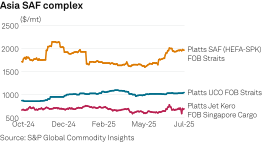
Aviation lacks decarbonization alternatives, unlike marine or road transport. But upstream SAF still depends heavily on agri-feedstocks. How can upstream costs be managed, especially when fossil jet fuel is cheap?
As an economist, I view the energy transition as one of the greatest economic opportunities of our time. Historically, mobility and energy have driven global growth, from camels and fire to jet engines and fossil fuels. Now we're stalled. That combination no longer delivers the same prosperity.
The next leap forward requires universal access to sustainable, affordable energy. If we achieve that, we could eliminate poverty -- truly.
Aviation plays a part. Decarbonizing this sector creates cascading benefits for others. But to do so, we must elevate SAF policy above transport ministries. It touches agriculture, energy, commerce, labor and education. It's a whole-of-government challenge.
Fossil fuel subsidies remain a big barrier. How can they be better aligned with SAF goals?
Let's take a look at the US tax code that allows oil companies to write off all operational costs. Renewables don't get the same benefit. That's unjustifiable today when fossil firms report more than 20% margins. Shift those write-offs to clean energy. It would likely be budget-neutral, even fiscally positive.
Another underused tool are guarantees. They don't require upfront cash, just reserves. Default rates are low at 3%-4%, and they de-risk investments. Institutions like the World Bank's MIGA use them for sovereign risks. We need similar mechanisms for airline projects, whether state-owned or not. This is how we build investor confidence.
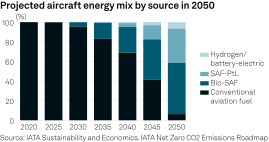
Is the current SAF shortfall compromising IATA 2030 and 2050 climate targets?
Absolutely, but airlines are committed. We're not working from a surplus. Every milliliter short matters. SAF is the strongest lever, but not the only one. We also lack sufficient offset programs and carbon capture deployment.
We're falling short on all fronts, and that delays everything.
What's your outlook on emerging SAF technologies like algae and direct air capture, especially in regions like Japan and the Middle East?
These are promising but won't scale fast enough. DAC, especially, needs to get much cheaper. For now, the most scalable and affordable option remains co-processing with existing infrastructure.
Southeast Asia may soon have surplus SAF volumes. Could those be redirected to the EU or US? What would that mean for pricing and policy?
Possibly, but not immediately. Take China -- they're scaling SAF for domestic use. That alone is a big milestone. Same with carbon credits: even if not fully in CORSIA (Carbon Offsetting and Reduction Scheme for International Aviation), China could generate credits for export, but the current focus is domestic use.
Eventually, when markets like China and India satisfy local demand, they'll look to export. At that point, certification must align with global standards -- ASTM, ICAO. I don't foresee problems, as long as the rules are followed.
This interview was recorded on the sidelines of the IATA 81st Annual General Meeting and World Air Transport Summit in June 2025.

Editor: