


Agriculture, Energy Transition, Biofuel, Renewables
July 31, 2025
INSIGHT CONVERSATION: Dr. Prapisala Thepsithar, Global Centre for Marine Decarbonisation
This is the second of a seven-part Insight Conversation interview series where leaders and stakeholders in the biofuels space share their thoughts on the opportunities and challenges in Asia's biofuels sector.
Dr. Prapisala Thepsithar leads the Global Centre for Maritime Decarbonisation assurance framework for drop-in green fuels initiative.
She talks to S&P Global Energy Senior Editor Aditya Kondalamahanty about the technology and financial barriers to marine decarbonization, as well as the emerging technologies in the space.

What is the current state of supply and demand in the marine biofuels sector?
Despite being recognized as a promising near-term measure for reducing greenhouse gas emissions, marine biofuels currently make up a very small share -- less than 1% of total marine fuels use.
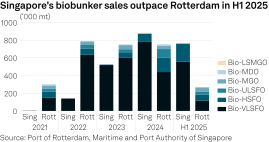
Bunkering volumes of biofuel blends in key hubs, like Singapore and Rotterdam, have increased significantly from negligible levels in 2020 to around 0.88 million mt and 0.76 million mt, respectively, in 2024. Their use represents only about 1.7% of total bunker sales at these hubs. Other alternative fuel supplies, such as bio-methanol and bio-LNG, are even more minuscule by comparison.
This year, the bunker volume of marine biofuels in Singapore reached nearly 0.5 million mt by April -- that's approximately 2.6 times of April 2024's volume.
The largest producers include the US, Brazil, the EU, China and Southeast Asia -- namely, Indonesia, Thailand and Malaysia.
In light of FuelEU Maritime, vessels calling EU ports will likely be the main consumers of marine biofuels this year and over the next two years.
Once the mid-term measures of the International Maritime Organization come into effect, demand for marine biofuels is expected to rise. The actual scale of adoption will be determined by the total cost of operations. Ship operators will weigh the cost of using biofuels against the financial impact of complying with regulatory obligations, such as meeting baseline emissions targets, fulfilling direct compliance thresholds, and qualifying for incentives.
Under the IMO's net-zero framework, with its escalating GHG fuel intensity targets, the biofuel blend ratio can be adjusted to help vessels meet direct compliance targets to avoid penalties or used to earn "surplus units" that can be passed on to other ships that need them, or "banked" for future use.
What are your thoughts on the role of cleaner fuels in the IMO's strategy for net zero by 2050?
It is unlikely that the global supply of biofuels or other green fuels alone, such as renewable methanol, ammonia or hydrogen, will be sufficient to meet the full energy demands of the shipping sector in the near- to medium-term due to limitations in sustainable feedstock availability, production scalability and global distribution infrastructure.
Thus, the funding mechanisms established under international regulatory frameworks will be critical. The revenues collected through mid-term measures on emissions can accelerate the development and deployment of alternative fuel technologies.
While some stakeholders argue that current targets and mechanisms remain too weak, the IMO framework sends a clear signal: polluting now comes at a cost. More importantly, they provide a good starting point from which to scale the industry's decarbonization efforts.
Can you outline the concerns that the shipping industry has with FAME and hydrotreated vegetable oil in terms of fuel quality? How can biofuel makers overcome these?
Unlike conventional marine fuels, FAME is more prone to oxidation and microbial growth. Its byproducts can potentially corrode shipboard engine systems or clog fuel delivery systems.
But these concerns are not insurmountable. According to research and technical guidance by engine and equipment OEMs, mitigation measures include prompt consumption of fuel to prevent biofuel degradation and byproduct formation, regular water drainage from fuel tanks and the use of additives to mitigate microbial growth.
More pressing, however, is the limited availability of sustainable feedstocks. FAME and HVO are both derived primarily from lipid-based sources, such as vegetable oils, animal fats, and used cooking oil. These feedstocks are inherently limited in volume and subject to competing demands from road transport and aviation.
Hence, it is essential to explore alternative and complementary pathways. This includes increasing the use of other waste streams -- such as agricultural residues and industrial waste -- and accelerating the development and commercialization of third-generation feedstocks, like algae. GCMD is currently investigating the feasibility of crude algae oil blends with marine fuel in engine OEM testbeds.
You published a study on fingerprinting FAME to verify feedstock claims. Talk us through the findings and how they can be incorporated into the supply chain.
Our recent study focused on developing a chemical fingerprinting method for FAME to help verify the declared feedstock origin, such as palm oil, rapeseed oil, soybean oil, jatropha oil, used cooking oil and tallow.
The key finding is that each feedstock leaves behind a distinct chemical profile based on its fatty acid composition. This allows us to differentiate between feedstock types of FAME in both neat form and when they are blended with conventional marine fuels.
In terms of real-world application, this fingerprinting approach can serve as a verification layer to support sustainability claims/declarations, particularly in certified supply chains, such as those governed by International Sustainability & Carbon Certification or the Roundtable on Sustainable Biomaterials.
Among the upcoming marine decarbonization technologies, which do you find has the most promise for the future?
Given the heterogeneity of the shipping sector, there is no scope to prematurely identify "losers" and "winners." Instead, what is needed is a diverse portfolio of solutions targeting various timeframes to effectively reduce emissions within the industry.
In the near term, energy efficiency technologies are crucial for reducing fuel consumption. It is projected that 80% of emissions reduction this decade will need to stem from improvements in energy efficiency.
Drop-in fuels, such as biofuels, offer a strategy for shipowners to mitigate penalties. However, they are considered an interim solution with supply challenges primarily due to feedstock availability.
Onboard carbon capture and storage is recognized as a key interim solution that can enable vessels operating on fossil fuels to decarbonize while the green fuels supply scale. It is particularly relevant for most of the existing fleet that is unlikely to be retrofitted with new fuel capabilities.
The IMO's approval of the world's first global emissions pricing framework, tied to GHG fuel intensities in April, is likely to further position renewable fuels like ammonia and green methanol as a viable zero-carbon fuel for shipping, but faces challenges like toxicity. Considering these developments, GCMD is collaborating with industry partners to close safety, technical and operational gaps in ammonia bunkering.
The overarching message for all these solutions is one of urgent action: there is no time to waste. Infrastructure development requires significant time, and the transition to alternative fuels relies heavily on coordinated progress across the entire ecosystem.


Editor: