
S&P Global Sustainable1 delivered a Universal Owner in Japan with Performance Analysis of Sustainability Disclosure and Human Capital Development
Case Study — 10 August, 2025
The Client:
Government Pension Investment Fund (GPIF)
Users:
ESG & Stewardship Department
Japanese Sustainable Market
Corporate sustainability practices have become increasingly relevant to corporate stakeholders, including investors, regulators, employees, customers and Non-Government Organizations. Like international standards, Japanese disclosure standards promote corporates’ transparency in sustainability indicators that are seen as material to the business and impacting enterprise value creation. Financial regulatory agencies, alongside specialist panels, play a central role in the transition toward sustainable economic growth through policy and regulatory frameworks that promote sustainable finance, improve sustainability reporting and foster responsible investment practices. There are two main documents in this context.
- Japan’s Stewardship Code: Sets out principles for responsible institutional investors to enhance the medium- to long-term investment return of their clients and beneficiaries, through emphasis on the importance of engaging with investee companies to promote sustainable growth and enhance enterprise value.
- Japan’s Corporate Governance Code: Outlines key principles for effective corporate governance, encouraging companies to adopt measures that foster appropriate disclosure, responsibilities of the board, dialogue with shareholders to achieve sustainable growth and the medium- to long-term corporate value creation.
Together, these documents serve as the backbone for Japan’s approach to sustainable finance.
GPIF’s Sustainability Investment Policy
GPIF’s Sustainability Investment Policy says “GPIF manages assets in accordance with the purposes of the Employees’ Pension Insurance Act and of the National Pension Act, which state that “(the management of pension reserves) is to be undertaken with the purpose of contributing to the sound management of employees’ pension insurance services for years to come, and is to be undertaken safely, efficiently, from a long-term perspective, and for the sole benefit of insureds covered under employees’ pension insurance. GPIF regards the reduction of sustainability-related risks and the creation of impact related to sustainability as an essential factor in achieving long-term performance of the entire portfolio.”
Pain Points
GPIF’s Sustainability Investment and Objective
GPIF promotes sustainability-conscious investment (Sustainability Investment) to reduce negative impacts of sustainability-related issues in the capital markets. It takes into account non-financial factors such as environmental, social and governance (ESG), social or environmental effects (impact), in addition to financial factors to pursue long-term return for the “sole benefit of insureds.”
One of GPIF’s initiatives of Sustainability Investment is equity investments benchmarked to its ESG indexes. Companies that disclose a larger amount of sustainability-related information are likely to have higher ESG ratings, providing more opportunities to be included in the ESG indexes. In addition, information disclosure forms foundation for constructive dialogue (engagement) between external asset manager and investee companies. Given these, GPIF pays attention to the enhancement of information disclosure by companies.
GPIF aimed to deepen its understanding in two areas: transparency (or disclosure) in ESG, and the progress that large- and mid-cap companies in developed markets have made in managing human capital risks and opportunities. Japan has rapidly advanced its regulatory framework for human capital disclosure, reflecting both global investor expectations and the need to improve mutual understanding on human capital development among stakeholders (i.e., executives, employees and investors).
High-quality and comparable data was essential for GPIF to promote its Sustainability Investment, including ESG index-based investment by GPIF. To achieve this, GPIF required a robust data collection methodology capable of capturing granular insights into corporate sustainability (and human capital) practices. Understanding the methodological frameworks and data points used in the analysis was crucial for delivering desirable results.
High-quality and comparable data was essential for GPIF to promote its Sustainability Investment, including ESG index-based investment by GPIF.

The Solution
S&P Global Sustainable1 provided comprehensive analytical support to GPIF by delivering detailed data analysis across 100 selected ESG datapoints. The deliverables comprised structured Excel tables presenting aggregated datapoint analysis and accompanying descriptive and causality-based commentary on the selected indicators.
These analytical outputs provided a foundation for GPIF to produce an annual Sustainability Investment Report. S&P Global Sustainable1 produced a supplementary report for GPIF, Performance Analysis of Sustainability Disclosure and Human Capital Development. This report was published as an associated material with the GPIF’s annual report on the GPIF website.
The analytical report published by GPIF focused on companies’ transparency patterns in selected ESG datasets and on the progress companies have made in developing and managing human capital risks and opportunities. The research universe consisted of large- and mid-cap companies in the developed markets, with regional breakdowns for North America, Europe, Asia-Pacific (excluding Japan) and Japan, as well as Global Industry Classification Standard (GICS) sector breakdowns.
The Solution
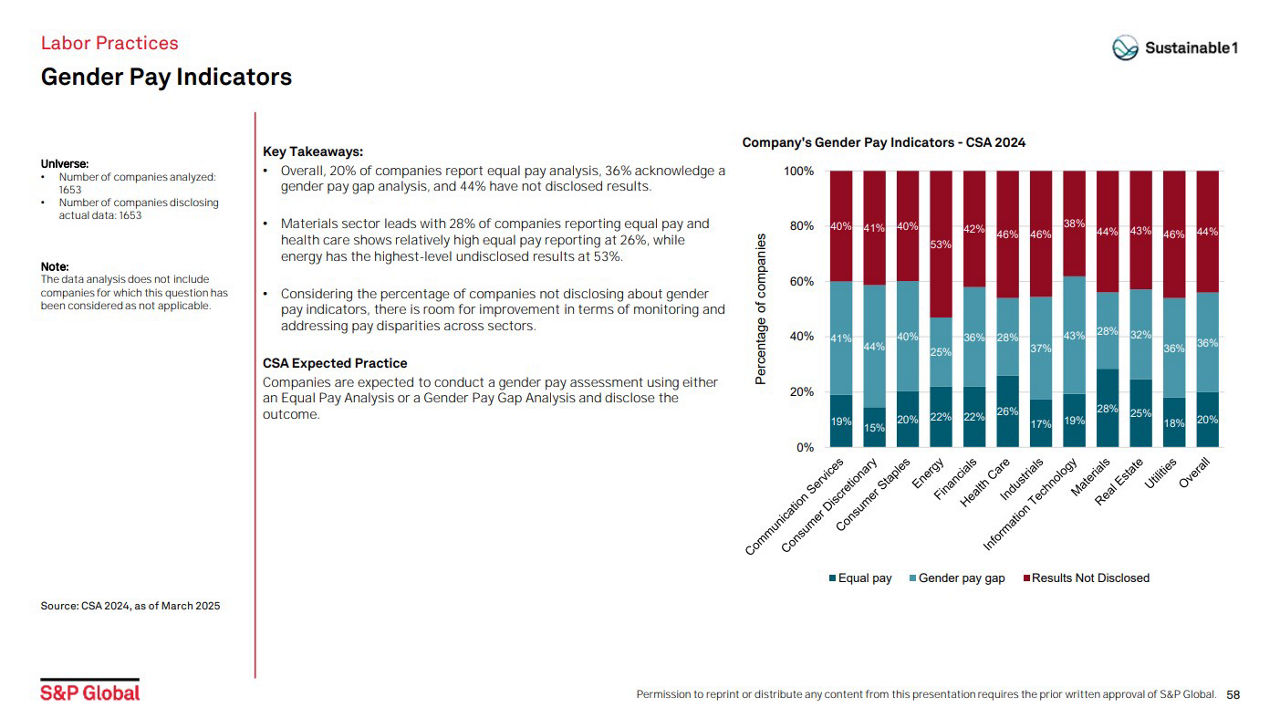
Performance Analysis of Sustainability Disclosure and Human Capital Development
The analysis used the S&P Global Corporate Sustainability Assessment (CSA) framework to evaluate how large-and mid-cap companies in developed markets manage key sustainability-related factors.
It focused on two main areas.
- Transparency and accountability on sustainability-related information: Assessing how companies publicly and comprehensively disclose sustainability-related information.
- Human capital: Examining the progress companies have made to identify and manage risks and opportunities across the supply chain through effective human capital strategies, governance and accountability.
The research covered companies across Japan, Asia-Pacific (excluding Japan), Europe and North America, providing regional benchmarks and insights to help investment decisions.
The analysis produced four key points.
- Regional insights: The analysis offered a detailed breakdown of sustainability-related practices across regions, enabling stakeholders to compare and benchmark performance by geography.
- Human capital: The analysis shed light on to what extent human capital development practices have been evolved as a measure for the integration of human capital strategies with business strategies, which is emphasized in the human capital visualization guidelines that aim to enhance enterprise value and improve risk management capabilities.
- Transparency and accountability on sustainability-related information: The international and Japanese disclosure standards have shown their potentials to increase transparency in ESG indicators, helping to promote sustainable growth and responsible investment practices.
- Governance and accountability: We focused on the effectiveness and accountability of the board composition and risk oversights, which are important governance frameworks in driving sustainable growth.
This analysis informs financial market stakeholders seeking to understand the evolving landscape of sustainability and human capital development. By leveraging the CSA methodology, companies can effectively benchmark their ESG performance and strategically manage sustainability factors to identify improvement areas and align their strategies with best practices.

Business Case and Service Proposition
The report highlights the growing need among financial institutions and corporates for reliable, comparable and material ESG data that is supported by a trusted methodology. Access to transparent, high-quality datasets that provide a clear understanding of the underlying framework is essential to deriving trustworthy and meaningful insights.
To support this, we offer a service package that helps clients analyze ESG data using the S&P Global CSA methodology and data validation approach. This service provides consistent analysis and comparable data that clients can use in their reports or public disclosures.
ESG Data and Analysis Service

Access to CSA Datasets via Capital IQ Pro
- Enables clients to explore relevant ESG datapoints and indicators.

CSA Methodology Brief
- A concise session introducing the CSA framework, data collection approach and scoring principles, aimed at helping clients understand the relevance and application of the methodology in assessing sustainability metrics.

CSA Data Analysis and Observations
- Aggregated analysis of selected ESG datapoints, with descriptive and causality-based comments to interpret key trends and potential relationships.
- Thematic data analysis based on CSA predefined topics.
- Outputs delivered in Excel or PowerPoint presentation format, supporting internal use or integration into sustainability reports.

Debriefing Session
- A discussion to walk clients through the analytical outputs and clarify insights from the results to ensure clear understanding.
- Performance Analysis of Sustainability Disclosure and Human Capital Development
- Performance Analysis of Sustainability Disclosure and Human Capital Development (Appendix GICS Sector Analysis)
- [Case Study] S&P Global Sustainable1 delivered a Universal Owner in Japan with Performance Analysis of Sustainability Disclosure and Human Capital Development