ECONOMICS COMMENTARY — 21 Jul, 2026
Flash PMI surveys to help assess ongoing war impact

This week sees the publication of July ‘flash’ PMI data for the major economies. The data will provide key insights into economic trends as major central banks cite a “data dependency”, eager to see how the changing geopolitical environment has affected growth, inflation, employment and confidence.
Roller coaster ride so far in 2026
July’s surveys follow a roller-coaster first half of 2026 for businesses. A good start to the year for the global economy was knocked off course by the war in the Middle East. However, after an initial lull in March, growth has since edged steadily higher to show encouraging resilience. June’s data also indicated a cooling of inflationary pressures.
However, the June survey period had seen improved news out of the Middle East and an accompanying sharp drop in oil prices. Since then, tensions in the region have reignited, and oil prices have spiked higher again.
Warning signals
Moreover, although output growth has shown resilience in recent months, scratch the surface and we start to see some warning signals.
- Some of this recent expansion looks temporary, reflecting precautionary stock building.
- High prices are meanwhile acting as a major drag on demand globally.
- Supply chain stress is slowing growth in many economies, notably in South East Asia.
- Tellingly, businesses have also lacked the confidence to match higher output with headcounts. Employment has now fallen globally for two successive months.
What to watch
July’s survey data will therefore be eyed to assess the following trends in particular:
- Supply chains and manufacturing: To what extent is precautionary stock building continuing to provide a boost to manufacturing worldwide, and to what extent are supply constraints emanating from the closure of the Strait of Hormuz limiting growth?
- Inflation: After June saw price pressures moderate, will the recent jump in oil prices have fed though to higher costs, and to what degree are these being passed on to selling prices?
- Consumer spending: June’s data showed a revival of demand for consumer services, which had been hardest hit by the war and its associated oil price rise. Now that oil prices are rising again, will we see consumers rein in their spending again?
- US outperformance: The US has outperformed Europe since the outbreak of the war, the latter indicated to have seen flat GDP for both the eurozone and UK in the second quarter. Can this US outperformance last, especially as recent surveys have shown markedly weakened job creation?
- European malaise: Will the return of higher oil prices push Europe into a downturn? How has heightened UK political uncertainty exacerbated existing headwinds?
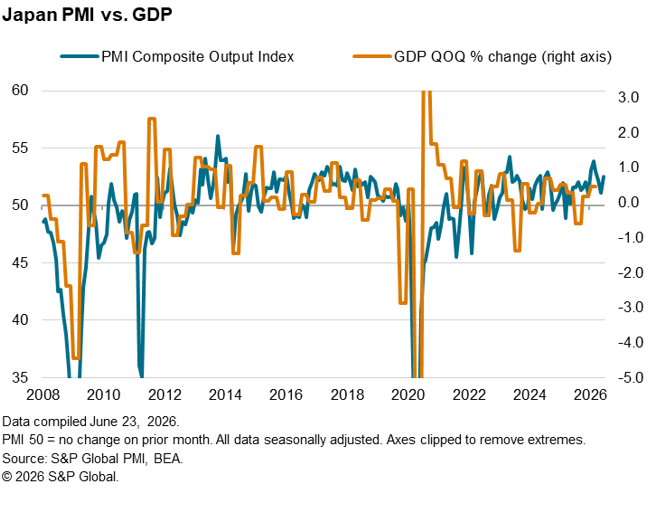
- Weaker yen impact: Japan’s growth has been buoyed by the weaker yen, but while output growth has benefited, inflationary pressures have surged, with June seeing the second-steepest rise in input prices since PMI data were first available in 2007. How has the sustained yen weakness impacted businesses?
- Interest rates: What does all this mean for central bank policy making? We can see a close relationship between the business environment as depicted by the PMIs and historical central bank policy decisions in the US, Europe and Japan, so how will the policy signals change with the updated PMI numbers?
Catching up on last month’s PMIs
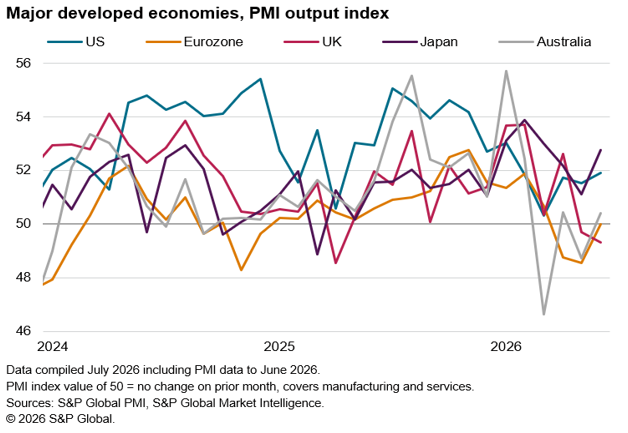
Flash PMIs signal diverging growth trends among the major developed economies
S&P Global’s flash PMI surveys showed business growth accelerating in both the United States and Japan in June while further declines were recorded in Europe.
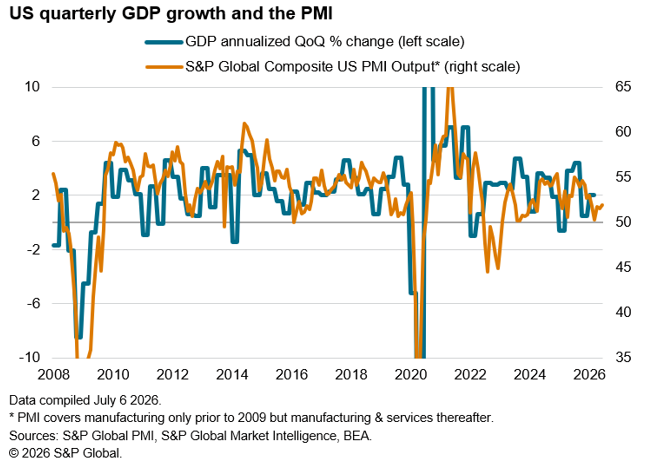
A slight acceleration of growth in the services economy takes the US expansion to the strongest since the outbreak of the war in the Middle East, though the pace of growth remains lacklustre compared to that seen at the start of the year. The survey data are hence broadly indicative of the economy only growing at a 1.2% annualized rate over the second quarter.
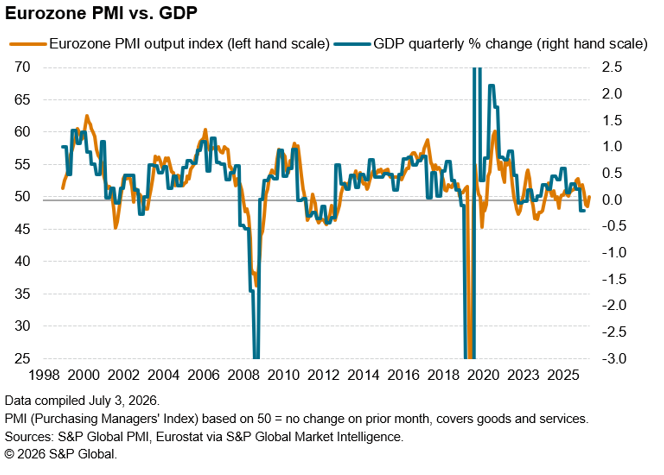
Eurozone flash PMI points to flatlining economy in June but price pressures cool
The eurozone economy is showing enough resilience to just about stay out of recession.
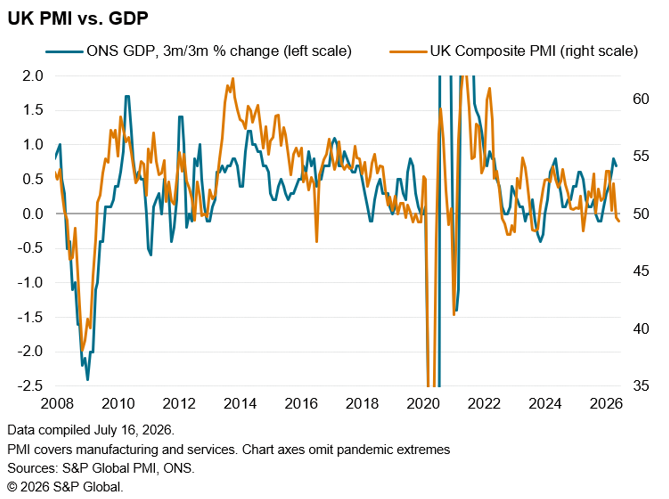
UK flash PMI signals further drop in output during June, but also hints at inflation peak
A disappointing June flash PMI indicates that the economy likely stalled over the second quarter.
Japan flash PMI shows brighter growth picture in June but price pressures run close to survey highs
The S&P Global Flash PMI data showed output growth staging a welcome improvement in Japan during June, rounding off a solid second quarter.
© 2026, S&P Global. All rights reserved. Reproduction in whole or in part without permission is prohibited.
Purchasing Managers' Index™ (PMI®) data are compiled by S&P Global for more than 40 economies worldwide. The monthly data are derived from surveys of senior executives at private sector companies, and are available only via subscription. The PMI dataset features a headline number, which indicates the overall health of an economy, and sub-indices, which provide insights into other key economic drivers such as GDP, inflation, exports, capacity utilization, employment and inventories. The PMI data are used by financial and corporate professionals to better understand where economies and markets are headed, and to uncover opportunities.
Read our latest PMI commentary here.
This article was published by S&P Global Market Intelligence and not by S&P Global Ratings, which is a separately managed division of S&P Global.
Theme
Location
Products & Offerings