
Navigate Critical Minerals Uncertainty with Actionable Intelligence
Gain clarity amid disruptions in the critical minerals market and supply chain with expert insights and robust solutions.
Vault Strategy and the Future of Critical Minerals: Q1-26 Market Outlook
The critical minerals market is entering a new strategic phase. As the U.S. advances Project Vault—a strategic reserve designed to strengthen access to critical minerals and reduce supply chain dependence on concentrated foreign sources—market participants must reassess procurement, pricing, trade relationships, and long-term investment strategy. In this Q1 2026 briefing, S&P Global Market Intelligence explores how evolving policy moves, allied trade coordination, and shifting commodity fundamentals are reshaping the outlook for critical minerals worldwide.
In our Critical Minerals Briefing report, you’ll discover:
- How Project Vault could impact supply security, domestic sourcing, and market trends.
- The effect of new trade deals, including a proposed trade zone, on mineral flows and prices.
- Insights on FORGE and supply chain partnerships building resilient, diverse mineral networks.
- Market outlooks for key commodities amid supply issues, geopolitics, and energy demand.
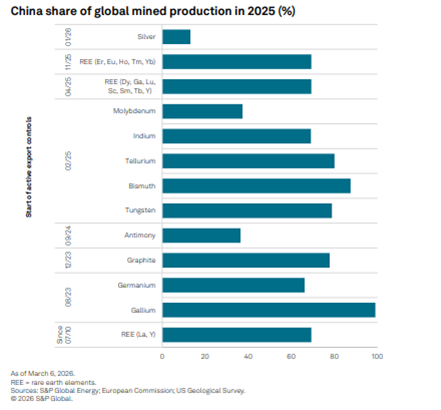
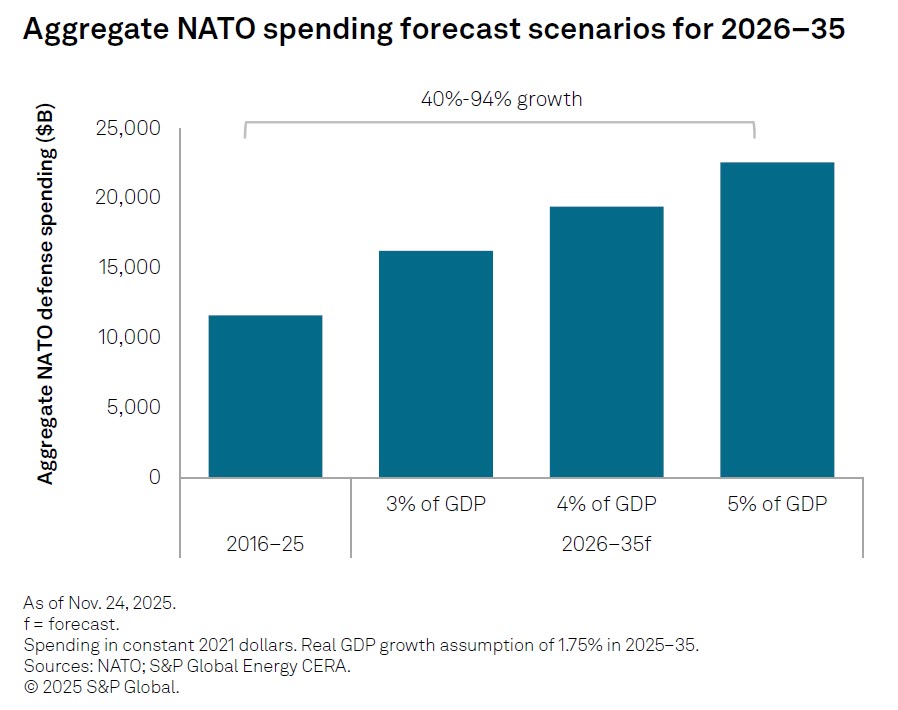
Defense spending is accelerating. Can critical minerals keep up?
NATO member countries have set a goal to increase defense spending to 5% of their GDP by 2035, building on the 2% benchmark established at the 2014 Wales Summit. NATO’s commitment to significantly increase defense spending is reshaping demand for the minerals that underpin advanced military systems — from aerospace alloys and electronics to propulsion, sensors, and energy storage.
In our Critical Minerals Briefing snapshot, you’ll discover:
- How NATO’s defense targets could drive a step‑change in demand for critical minerals through 2035
- The 12 defense‑critical minerals identified by NATO — and why nine face elevated supply risk
- Where supply concentration, export controls, and permitting bottlenecks pose the greatest challenges
- How policy moves, alliances, and new project pipelines are reshaping the global supply outlook
Critical Minerals Key Stats
EVs share of total car sales to reach 40%
According to the IEA, EV sales are expected to surpass 40% of total car sales by 2030, with China leading at around 80%.
China accounts for 63% of REE capacity
China accounts for 63% of the global rare earth elements (REE) mining capacity and 92% of the global refining capacity.
The West to increase global share of lithium supply to 19%
The US, Canada and Europe are expected to significantly increase their share of global lithium supply from only 2.5% in 2025 to a projected 19% of global supply by 2035.
Average of 18.6 years for mines to go into production
Nickel and lithium mines take 18.6 years and 16.7 years respectively from discovery to production.
S&P Capital IQ Pro: Covering critical minerals intelligence from mine to market
Featured Content
Request Follow Up
Discover how we can help you gain clarity from critical minerals disruption with market and supply chain intelligence on critical minerals.