Agriculture, LNG, Chemicals, Maritime & Shipping, Refined Products, Biofuel, Wet Freight, Fuel Oil, Bunker Fuel
December 22, 2025
INTERVIEW: IMO may favor LNG as regulatory delay dampens methanol prospects

By Max Lin
HIGHLIGHTS
US favor LNG as marine fuel in regulatory talks
Net-Zero Framework tussle delays methanol intake: Wah Kwong
Venture Energy focuses on methanol projects for access to China
The International Maritime Organization may favor LNG as a marine fuel in future climate talks, while regulatory uncertainty is delaying the adoption of methanol bunkering, Wah Kwong Maritime Transport Executive Chairman Hing Chao said in a recent interview.
In mid-October, the UN agency's member states voted to delay the adoption of Net-Zero Framework by a year amid fierce US opposition, prompting doubts over the decarbonization regulation's future.
"To have a global framework, that means ... bringing back America into discussion," Chao told Platts, part of S&P Global Energy. "And we know what America wants. They want LNG to be part of the discussion."
LNG can reduce greenhouse gas emissions by 20%-30% compared with conventional, oil-based fuels, and classification society DNV estimates it could become a non-compliant fuel around 2030 under the IMO network's current regulatory design.
The US, the world's No. 1 LNG producer, has said the country opposes the regulation partly because it discourages LNG use while favoring low-carbon fuels whose availability is limited and whose prices are high.
November's average delivered bunker price for very low sulfur fuel oil was $11/Gigajoule in Singapore, compared with $13.89/Gj for LNG, and $47.21/Gj VLSFOe for 100% sustainable methanol, according to the Platts global bunker cost calculator.
Countries supporting the framework, such as EU member states, will need to "bring LNG back into place" while considering more decarbonization solutions like carbon capture technologies in future negotiations, Chao said.
"I think this will probably make other countries feel more comfortable about signing on to the Net-Zero Framework," he said. "Revision, in my view, is probably required."
Methanol demand
The framework was designed to place a cost on maritime greenhouse gas emissions from 2028, and Chao suggested that methanol demand would have much better prospects had it been adopted in October as originally scheduled.
"The halt to the framework sort of exercised a delaying effect on the global demand" for green methanol, which "would definitely have shot up very rapidly" if otherwise, the CEO said.
Methanol -- when generated from renewable hydrogen or biomass -- is a low-carbon fuel with great potential to decarbonize maritime operations, and methanol propulsion is cheaper than LNG, according to its supporters.
Shipbroker Braemar estimated 87 methanol-capable ships were in operation as of Dec. 17, while 302 were on order. In comparison, 477 LNG-capable ships were in operation and 633 on order when LNG carriers -- generally able to run on LNG and conventional fuels -- are included.
Hong Kong-based Wah Kwong has a fleet of 40 owned and chartered tankers and dry bulk carriers, including four 175,000 cu m LNG carriers due to be delivered in 2026-2028. Its ship management arm has experience in managing LNG and methanol bunkering barges.
In June, the private company launched Venture Energy, a subsidiary tasked with the procurement and trading of clean fuels with an initial supply portfolio of 500,000 metric tons/year of low-carbon methanol under memorandums of understanding.
Venture Energy is "fuel agnostic" and could invest in LNG, biofuels or ammonia for supplying shipping companies even though its focus has been on methanol due to its access to China, according to Chao.
"We spent a lot of time looking at the full value chain of green methanol," Chao said. "Because we do believe that if there's any one country that could become an early mover for green methanol, that's China."
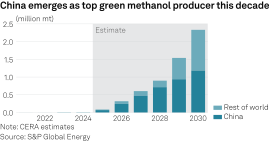
Many industry participants expect China to become a major producer of green fuels due to its low supply chain costs and short construction times. S&P Global Energy CERA expects Chinese eMethanol and biomethanol output to grow from 66,000 mt in 2025 to 1.2 million mt in 2030, sitting atop of the world.
"China has a reliable, widespread and very efficient green grid, and the technology is ready," Chao said. "And there is policy support."
Earlier in December, CIMC Enric Holdings commissioned its 50,000 mt/year biomethanol plant in Zhanjiang -- China's first large-scale plant of its kind. The state-backed energy equipment maker has signed a strategic partnership agreement with Wah Kwong on green methanol bunkering applications.
Venture Energy could make equity investments in green fuel facilities to secure supplies when suitable opportunities arise, but the company will, in general, take "an asset-light approach" as "we are at the very beginning of this journey," Chao said.

Editor: