Maritime & Shipping, Energy Transition, LNG, Refined Products, Agriculture, Carbon, Emissions, Diesel-Gasoil, Fuel Oil, Biofuels
November 20, 2026
IMO faces tough compromise on shipping emissions rules amid US opposition
Editor:
HIGHLIGHTS
Financial compliance mechanism remains main sticking point
Countries propose alternative approaches to bridge divisions
Industry seeks certainty while NGOs warn against weaker rules
The International Maritime Organization faces another difficult round of negotiations over the Net-Zero Framework from late November, with countries seeking a compromise on the contentious carbon pricing mechanism that could determine the pace of shipping's transition to low-carbon fuels.
While industry participants see growing agreement on the framework's technical requirements for marine energy's greenhouse gas emissions intensity, deep divisions remain over how ships should comply with the GHG standards, whether mandatory payments should be imposed for non-compliance, and how any revenues should be distributed.
The UN agency's member states will meet Nov. 23-27 for technical negotiations, followed by the Marine Environment Protection Committee's 85th session on Nov. 30-Dec. 3. An extraordinary session could resume Dec. 4 to consider adopting the framework.
The meetings follow a decision in October 2025 to postpone adoption for a year amid fierce US opposition to what Washington describes as a global carbon tax.
"I think it's very hard to predict [the outcome]," Lloyd's Register CEO Nick Brown told Platts, part of S&P Global Energy. "Most of the concern is around the commercial instrument, because we don't really have any experience of a global carbon tax that is applied across all countries, and how it is collected, and then what happens to the money."
He suggested that governments could initially introduce technical requirements while gradually implementing financial measures.
"Maybe the economic measures could be introduced or phased in or ramped up over time," Brown said.
Countries seek compromise
The framework approved in April 2025 combines progressively tightening GHG intensity thresholds from 2028 with financial penalties for ships failing to meet the requirements.
Under the original proposal, companies could comply by using lower-emission fuels, acquiring surplus units from other ships or purchasing remedial units, with payments directed into an IMO-managed fund.
The US has opposed mandatory payments, arguing that they would increase shipping costs and consumer inflation.
US Federal Maritime Commission Chairman Laura DiBella told Platts Nov. 11 that she expected countries to move toward consensus, although final rules might not be codified until 2027.
"I don't think anything will be codified this year -- maybe 2027 it will be codified. But I think we'll come to some sort of consensus," DiBella said.
Several countries have proposed alternative compliance arrangements.
China has suggested using multipliers to encourage uptake of zero or near-zero emission fuels, while Norway has proposed similar initiatives.
In separate proposals, Japan, Djibouti, Iraq, Jordan, Kuwait, Lebanon, Saudi Arabia, Somalia and Yemen have suggested ships could meet obligations through investments in maritime decarbonization projects rather than mandatory penalties.
Most EU and Pacific Island states continue to support the existing framework, although divisions have emerged within Europe.
Cyprus, Greece, Italy and Malta have called for pragmatic, cost-effective global measures, while Union of Greek Shipowners President Melina Travlos accused the EU of taking an uncompromising position that risked another negotiating deadlock.
"The EU's uncompromising position is steering the IMO process to a new dead end," Travlos said in a Nov. 16 statement, questioning whether Brussels is more interested in preserving revenues generated from its Emissions Trading System for shipping and FuelEU maritime rather than pursuing a global framework.
The European Commission did not respond to emails seeking comment.
Compliance dilemma
Edmund Hughes, the International Bunker Industry Association's representative to the IMO, said the central challenge was establishing a workable compliance mechanism for ships unable to obtain alternative fuels or sufficient surplus units.
"You can't leave that void. It's a void at the moment, and that's where the impasse is ... in the negotiation," Hughes told Platts. "If you have a technical standard, you have to find a way to comply with it."
Hughes said negotiators were attempting to balance environmental ambitions, commercial realities and political demands while preserving a framework acceptable to enough member states.
A coalition of nine shipping associations, including BIMCO, the International Chamber of Shipping, IBIA and INTERTANKO, has urged governments to agree on enforceable global regulations that provide investment certainty and flexible compliance options.
The groups warned that fragmented regional rules could impose overlapping obligations and additional costs on shipping companies.
Separately, a group of shipowners, maritime associations and flag registries has called for an alternative global emissions framework that takes into account the availability and affordability of cleaner fuels, technological readiness and potential impacts on international trade.
The statement, circulated to media by Saudi Arabia's energy ministry, was accompanied by a list of supporters that the ministry said represented approximately 55% of the international merchant fleet. The ministry stressed that the statement was industry-led and did not represent Saudi Arabia's official position.
Environmental organizations, however, have cautioned against diluting the framework.
"The biggest danger at MEPC 85 is no longer delay, but a rushed deal designed to get Trump and his allies to the table," said Alex Springer, deputy director of shipping at Transport & Environment.
Springer warned that concessions favoring fossil LNG and crop-based biofuels could prolong shipping's dependence on fossil fuels.
Clean Shipping Coalition President Lucas Leppert urged countries to adopt the framework before year-end, arguing that further delays would undermine climate action.
Fuel demand implications
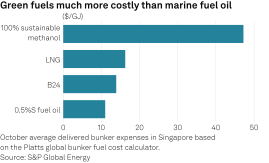
Whether and how IMO member states design the framework's financial elements could affect the uptake of sustainable fuels, which remain more expensive than conventional, oil-based fuels due to limited availability.
October's average delivered bunker costs in Singapore were $22.78/gigajoule for 0.5%-sulfur fuel oil, compared with $27/GJ for B24 biofuel blends, $28.48/GJ for LNG and $48.47/GJ for 100% sustainable methanol, according to the Platts global bunker cost calculator.
"No shipping company is going to carry on buying more expensive fuel while their competitors are not," Hughes said. "You need some way of closing that price gap."
S&P Global Energy's October 2026 Global Alternative Bunker Fuels Long-Term Outlook forecasts conventional fuel oil and gasoil's share of bunker energy demand declining from 85% in 2030 to 26% by 2060, with shipping companies shifting to alternative fuels.
"The market is likely to follow the most cost-effective pathway, resulting in a bias towards LNG-fuelled ships," according to the outlook. "If conditions are right, parts of this fleet could migrate to ammonia fuel later in the forecast."