Maritime & Shipping, Crude Oil, Wet Freight
November 03, 2026
Tanker fleet growth threatens freight boom, bullish secondhand markets: analysts

By Max Lin
Editor:
HIGHLIGHTS
Fleet capacity surges 23% through 2029
Supply growth risks eroding record rates
Market uncertainty amid geopolitical conflicts
A wave of tanker deliveries is set to test whether geopolitical disruption and longer trading routes can continue supporting charter rates and ship values, according to S&P Global Energy CERA's latest fleet outlook, after an extraordinary freight market rally pushed some secondhand ship values above newbuilding order prices.
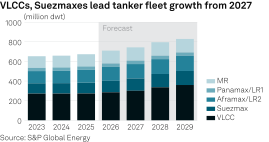
Taking newbuild order books and scrapping into account, CERA analysts forecast global tanker capacity will rise from 703.72 million deadweight tons at the end of 2025 to 743.56 million dwt in 2026, 778.35 million dwt in 2027 and 830.61 million dwt in 2028, before reaching 862.98 million dwt in 2029. That would represent cumulative growth of 22.6% over four years.
"The tanker market is entering a transition from scarcity-led strength to a period in which demand must work much harder to absorb supply," according to the fleet outlook published on Oct. 28. "The critical issue is not whether supply will grow, it clearly will, but whether ton-mile demand, scrapping, sanctions-related inefficiencies and operational segmentation can absorb that growth without a material decline in utilization and freight rates."
Record rates
Tanker rates across segments have risen to record levels following the outbreak of the US-Iran war at the end of February, boosted by increased ship requirements as Asian importers seek barrels from farther afield and Middle Eastern producers rely on ship-to-ship transfers to mitigate transit risks around the Strait of Hormuz.
Platts, part of S&P Global Energy, assessed the its Global Dirty Tanker Index for non-scrubber-fitted, non-eco tonnage at $840,921.58/day on Nov. 2, compared with $161,876.1/d on Feb. 27, increasing more than 400%. Meanwhile, the Platts Global Clean Tanker Index for non-scrubber-fitted, non-eco tonnage has risen to $143,454.09/d from $38,131.69/d over the same period, increasing more than 275%.
The inefficiencies "cannot be assumed to expand indefinitely," CERA analysts said, while adding that normalizing geopolitical trade patterns, easing sanctions or the return of restricted ships to mainstream employment could increase effective supply more rapidly than the headline fleet figures indicate.
Newbuild deliveries
The order book comprised 1,494 tankers totaling 184.10 million dwt at the end of September, equivalent to 18.3% of the fleet by ship count but 25.1% by carrying capacity, according to CERA data. Very Large Crude Carriers and Suezmaxes accounted for about 70.5% of ordered capacity.
VLCC capacity is forecast to increase 31.5% from 273.31 million dwt in 2025 to 359.28 million dwt in 2029, while Suezmax capacity is projected to expand 30.6% to 143.13 million dwt, the data shows. Product tanker deliveries are more front-loaded, with Aframax/Long Range 2 and Medium Range growth expected to moderate after 2026-2027.
"The more challenging period is 2028-29, when VLCC and Suezmax deliveries become exceptionally large," CERA analysts said.
The freight boom has transformed tanker asset markets. CERA estimated a five-year-old VLCC at $185 million, up 57.4% over nine months and around $40 million above a newbuilding order price of $145 million.
The analysts described the VLCC market as displaying "one of the clearest inverted asset-value structures in modern shipping history," as ships in operation can capture record earnings immediately.
Ship values
XClusiv Shipbrokers assessed October newbuilding prices at $131.5 million for a VLCC, $90.5 million for a Suezmax, $78 million for an Aframax and $52.5 million for an MR2, 4%, 5%, 8% and 8% higher year on year, respectively. Its secondhand estimates showed sharper increases, including a 10-year-old VLCC at $186 million, up 117% year on year, and a 15-year-old VLCC at $160.4 million, up 178%.
The market was characterized by "selective investment rather than uniform buying appetite," the Greek brokerage said in a Nov. 2 note. The brokerage recorded 371 tankers offered for sale during September-October against 146 transactions, with VLCCs and Suezmaxes representing 34% of completed deals but less than 8% of offers.
The figures suggested buying was "disproportionately concentrated in larger tankers," potentially reflecting stronger earnings expectations and confidence in crude transportation, while the availability of older tonnage highlighted owners' willingness to "capitalize on current asset values," according to XClusiv Shipbrokers.
Veson Nautical similarly said five-year-old tanker values were 32% higher on average than in January, with VLCCs up 70% to $196.3 million, according to a Nov. 3 report. With values above pre-2008 highs and "low visibility on future chartering markets," Veson expected ordering to "calm."
The analytics firm's outlook indicates that tanker values will decline over the forecast period, particularly in the VLCC and Suezmax segments, as deliveries accumulate. But Veson expects full restoration of Middle East oil flows to remain unlikely before at least mid-2027, potentially prolonging the inefficiencies supporting near-term earnings and values.
