Crude Oil, Refined Products, Maritime & Shipping, Fuel Oil, Wet Freight
October 08, 2026
Appetite for US crude oil exports climbs despite high freight

By Binish Azhar
Editor:
HIGHLIGHTS
South Korea tops US crude destinations at 568,600 b/d
VLCC rates to Asia double, closing arbitrage window
European refining margins widen gap over Singapore
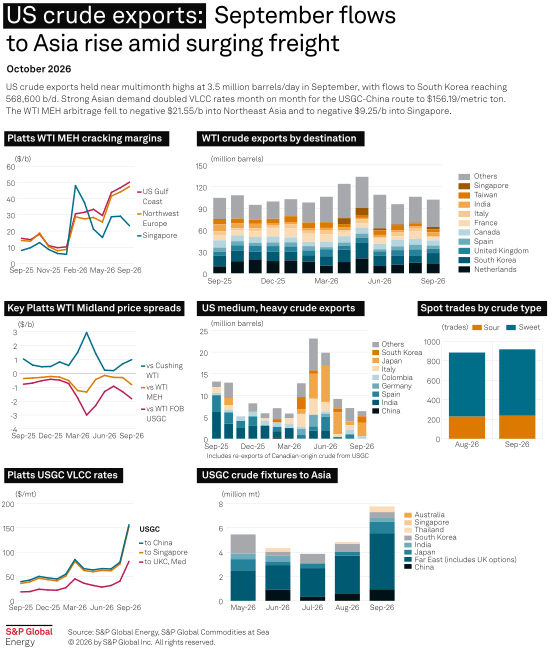
US crude exports remained elevated at 3.5 million b/d in September, edging up from 3.4 million b/d in August, according to S&P Global Commodities at Sea data, but well below the May peak of 4.4 million b/d. South Korea was the largest single destination at 568,600 b/d, followed by the Netherlands at 459,000 b/d, with Japan, France, Canada and the UK also among the top receivers.
Volumes into Asia climbed across the region, including Northeast Asia, where US exports rose from 793,000 b/d in August to 1.1 million b/d. Exports into Southeast Asia climbed from 292,000 b/d to 528,000 b/d, while volumes into the Indian subcontinent climbed from 68,000 b/d to 220,000 b/d over the same period.
Asian volumes in September largely reflect cargoes fixed before VLCC freight on USGC-Asia routes roughly doubled. The Hormuz disruption initially drove Asian refiners toward US crude as an alternative supply source, but its knock-on effect on tanker markets has since eroded the economics of those trade flows.
Fixtures to Asia, including some UKC options, climbed to 7.8 million metric tons in September compared to 4.8 million in August.
Surging tanker rates have effectively closed the spot eastbound arbitrage for US crude exports to Asia. Arbitrage calculations favor WTI Midland barrels going to Northwest Europe, where refining margins have strengthened and the freight burden remains comparatively manageable.
The arbitrage for WTI MEH into Rotterdam was $19.99/b as of Oct. 8, while the equivalent incentive into Singapore had fallen to minus $17.01/b and into Northeast Asia at minus $19.77/b, according to S&P Global Energy CERA.
VLCC rates on the USGC-China route surged from an average of $79.21/mt in August to a $156.19/mt average in September, while the USGC-Singapore route averages rose from $75.51/mt to $152.49/mt over the same period, according to Platts assessments.
The USGC-UK Continent and Mediterranean route also roughly doubled, climbing from $40.26/mt to $80.82/mt. While the percentage increases were broadly similar across all three routes, approximately 97% to 102%, the economic impact is far more severe on Asian voyages because of the greater distance involved, higher bunker consumption and the longer period a vessel is tied up in transit.
South Korean and Japanese refiners, in particular, may continue to lift WTI cargoes under term supply arrangements or for crude diversification, regardless of whether the prompt spot arbitrage is open.
The Netherlands' 459,000 b/d intake is consistent with the strongly positive Rotterdam arbitrage and reflects the country's dual role as both a refining center and a transshipment hub for the broader Northwest European market.
With the WTI MEH-versus-Forties incentive at $14.72/b, Europe is the economic clearing destination for incremental US barrels, and transatlantic flows are likely to remain supported even after the climb in freight costs.
Asia vs Europe
The result is a widening of the refining economics gap between the Atlantic Basin and Asia. Platts WTI MEH cracking margins into Northwest Europe climbed from $44.13/b in August to $47.47/b in September, and into the US Gulf Coast from $46.75/b to $50.12/b, according to CERA.
By contrast, the equivalent margin into Singapore fell from $29.13/b to $23.09/b over the same period.
All three margins remain dramatically stronger than February levels, when Singapore was at just $5.60/b, NWE at $8.62/b and the USGC at $10.21/b.
Midland's discount to WTI MEH, the Houston-area coastal marker that most directly captures export optionality, widened from $0.30/b to $0.82/b, while its discount to WTI FOB USGC increased from $1.33/b to $1.83/b.
WTI Midland's premium to Cushing WTI widened from $0.68/b in August to $0.98/b in September.
The pattern shows that coastal, export-ready barrels attracted a growing premium over inland crude, reflecting competition between domestic refiners and Atlantic Basin exporters for Gulf Coast supply.
