Natural Gas, Electric Power, Maritime & Shipping, Crude Oil, Refined Products
September 18, 2026
US energy companies need more than OFAC nod to enter Venezuela: panelists
By Binish Azhar and Ashok Dutta
Editor:
HIGHLIGHTS
Banks hesitate to finance Venezuela deals
Multiple licenses required beyond OFAC
Venezuela targets 10 million b/d oil production
US energy companies eyeing Venezuela's vast oil reserves face a more complex reentry assessment than field economics alone can answer, with every prospective trade, service contract or investment required to clear an evolving US sanctions framework before a single barrel moves or a dollar is financed, observers of the situation say.
The central challenge, as attorneys and tax experts noted during a Sept. 17 panel discussion at the Venezuela Reawakening conference in Houston, is the incongruence between legal authorizations issued by the US Office of Foreign Assets Control (OFAC) and financial viability.
A transaction may be technically permitted under a US Treasury general license, yet remain commercially impossible if a bank refuses to process the payment, an insurer declines to cover the voyage or a vessel's ownership history triggers a sanctions screening failure, the panelists said.
Miguel Rivero Betancourt, senior partner at LEĜA Law Abogados, a corporate law and tax consulting firm based in Caracas, said the divide between legal authorization and financial acceptance is already shaping how companies approach Venezuela.
"There is a real reluctance on the part of the banks to rely on general licenses — they really want to see something formally approved by OFAC before they're comfortable financing," Rivero said during a panel discussion. "If you're looking at anything pertaining to the formation of a joint venture or investment, most likely you're going to go the specific licensing route."
For service transactions, the picture is improving, Rivero said.
"The banks are getting more comfortable with the applicability of a general license for that," he said.
The distinction matters financially because it divides the market into different pools of capital: a company able to operate under a general license may move more quickly, while one requiring specific approval must price regulatory delay and denial risk into its valuation.
Pathways for reentry
Paul Luther, a Washington-based partner who leads Houston-based international law firm Baker Botts' international trade practice, outlined the principal licensing pathways available to companies.
The first US regulatory pathway Luther described is what he called the "trader's license," which targets the disposition of product post-production.
"This is what we typically call the trader's license because, really, what it's saying is it's allowing you to lift and market products of Venezuelan origin," he said.
A trader's license covers lifting, export, re-export, sales and storage, but imposes a specific requirement that the principal party be an established US entity — defined as any entity organized under US law on or before Jan. 29, 2025.
On the question of who must qualify as an established US entity, Rivero said OFAC guidance has clarified the scope of the requirement.
"The good news is OFAC has said that the established US entity reference refers to anybody engaging in the principal activities under that general license — so if you're responsible for lifting, export, re-export, sales and supply, you need to be an established US entity," Rivero said. "But the guidance says that if you're a non-US person, you can participate in those associated services, so long as you're ensuring that whatever activities you're undertaking are not involving somebody who is blocked."
The requirement is therefore activity-specific, Rivero said.
A second US pathway covers the sale and supply of equipment and products for oil and natural gas exploration, development and production, as well as electricity generation, transmission, storage and distribution. Luther said this authorization has grown broader over time, extending to associated payments, logistics, chartering and insurance.
Unlike the trader's license, it does not require the party to be an established US entity. Critically, Luther said, this license does not authorize new investment.
A third pathway offered by the US, under General License 49A, allows companies to enter into contingent agreements for investment in Venezuela's oil, gas, petrochemical or electricity industries, including through joint-venture formation, but implementation requires a subsequent specific license from OFAC.
Chevron only US major in Venezuela
According to S&P Global Energy CERA analysts, joint-venture projects are leading production growth in Venezuela, specifically output in NABEP's Petrozamora joint venture and Chevron Corp.'s Petroboscan JV. Production gains will be supported by Repsol SA's Petroquiriquire SA and Maurel & Prom's PetroRegional del Lago SA in the coming months, the analysts said.
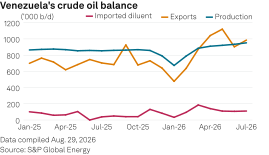
Increased short-term activity will also come from Chevron, the only US major in Venezuela, either from its newly acquired Ayacucho 8 Block or its PetroIndependencia JV.
Luther also highlighted a more recently issued general license allowing established US entities to enter into contracts that would otherwise be prohibited by executive orders that effectively sanctioned the Venezuelan government.
Luther warned that OFAC authorization does not cover every regulatory requirement relevant to exporting equipment.
"OFAC doesn't technically regulate exports — they make authorization available for you to export, but that export also has to be compliant with regulations administered by the Bureau of Industry and Security within the Commerce Department," he said.
The financing and regulatory barriers will ultimately determine whether Venezuela's reserve potential translates into production reality.
Venezuela's potential
"The pace of dealmaking is clearly picking up but the main thing I'd watch now is how quickly these announcements turn into actual spending and activity on the ground," Radhika Bansal, senior vice president of Norwegian energy consultant Rystad told Platts, part of S&P Global Energy, on Sept. 18. "Venezuela still needs a lot more rigs, crews, oilfield-service capacity and infrastructure."
Bansal warned that announced capacity and operational reality in Venezuela remain two different measures, saying rig mobilization and actual production growth — rather than deal announcements — are the more reliable indicators of whether the new contracting framework is gaining traction.
Contract durability, including fiscal terms, tenure and the consistent application of rules, will also be key to sustaining investor confidence, she said.
And Roberto Smith Perera, minister of transportation and communications under former Venezuelan President Carlos Andrés Pérez, who preceded the Bolivian socialist regimes of Hugo Chavez and Nicolas Maduro, said output ambitions extend well beyond the 3 million b/d figure most analysts cite.
"I think that's conservative — Venezuela will produce 10 million b/d," Smith Perera said at the Sept. 17 conference, pointing to the US shale expansion as a model, where mid-size independents rather than majors drove the bulk of growth. "The majors only produce 3 million b/d of the 10 million today. So there's a myriad of companies, mid-size companies."
Smith Perera cited Continental Resources founder Harold Hamm's recent decision to sign a deal in Venezuela's Orinoco Belt as an early signal that independent operators are moving ahead of the majors — precisely the dynamic, lawyers at the conference said, that general licenses were designed to enable, provided banks are willing to follow.
Orinoco crude is largely blended with imported diluent or imported light crude to produce export grades. Approximately 92% of Venezuela's crude exports in 2025 originated in the Orinoco Belt, according to CERA data.
"Just across the Caribbean there's 300 billion barrels sitting," he said. "We are strategic for the survival of the US."
