Maritime & Shipping, Crude Oil, Refined Products, Dry Freight, Wet Freight, Fuel Oil
September 17, 2026
VLCCs avoid Red Sea strait as Houthi threats boost rates amid rising shipping risks
Editor:
HIGHLIGHTS
VLCCs, Suezmaxes avoid Bab al-Mandab
Higher general risks for other ships as collateral damage
Saudi crude reroutes via the longer Cape route
Large tankers have steered away from the Bab al-Mandab Strait amid intensifying Houthi military advances and attacks on Saudi energy infrastructure, supporting oil shipping rates while other types of commercial ships show more willingness to tolerate Red Sea transit risks.
Earlier this month, the militant group's troops moved southward into the coastal city of Mokha while claiming Perim Island in the strategic waterway, while attacking the East-West pipeline amid an escalation of its conflicts with Saudi Arabia.
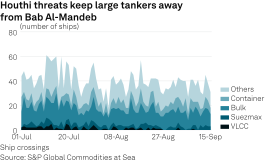
S&P Global Commodities at Sea data shows no Very Large Crude Carriers have transited the strait since Sept. 9 after three crossings earlier this week, compared with 24 for the whole of August, and 63 for July.
"Mokha and Perim provide the Houthis with their most advantageous position on Bab el-Mandab in years," said Scarlett Suarez, risk consultancy Dryad Global's senior intelligence analyst.
"The current assessment suggests a significant risk to Saudi-associated tankers and cargoes, [and] an increased likelihood of targeted strikes at the choke point," Suarez told Platts, part of S&P Global Energy.
The development came after the Houthis declared a naval blockade on ships sailing to and from Saudi ports July 20 before attacking several tankers operated by Bahri, the Saudi state carrier.
Maritime traffic via the Bab al-Mandab in other sectors has not decreased as much as for oil tankers, with CAS data showing the seven-day average of dry bulk ship crossings at 12.7 Sept. 15, compared with 17.4 July 20, and container ship crossings at 5.9, compared with 6.
Tanker executives said Red Sea diversions have been a key driver of bullish tanker markets, with VLCCs transporting more oil from the Mediterranean and the Atlantic to Asia, boosting ton-mile demand.
"Trades are moving around, and we have to move our ships around to manage what the customers need," Pankaj Khanna, CEO of Heidmar Maritime Holdings Corp., said at an industry conference Sept. 15.
Platts' Global VLCC Index for non-scrubber, no-eco ships reached $970,635/day Sept. 16, a historic high, up from $519,041/d Sept. 1, and $283,635/d July 20.
Heightened risks
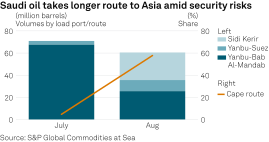
With disruptions at Bab al-Mandeb, Saudi Arabia has been shipping more crude from Yanbu to Asian consumers via the Suez Canal, either by direct shipments or by transshipment through the SUMED pipeline, loading at the Mediterranean port of Sidi Kerir in Egypt.
Such shipments, which would take the Cape of Good Hope route and add at least three weeks to voyage time compared with Bab al-Mandab, made up 58% of Saudi-Asia flows in August compared with 5% in July, according to CAS. The estimates do not account for Saudi exports via the contested Strait of Hormuz.
Looking forward, S&P Global Market Intelligence Head of Middle East & North Africa Country Risk Jack Kennedy said the Houthis could erode "the resilience of Saudi Arabia's Red Sea export route at a strategically important moment."
"The main near-term enhancement would be in surveillance and seizure capability, rather than an immediate step-change in uncrewed surface vessel attack," Kennedy added.
"Even sporadic attacks, seizures, drone or missile launches, and credible threats could raise insurance costs, delay cargoes, complicate chartering, and encourage rerouting around the Cape of Good Hope."
The Houthis said in a Sept. 10 statement that Red Sea shipping "is safe," aside from Saudi-linked ships. But the analysts said general maritime risks have increased due to a history of misidentification and retaliation by Saudi-backed forces, leading to more crossfires.
"Houthi access to the waterway is greater, and the political temperature is higher," Suarez said. "The practical danger in a widening campaign is less a comprehensive embargo than being the vessel that happens to be in the wrong stretch of water."