Maritime & Shipping, Natural Gas, LNG, Wet Freight
September 14, 2026
LNG bunker price rally amplifies freight gains for LNG-fuelled clean tankers
By Palkin Sharma and Mannat Dora
Editor:
HIGHLIGHTS
AG-Japan LNG-equivalent freight up 33%
Aliaga-Genoa LNG-equivalent freight rises 15%
Rising LNG bunker prices pushed LNG-fueled clean tanker freight rates above conventional rates Sept. 7-11, highlighting the bunker-price sensitivity that alternative-fueled ships face.
Platts LNG-fueled Clean tanker freight represents the estimated cost of transporting cargo on a tanker using LNG as primary fuel, with the freight calculation reflecting prevailing LNG bunker prices. As LNG bunker prices change, the fuel cost of operating the ship changes, directly affecting voyage economics.
During Sept. 7-11, a sharp rise in LNG bunker prices coincided with higher Worldscale assessments across several clean tanker routes, pushing LNG-equivalent freight materially above conventional rates. The analysis uses an LNG-equivalent freight measure, a normalized calculation that applies the prevailing Worldscale level to the LNG-fueled vessel's daily freight component, rather than a separate market assessment.
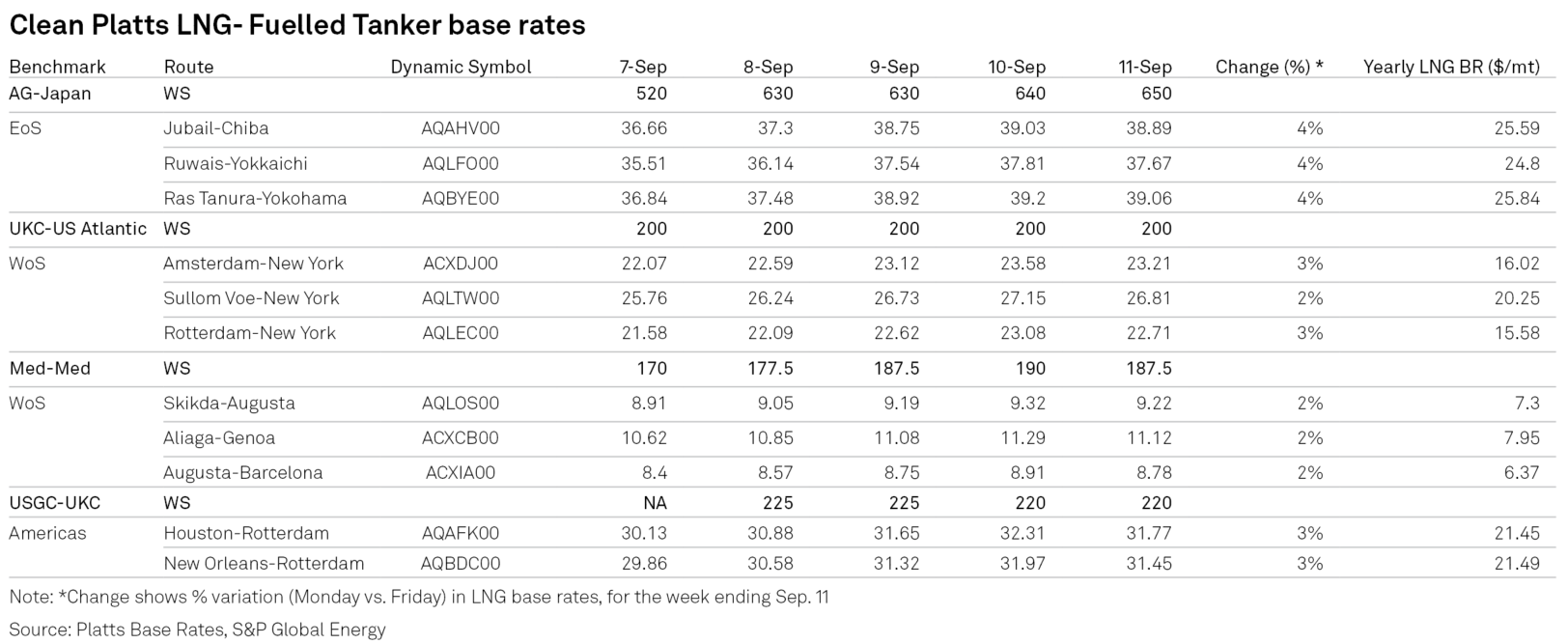
The divergence was most pronounced on Persian Gulf-Japan routes, including Jubail-Chiba, Ruwais-Yokkaichi, and Ras Tanura-Yokohama, where LNG-equivalent freight rose about 33%, compared to 25% increase recorded in conventional freight.
The daily LNG-fuelled Platts LNG Base Rates (PBR) by S&P Global Energy on the Jubail-Chiba route rose from $36.66/metric ton on Sept. 7 to $38.89/mt on Sept. 11. Over the same period, the applicable Worldscale daily assessment increased from w520 to w650.
East of Suez VLCC freight continued to firm Sept. 7, underpinned by a tightening tonnage list in the Gulf of Oman and prompt fixing requirements. Firmer Atlantic rates further strengthened owners' sentiment, with market participants expecting further upward pressure.
Sources attributed the latest gains to limited prompt tonnage rather than immediate concerns over the Strait of Hormuz. However, escalating Persian Gulf tensions and the potential emergence of additional cargo demand could provide further upside to freight rates.
Outside the AG-Japan corridor, the analysis found notable changes in freight costs on the Med-Med benchmark route, with LNG-equivalent tanker rates up 15% to $20.85/mt on Sept.11 on the Aliaga-Genoa route.
LNG bunker prices rose sharply during the week. Singapore bunker prices rose from $1,410/mt on Sept. 7 to $1,537/mt on Sept. 11. Rotterdam LNG bunker prices were up from $1,403/mt on Sept. 7 to $1,561/mt on Sept. 10 before easing to $1,522/mt on Sept 11.
Rotterdam's LNG bunker price rose for a fifth consecutive week, following a stronger front-month Dutch TTF natural gas contract, according to Platts bunker insights. Singapore's LNG bunker price increased less than Rotterdam's, reducing its premium over Rotterdam.
The contrast illustrates an important difference between the two freight measures. Conventional freight scales primarily capture the underlying tanker freight market, whereas LNG-fuelled freight also carries direct exposure to bunker-price movements. For owners and charterers evaluating alternative-fueled tonnage, that added sensitivity can materially change voyage economics even when the underlying tanker market moves less dramatically.