LNG, Maritime & Shipping, Refined Products, Natural Gas, Wet Freight, Fuel Oil
September 07, 2026
Bunker price volatility boosts freight rates for LNG-fueled dirty tankers
By Mannat Dora and Palkin Sharma
Editor:
HIGHLIGHTS
WAF-UKC LNG equivalent freight posted strongest increase of nearly 35%
Atlantic Basin dirty tanker routes largely unchanged despite higher Worldscale
Bunker price volatility was the key driver behind higher LNG-fueled dirty tanker freight rates, compared with conventional tanker freight values, Aug. 31-Sept. 4, across benchmark routes.
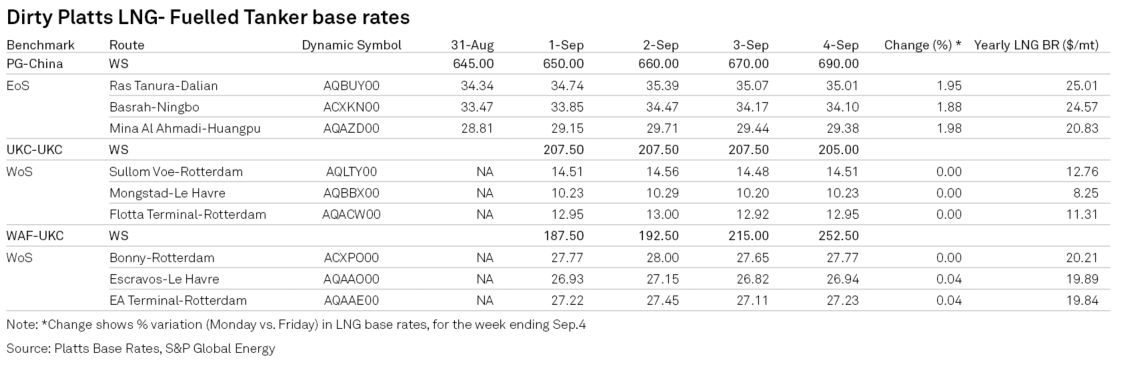
Platts Base Rates for LNG-fueled tankers reflect such freight costs in $/mt and provide a measure of how LNG bunker economics affect voyage costs relative to conventional tanker markets.
Platts Base Rates from S&P Global Energy tracked the dirty tanker benchmark routes of Persian Gulf-China, UK Continent-UK Continent and West Africa-UK Continent through three basket routes for the week ended Sept. 4.
LNG-fueled dirty tanker freight represents the estimated cost of transporting cargo on a tanker using LNG as its primary fuel, with the freight calculation reflecting prevailing LNG bunker prices. As LNG bunker prices change, the fuel cost associated with operating the ship changes, directly affecting the freight economics of the voyage.
Among the Persian Gulf-China basket routes, Basrah-Ningbo recorded notable increase in LNG base rates, rising to $34.10/metric ton by Sept. 4 from $33.47/mt on Aug. 31. Combined with a higher Worldscale point from WS645 on Aug. 31 to WS690 on Sept. 4. The LNG-equivalent freight value increased substantially over the week to $235.29/mt from nearly $215.88, an increase of about 9%. Compare LNG-fueled tanker economics with conventional tanker freight, this uses an LNG-equivalent freight metric. It is not a separate market assessment, but a normalized calculation that applies the prevailing Worldscale level to the LNG-fueled vessel's daily freight component.
For example, on Sept. 2, the Ras Tanura-Dalian calculation is: $35.39/mt × 660/100 = approximately $233.57/mt.
This implies a 70% spread between LNG-equivalent vs conventional freight costs as conventional freight on Sept. 2 stood at $137.21/mt on the above route.
WAF-UKC trades recorded the sharpest increase in LNG-equivalent freight during the week.
The daily LNG-equivalent freight at the Bonny-Rotterdam route increased from $52.06/mt on Sept. 1 to $70.12/mt on Sept. 4, a nearly 35% rise in comparison with the conventional freight increase of 8.71%.
The LNG freight equivalent versus conventional freight spread on Sept. 4 stood at 63%, marking the widest spread across the basket routes in the assessed period.
The move came against a backdrop of sharply higher LNG bunker prices during the week. Singapore LNG bunker prices rose significantly, increasing by around $62/mt to $1,399/mt on Sept. 2 from $1,337/mt on Aug. 31, before easing to $1,377/mt on Sept. 4. Rotterdam LNG bunker prices were subsequently quoted at around $1,402/mt on Sept. 2 before easing to $1,383/mt on Sept. 4. The increase was linked to stronger Dutch TTF gas prices and heightened geopolitical tensions in the Middle East.
The analysis provides a transparent measure of the freight impact of LNG bunker economics relative to conventional fuels, helping market participants evaluate vessel selection, voyage economics and the competitiveness of dual-fuel tonnage across key dirty tanker trades.
The relationship highlights the differing drivers behind the two freight indicators. Conventional freight value reflects underlying tanker supply-demand fundamentals, while LNG-equivalent freight additionally incorporates bunker-price exposure.
By comparing daily Platts LNG Base Rates with prevailing Worldscale points, the analysis illustrates how changes in LNG bunker prices can influence voyage economics and the relative competitiveness of alternative-fueled tonnage.
For charterers and shipowners, the findings suggest LNG bunker-adjusted dirty tanker freight economics were mixed in the week ended Sept. 4, with Middle East-to-China routes strengthening markedly while Atlantic Basin routes remained largely stable.