Crude Oil, Maritime & Shipping, Refined Products, Wet Freight
August 13, 2026
Russian shadow fleet premiums widen amid Black Sea risk, Baltic cargo constraints

Editor:
HIGHLIGHTS
Black Sea Suezmax premiums rise on risk
Baltic clean cargo visibility remains limited
Shadow fleet spreads widen amid disruption
Russian implied shadow-fleet freight spreads widened in early August as buyers and owners increasingly tested which voyages were executable and which stems were actually placeable, according to multiple market sources, analysts and S&P Global Commodities at Sea data.
Black Sea dirty tanker routes carried the clearest risk premium, with Suezmax owners seeking higher compensation for disruption and clearance uncertainty. For clean tankers, refinery disruption made Medium Range tanker employment more sensitive to whether Baltic cargoes could be worked and stem placement could be secured.
The result was a more uneven market, with Black Sea strength persisting while Baltic clean pricing tightened back toward neutral.
Black Sea dirty tanker TCEs rise
Black Sea dirty tanker owners pushed for markedly higher returns for Suezmax voyages into West Coast India. Market participants said the issue was increasingly about whether tonnage could be persuaded to enter the trade and complete the voyage.
"Nobody wants to go in Black Sea now, so it's case by case, as it's not easy to assess," one shipbroker said. Another broker described both the Baltic and Black Sea as "dangerous now," while an analyst pointed to continued disruption linked to the Russia-Ukraine conflict.
The Suezmax Novorossiysk-Vadinar time charter equivalent rose from $262,073.34/day on Aug. 3 to $438,660.78/day on Aug. 7, then held at $438,420.42/day on Aug. 11, CAS data showed.
The move suggested the Black Sea Suezmax premium functioned as an execution fee, compensating owners for delays, refusals, disruption and clearance risk.
Baltic crude values were steadier but still reflected cautious fixing. The Aframax Ust-Luga-Sikka TCE eased from $98,484.95/day on Aug. 3 to $86,489.10/day on Aug. 4, before stabilizing at $88,069.74/day from Aug. 5-7 and dipping slightly to $87,809.87/day on Aug. 11, CAS data showed.
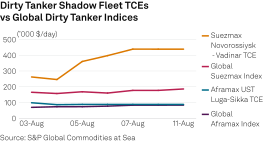
The steadier Baltic TCE showed Russian crude still had workable outlets, but less confidence and fewer flat-rate fixtures, with earnings assessed cargo by cargo.
Black Sea Suezmax premium lifts dirty tanker spreads
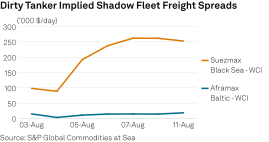
The same split appeared in implied shadow fleet freight spreads. The spread between the Global Suezmax Index and Suezmax Black Sea-West Coast India jumped from $98,165.36/day on Aug. 3 to $261,772.28/day on Aug. 7, held at $261,531.92/day on Aug. 10, and eased to $252,488.29/day on Aug. 11.
The Global Suezmax Index also strengthened, rising from $165,048.92/day on Aug. 3 to $185,932.13/day on Aug. 11, but the larger Black Sea move pointed to a route-specific premium.
The Aframax Baltic-West Coast India spread was more stable. It increased from $14,835.69/day on Aug. 3 to $18,450.79/day by Aug. 11. Baltic spreads were narrower than the Black Sea, against the average dirty tanker.
Clean Tanker MR TCEs stable
Medium Range clean tankers carrying Russian refined product cargoes were steady to slightly firmer.
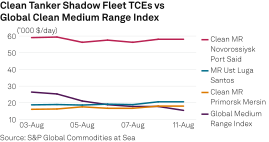
The Primorsk-Mersin TCE rose from $16,077.01/day on Aug. 3 to $16,687.27/day on Aug. 7 and $17,988.55/day on Aug. 11. The Ust-Luga- Santos TCE moved from $18,740.31/day on Aug. 3 to $18,889.36/day on Aug. 7 and $20,573.12/day on Aug. 11.
In absolute terms, Black Sea route remained the firmer pocket. The Novorossiysk–Port Said TCE stood at $59,047.76/day on Aug. 3, dipped to $56,236.93/day on Aug. 7, and recovered to $58,069.78/day on Aug. 11.
Clean MR spreads widen
MR clean tanker spreads widened, largely driven by a weaker global MR index rather than a sharp rise in Russian-linked clean freight direction.
The Global MR Index fell from $26,404.08/day on Aug. 3 to $17,770.02/day on Aug. 7 and $15,429.63/day on Aug. 11, according to CAS data. As that benchmark declined, tankers carrying Russian-origin cargoes looked stronger by comparison, even where route earnings rose modestly.
The implied Baltic-Mediterranean spread improved from minus $10,327.07/day on Aug. 3 to minus $1,082.75/day on Aug. 7, before turning positive at $2,558.92/day on Aug. 11. The Baltic-East Coast South America spread moved from minus $7,663.77/day on Aug. 3 to $1,119.34/day on Aug. 7 and $5,143.49/day on Aug. 11.
The Black Sea premium remained much wider. The Black Sea-Mediterranean spread rose from $31,274.82/day on Aug. 3 to $38,466.91/day on Aug. 7 and $42,640.15/day on Aug. 11, CAS data showed.
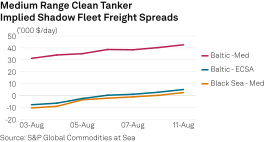
The wider spreads did not eliminate the underlying imbalance. Baltic clean cargo visibility stayed limited as refinery disruption reduced stem availability.
"There's no Russian cargoes anymore," one broker said. "Maybe on dark fleet. I never see those cargoes anymore."
