Refined Products, Crude Oil, Gasoline, Diesel-Gasoil
August 05, 2026
China's real oil demand masked by rise of unlicensed fuel trade: sources
HIGHLIGHTS
Unlicensed fuel sales obscure consumption drop
Apparent oil demand in Q2 falls 12% amid Middle East war
Independent refiners' stocks decline sharply
Chinese oil demand figures derived from official data may underestimateactual consumption, as a resurgence in unlicensed fuel sales since the start of the Middle East war has diverted diesel and gasoline volumes away from monitored retail channels, according to five analysts, six traders and four transport operators.
Beijing does not publish actual oil consumption figures, so the market relies on "apparent demand," calculated as official refinery throughput plus net imports of refined products. According to official data, China's total apparent oil demand in the second quarter of 2026 fell 12% year over year to 153.47 million metric tons.
Overall, Chinese oil demand has contracted sharply in the face of the Middle East disruptions, with refiners drawing down inventories, suffering weak refining margins, and ongoing restrictions on refined product exports. In June, crude imports fell to a near-decade low of 7.15 million barrels/day, and refinery throughput slid to a near four-year low of 12.52 million b/d, according to state statistical data, down 38% and 15%, respectively, year over year.
China's gasoline demand peaked in 2024 and has been in structural decline since then, according to S&P Global Energy CERA estimates, primarily due to one of the world's fastest electric vehicle adoption curves. But recent pump price rises have accelerated this trend. In June, land transportation fuel sales at the retail outlets of Sinopec and PetroChina fell by as much as 20% year over year following fuel price increases triggered by the Middle East war, analysts at the two state-run oil companies told Platts, part of S&P Global Energy.
Sinopec, which owns the biggest product sales network in China, saw its domestic oil product sales slump 18.9% year over year to 35.58 million mt in April-June, it said in a first-half 2026 operating update.
But China's actual end-use oil demand likely did not fall by that magnitude, even given the rapid adoption of new energy vehicles, according to analysts.
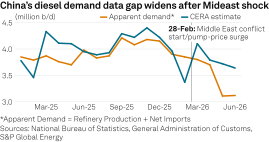
S&P Global Energy CERA estimated that the underlying demand for gasoil in the second quarter declined by about 8.2% year over year. In comparison, China's apparent gasoil demand — calculated from official refinery output and net imports — fell 13.7% year over year to 3.3 million b/d in the quarter.
A London-based oil analyst said he estimates China's actual gasoline and diesel production at around 200,000 b/d above official figures, potentially reflecting off-record fuel volumes supplied by the undocumented value chain.
China's gasoline output in the second quarter slumped 9.9% year over year to 3.12 million b/d, while diesel production dropped 14.2% to 3.37 million b/d, according to data from the National Bureau of Statistics.
Unlicensed sales
With the Middle East conflict keeping oil prices elevated, some private wholesalers are using unauthorized tanker vehicles to supply discounted diesel and gasoline directly to commercial vehicles and construction equipment, bypassing monitored pumps at retail stations and avoiding tax scrutiny, according to trading sources.
The unlicensed fuel sales, made mainly via unauthorized "mobile refueling vehicles," are not captured in official statistics and are obscuring China's official data showing falling gasoline and diesel consumption, multiple domestic wholesalers told Platts.
The fuel sold this way is usually 1-2 yuan/liter cheaper than at regular service stations, and without invoices for reimbursement, according to four operators with vehicle leasing and truck fleet companies.
Chinese officials have cracked down on such sales in the past, but oil product traders and truck fleet owners said the recent rise in pump prices has revived the activity.
A Shanghai-based oil analyst with an investment bank said many diesel-powered truck fleets are buying fuel from the unlicensed market, adding, "It is difficult to quantify how many fleets rely on these channels and how much fuel they consume nationwide."
Usually supplied by independent refineries to fuel wholesalers, about a third of diesel sold by private wholesalers and retailers was supplied via unauthorized mobile refueling vehicles in the first half of 2025, according to three domestic traders.
Inventory countdown
In September 2025, China's Ministry of Commerce implemented a new regulation prohibiting wholesalers from supplying refined oil products directly to end users, including motor vehicles, vessels, and machinery. Retailers are also required to obtain approval before engaging in such transactions.
The Ministry of Commerce did not respond to a query from Platts on whether it acknowledges or estimates the size of unlicensed fuel sales in the market, nor did the National Bureau of Statistics, which oversees China's refining throughput and product output data.
The current surge in unlicensed markets may prove self-limiting, however, with potential knock-on effects for China's crude buying appetite and global prices, according to CERA analysts and the two market analysts in Shanghai and London.
The independent refineries feeding the unlicensed market are concentrated in Shandong province and are the main buyers of sanctioned Iranian and Russian crude, according to five transportation fuel traders in Shandong and Guangdong.
Commercial and refinery crude stocks in the province, covering both state-owned and independent tanks, dropped to about 274.84 million barrels in July from 294.96 million barrels in April, according to Kpler shipping data.
"Unauthorized supplies rely on the crude inventories available to the independent producers," the Shanghai-based analyst said. "As their crude imports decline and they burn through stocks during the war, such supplies will not be sustained."
CERA analysts said an eventual reduction in unofficial fuel volumes would cut two ways: replacing the lost barrels would require fresh crude purchases, adding to upward pressure on prices, but pulling discounted fuel out of the market would also lift pump prices for end-users, denting consumption and partially offsetting the need for incremental compliant imports.
That demand destruction offset would grow if renewed disruption to flows through the Strait of Hormuz pushed crude, and therefore fuel, prices higher still, the CERA analysts said.
