Refined Products, Maritime & Shipping, Fuel Oil, Bunker Fuel, Wet Freight, Dry Freight
July 22, 2026 · Updated July 23, 2026
INTERVIEW: High bunker prices drive decarbonization amid Hormuz crisis

By Max Lin
Editor:
HIGHLIGHTS
High bunker prices spur efficiency gains
Green fuel costs block decarbonization shift
Sea Cargo Charter loses six key signatories
High bunker prices are driving decarbonization efforts during the Hormuz shipping crisis this year, according to Sea Cargo Charter Chair James Lewis, as shipping companies seek to improve energy efficiency to reduce costs.
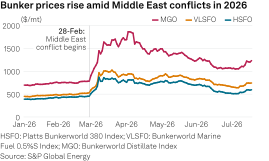
Iran has seized control of the Strait of Hormuz since its war with the US broke out in end-February, limiting maritime traffic via the choke point -- which handles 20% of the world's oil and LNG seaborne flows -- to 10% of normal levels aside from a brief spike in June.
The development has led to significantly lower oil supplies from the Persian Gulf, resulting in more expensive conventional bunker fuels, and ships stranded at Middle Eastern ports or taking longer routes to serve global energy trades.
"Ships stuck in the Gulf is not good for emissions [reduction]," Lewis told Platts, part of S&P Global Energy, in a recent interview, adding, "Disruption like this is a challenge for emissions."
"But on the other hand, the very high bunker prices have seen vessels slowing down even more. So that has been a positive," Lewis said.
Platts' Bunkerworld Marine Fuel 0.5%S Index, a market indicator for the most common bunker type, rose from $527.76 per metric ton on Feb. 27 to $1,022.18/mt on March 19 before easing back to $758.53/mt July 21, still a historically high level.
Lewis, who is also global head of operations at Cargill Ocean Transportation, the trading house's shipping unit, said ship operators have been seeking gains in energy efficiency to mitigate the impact of high bunker costs.
"Burning less fuel is commercially the right thing to do, and it's the right thing to do in terms of CO2," the executive said.
Aside from slow steaming, less in-port and ballast time, speed optimization, and better routing according to weather conditions could also help reduce bunker consumption as the Middle East war redraws the global trade map, according to Lewis.
Green fuels
In May, Lewis was appointed as chair of Sea Cargo Charter, whose signatories, including Cargill, handle 14% of global seaborne wet and dry bulk trades.
Launched by ship charterers and operators in October 2020, the Sea Cargo Charter has aimed to enhance the integrity and transparency of shipping emissions data by requiring its signatories to disclose their greenhouse gas emissions annually based on a common framework.
The companies' performances were benchmarked against the International Maritime Organization's targets to reduce lifecycle GHG from international shipping by at least 20% by 2030, 70% by 2040, compared with 2008 levels before reaching net zero close to 2050.
Despite efforts to enhance energy efficiency, Lewis expects the signatories to face greater difficulty going forward in meeting the UN shipping agency's goals unless they can shift to low-carbon fuels in droves.
"One thing that is very important is that the commercial realities are still what drive our members' actions," said Lewis, adding that low-carbon marine energy is still too costly.
The average delivered bunker price in June for 0.5% sulfur fuel oil in Singapore was $17.63 per gigajoule, compared with $49/Gj or 100% sustainable methanol, according to the Platts bunker cost calculator, which estimates fuel expenses based on Platts assessments.
"The price has been too high, and the difficulty is finding [freight] customers today to pay that premium is proving pretty elusive," Lewis said, adding, "People are not going to run loss-making businesses and just invest in fuels that don't make sense."
IMO member states have been seeking to finalize the Net-Zero Framework, originally designed to place a cost on maritime GHG from 2028. However, its adoption has been delayed due to strong opposition from the US since Donald Trump's return to the White House in January 2025.
"Talk about the step change, that's not happening today. We need regulatory support on that, I believe," Lewis said, referring to a low-carbon bunker transition of the shipping industry.
At its peak, 37 companies committed to the Sea Cargo Charter. However, the number of signatories currently stands at 31 as Shell, Chevron, Maersk Tankers, and three other companies have withdrawn in the past year.
"Decarbonization has taken a little bit more of a backseat in some companies more than others," amid the changing geopolitical environment, Lewis said. "It's been a difficult period over the last year, but we're hoping for more stability."
Lewis hopes more companies can join the industry initiative, managed by nonprofit Global Maritime Forum, saying collaboration can help promote maritime decarbonization.
"The more members we have, the more collaboration, the more sharing of data, the more transparency in the industry, I think the better," he added.
When contacted, Shell said it remains committed to helping the shipping industry achieve net-zero emissions by 2050. Chevron said in a statement to Platts that the company would still lower the carbon intensity of its operations and "advance a lower-carbon future." Maersk Tankers did not respond to requests for comment.
