Crude Oil, Maritime & Shipping, Wet Freight
July 18, 2025
EU sanctions to drive G7 tankers out from Russia, benefit shadow fleet
By Max Lin and Kelly Norways
HIGHLIGHTS
Greek operators expected to leave OPEC+ member for now
Share of G7 tankers in Russia at 19-month high in June
Oil flow disruptions, high tanker rates expected in short run
The EU's new sanctions package is set to drive Western tanker operators out from Russian trade while giving shadow fleet operators opportunities to charge higher freight rates temporarily, according to industry participants, even as its long-term impact on the OPEC+ member's seaborne flows is doubtful.
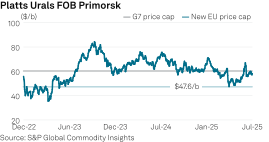
Following weeks of negotiations, the bloc's member states on July 18 agreed to lower the price cap on seaborne Russian crude exports to $47.60/b from $60/b while blacklisting more than 100 ships for their circumvention of sanction rules, among other measures.
"This will make it a lot harder for Western operators" to trade in Russia, Gibson Shipbrokers' research director, Richard Matthews, told Platts, part of S&P Global Energy. "You will see a lot of shadow fleet vessels moving in."
Brussels had previously teamed up with G7 countries to ban maritime service companies to transport Russian crude unless the barrels were sold for under the $60/b threshold since December 2022, with a dual goal of undermining Moscow's war chest against Ukraine while maintaining oil supplies to global markets.
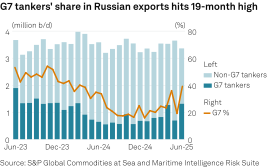
The unilateral change came after G7-linked tankers lifted over 39% of Russia's 3.36 million b/d crude exports in June, the highest since the end of 2023, according to S&P Global Commodities at Sea and Maritime Intelligence Risk Suite data.
The data shows tanker operators in Greece, Europe's top shipowning nation, were responsible for lifting 24.5 million barrels of Russian crude in June, the highest since August 2023.
"Greek operators obviously will need to care about EU sanctions, because Greece is part of the EU," Matthews said.
Platts' assessment of Urals, Russia's flagship crude export grade, has been below $60/b since late February, aside from some brief spikes. This suggests the ships could operate in the restricted market.
Shadow fleet
Without the G7 shipping capacity, analysts expect Russia to turn to shadow fleet operators to fill the gap, relying on their aged tankers devoted to shipping sanctioned oil.
The EU blacklisted 105 such ships in their latest sanctions package, bringing the total number of blacklisted vessels to 444. It also sanctioned the captain of a shadow fleet ship, as well as a private operator of an international flag registry, for the first time.
Past experiences suggest Western sanctions could disrupt Russia's oil flows and push up tanker rates for transporting Russian barrels in the short run. Brokers said the freight deals for shipping crude from the Black Sea to the western coast of India were mostly done at between $5 million and $6.5 million on a lump-sum basis in June.
But S&P Global Energy analyst Nikesh Shukla said the sanctions "will not make much difference" eventually.
"The buyers will be there, the vessels will be there ... the sellers and buyers are capable of creating provision for insurance as well if required," Shukla said. "A temporary dip could be there [before the relevant parties] find a workaround, but the imports won't stop."
Compliance landscape
The EU said it would introduce "an automatic and dynamic mechanism" to modify the oil price cap based on market prices, which will set the cap at 15% below the average market price for Urals from Sept. 3, subject to review every six months.
Brussels also will ban the imports of refined products made from Russian crude but didn't provide details on how, or whether its price cap regime with G7 on Russian petroleum products would be revised from the current thresholds -- $45/b for discounted products and $100/b for premium products.
In comments to the Russian news agency Tass, Kremlin spokesperson Dmitry Peskov said that Russia has "acquired a certain immunity to sanctions" but denounced new measures as illegal and anti-Russian.
EU sanctions enforcement could often fail to pressure Russian oil exports or prices, with its impact mainly on Western companies rather those in India and China, the top Russian crude importer, according to some industry participants.
The UK, which tends to work in tandem with Brussels in sanctioning Russian oil, also announced it was making the same reduction in the price cap for Russian crude.
However, it noted there was no change to the parallel price cap on oil products such as diesel, gasoline and fuel oil. US President Donald Trump has yet to agree to new sanctions on Russia since his return to the While House in January, but he recently suggested he might pressure Russia more due to the lack of progress in peace talks.
Without a united front by G7, Western tanker operators could need to meet different price cap requirements in various jurisdictions and that would be "a compliance headache," Matthews said.

Editor: