Crude Oil, Maritime & Shipping, Wet Freight
July 10, 2025
Russian crude exports on G7 tankers hit 19-month high in June

By Max Lin
HIGHLIGHTS
Greek operators take pole position in restricted market
Urals below G7 price cap aside from brief spikes in recent months
Limpet mines could threaten tanker owners more than sanctions
Russia lifted the share of its seaborne crude exports on tankers using G7 services last month to the highest since the end of 2023, boosted by the return of Greek operators who displayed growing confidence in navigating Western sanctions schemes.
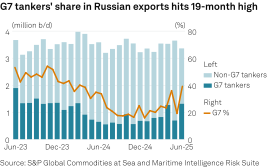
Over 39% of the OPEC+ member's 3.36 million b/d in June were loaded by tankers flagged, owned or operated by companies based in the G7, the EU, Australia, Switzerland or Norway, or insured by Western protection and indemnity clubs, S&P Global Commodities at Sea and Maritime Intelligence Risk Suite data shows.
The proportion was the highest monthly reading since November 2023 and far above 19% in May, though not too far from 36.9% in April.
"The main reason [for more G7 tanker shipments] is the price of Urals has dropped below the price cap" in general over the past few months, Gibson Shipbrokers' research director, Richard Matthews, told Platts.
Based on Platts assessment of FOB Primorsk cargoes with 10-25 days of forward loading, the price of Russia's flagship crude export grade has been below $60/b since late-February aside from some brief spikes, of which the most notable one occurred during the 12-day Israel-Iran conflict last month.
G7 countries and their allies allow maritime services firms to transport Russian crude to other countries when the barrels are sold for no more than the threshold, and recent attempts by the UK and EU to lower the cap, potentially to $45/b, have so far failed to yield any fruit due to a lack of US support.
Some market participants said some G7 firms steered away from Russia last month due to large sanction enforcement, but Matthews suggested overall "fears of breaching sanctions" were easing as Western authorities mainly targeted shadow fleet operators rather than mainstream shipping companies.
Greek tanker firms
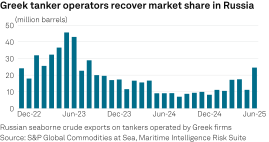
CAS and MIRS data suggests tanker operators in Greece, Europe's top shipowning nation, were responsible for lifting 24.5 million barrels of Russian crude in June, up from 11.1 million barrels in May and the highest since August 2023.
Those were generally Suezmax and Aframax shipments of Urals from the Black Sea and Baltic to India or Turkey at a time when security situations in the Persian Gulf were in flux due to the earlier conflicts. Brokers said the freight deals for shipping crude from the Black Sea to the western coast of India were mostly done at between $5 million and $6.5 million on a lump-sum basis last month.
June was the first time Greek operators took the pole position in the restricted market since February 2024, but their peers in China, the UAE, Seychelles and Hong Kong still retained large market shares in June without exposure to G7 services.
The non-G7 fleet, mainly composed of shadow tankers transporting sanctioned oil, has come under increasing scrutiny by various Western authorities even though the US has stayed on the sidelines since US President Donald Trump returned to the White House in January.
The UK blacklisted 20 oil tankers in the shadow fleet last month to undermine Moscow's war chest against Ukraine, having sanctioned 128 ships in two rounds of similar enforcement actions in May.
Having added 189 tankers to its sanctions list in May, the EU has faced difficulties in agreeing on the 18th package of sanctions against Russia due to opposition from Hungary and Slovakia.
Assuming Ural prices stay below the cap, mainstream tanker owners would be more worried about safety issues than sanctions when trading in Russia, according to Matthews.
So far this year, six tankers with a trading history in Russia have been hit by unexplained explosions possibly caused by limpet mines even though no significant damage and casualties were reported. Security officials have urged shipowners to stay on alert when trading in the country at war with Ukraine.
"Owners could be cautious" when taking those business opportunities, Matthews said.

Editor: