Crude Oil, Maritime & Shipping, Chemicals, Wet Freight
June 18, 2025
Number of Persian Gulf-bound oil tankers at multi-year low amid mounting maritime risks

By Max Lin
HIGHLIGHTS
Daily average number of tankers in ballast to Gulf falls sharply
Oil flows remain normal but could come down later
Shipowners face GPS jamming and hike freight rates
Shipping companies have become less keen to send their tankers to lift oil and chemical products from the Persian Gulf, with heightened operational risks amid electronic interference following the escalation of Iran-Israel military conflicts, according to industry data and participants.
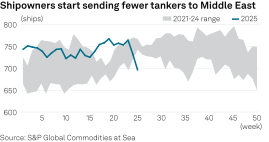
S&P Global Commodities at Sea data shows the daily average number of unladen tankers destined for the eight Middle Eastern countries in the Gulf with oil export facilities, including Saudi Arabia, has averaged 712 so far in the week beginning June 15, the lowest since at least 2021 when adjusted for seasonality.
The weekly reading showed a significant fall from 739 on June 8-14 and 761 on June 1-7, before Israel began its latest round of airstrikes on Iran and drew retaliation in their worst direct military conflicts in recent history.
"The conflict levels seem to be escalating, causing concerns in the shipowner community," said Jakob Larsen, chief safety officer at BIMCO, the world's largest shipowner association by direct membership.
"We are now seeing a modest drop in the number of ships sailing through the area... It appears that most shipowners currently choose to proceed, while some seem to stay away."
When tensions have flared in recent decades, Iran has often threatened to close the Strait of Hormuz, a chokepoint supporting over 30% of global seaborne oil flows.
The Islamic republic has suggested it would target ships linked to Israel and its allies, and Larsen said Iranian forces are highly skilled in asymmetric warfare and have prepared for a scenario like this.
"If pressure on Iran continues to mount, for example if the US got more directly involved, Iran might expand their threats to also take aim at ships without links to Israel," Larsen added.
GPS interference
Maritime authorities, including the Joint Maritime Information Center, have reported more electronic interference in Hormuz and Gulf waters that have jammed ships' satellite navigation systems and affected navigational safety.
On June 17, Frontline's VLCC the Front Eagle collided with an alleged shadow fleet tanker, the Suezmax Adalynn, amid electronic interference in an incident that the shipowner suggested was not directly related to regional conflicts.
"Vessels should be prepared to navigate using alternative means, such as radar and visual fixes, due to reported GPS and gyro compass disruptions caused by electronic interference," consultancy Dryad Global's senior analyst, Scarlett Suarez, told Platts.
Underscoring safety issues, QatarEnergy has asked LNG and chemical tankers to wait outside of Hormuz before the day of loading. Data from Kpler indicated seven LNG carriers showed unusual behavior near the 167-km waterway.
Market implications
While Iran has yet to actually arrest or attack ships in current conflicts, like it occasionally did in the past, tanker operators and marine insurers have started to add risk premiums when offering their services to oil companies.
"In previous times of unique regional sensitivity, Iran has demonstrated both an intent and capability to disrupt commercial shipping activities within the Persian Gulf and Gulf of Oman," said Munro Anderson, the head of operations at marine war risk and insurance specialist Vessel Protect, part of Pen Underwriting.
"The current conflict and associated risk profile must be contextualized against previous Iranian activity," Anderson said.
Platts assessed the benchmark VLCC rate for the Persian Gulf-China trade at $15.26/mt on June 18, off from the recent peak of $15.82/mt June 17 but still much higher than $9.95/mt June 12, the day before Israel began its attacks.
Until June 13, the additional risk war premium for tankers was around 0.05% of the hull and machinery value for a seven-day transit through the Persian Gulf, but market participants said the rate could be hiked to 0.1%, 0.15% or even 0.5%.
With fewer empty sailings to the Gulf area, Ben Hoff, head of commodity research at Societe Generale, suggested future oil flows could slow down from normal levels if freight and insurance rates continue to rise.
CAS data showed total oil and chemical transits averaged 18.3 million b/d on June 1-16, not far from the nearly 19 million b/d in the first five months of this year.
"Marginal" barrels would stop flowing when insurance and tanker rates "go through the roof," and all Iran really needs to do is threaten safe passage through Hormuz, according to Hoff.
Initial CAS data suggests Iran's oil and condensate exports could fall to 1 million b/d in June from 1.6 million b/d last month, but the figures could be revised upward later as ships in the sanctioned trade tend to cover their tracks in the days following loadings before they are revealed.
Hoff said whether Iranian exports could face long-term disruptions depends on its nuclear negotiations with the US, whose sanctions could "easily" take 800,000 b/d off the market.
"On the other hand, if we end up in a situation where there's some form of negotiated deal at the end of this" conflict, Iran could even hike its exports by another 500,000 b/d, Hoff said. "It's a really binary question... we're going to have to just see where things come out over the coming days."

Editor: