Refined Products, Chemicals, NGLs, LPG, Olefins, Polymers
December 26, 2025
COMMODITIES 2026: China's US propane imports may not recover despite new PDH capacity
HIGHLIGHTS
China prefers supplies from the Middle East and Canada
Weak property market limits propane consumption
Wanhua Chemical’s retrofit project at Yantai dents demand
This is part of the COMMODITIES 2026 series, where our reporters bring you key themes that will drive commodities markets in 2026.
Chinese imports of US propane are not expected to rebound significantly in 2026, following a decline in 2025 due to trade tensions between the two countries, even as new propane dehydrogenation facilities in China are ready to be commissioned, according to Chinese trade sources and analysts.
Weak margins in China's chemical sector, Wanhua Chemical's conversion of a plant to ethane feedstock, and a shift toward Middle Eastern and Canadian LPG supplies -- driven by retaliatory tariffs -- are expected to limit inflows from the US, traders and analysts say.
"It is very unlikely that even in the coming months, US discharges in China will breach the 1 million metric ton mark," S&P Global Commodities at Sea analysts wrote in a Dec. 18 report.
Beijing imposed a 34% retaliatory tariff on US propane starting April 10, 2025, which was subsequently increased to 125% on April 12, before being reduced to 10% effective May 14.
US propane arrivals fell to 295,525 mt in June, the lowest level since March 2020, according to China's General Administration of Customs. November arrivals reached 879,663 mt, but remained well below the 2024 monthly average of 1.44 million mt.
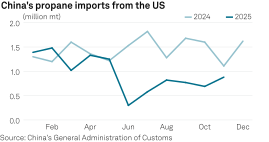
The US propane market share in China dropped to 31.4% over July-November from 60.6% during the same period a year earlier, according to the GAC, with chemical plants in southern China almost entirely relying on imports from the Middle East to avoid tariffs and benefit from shorter voyages.
The Middle East's share of China's propane imports rose 14 percentage points year over year to 45.9% over July-November, while Canadian imports surged from zero to 1.13 million mt, capturing a 17.6% market share, GAC data showed.
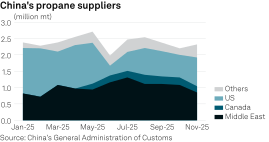
"Only those [plants] in North and East China occasionally take US cargoes, which may otherwise find outlets in South Korea or Japan," a trader with a South China-based PDH plant said.
A long-term supply agreement between East China-based Wanhua Chemical and Kuwait Petroleum Corp., signed in April, is expected to further reduce reliance on US imports, traders say.
PDH challenges
PDH plants are the primary consumers of propane, followed by mixed-feedstock crackers and the cooking sector.
S&P Global Energy CERA estimates that China's propane demand from PDH plants will reach 19.96 million mt in 2025, with almost all of these plants dependent on imports. The country imported 26.16 million mt of propane in the first 11 months of the year, according to GAC. This suggests that the PDH plants accounted for about 70% of the imports.
However, utilization rates at existing PDH plants in China averaged just 69.52% over July-November, down from 70.03% a year earlier, according to JLC.
"Even without tariffs, PDH plants struggle to break even and merely run for cash flow. Once the cash flow dries up, a plant will be shut," said the trader with a South China-based PDH plant.
Three PDH plant sources noted that a slower Chinese property market in 2025 has weighed on demand for chemical materials, including propylene's downstream products.
"Both the property and infrastructure sectors declined at a faster pace this year, with new home construction falling 20.5% year over year and infrastructure investment down 9.7% year over year in November," a Beijing-based policy observer said, speaking on condition of anonymity.
The observer said the government has signaled only moderate support measures for the economy in 2026, rather than strong stimulus, which could keep the property market subdued.
Additional new PDH units "may further limit operating rates due to a cautious outlook for the olefins market," said Anmol Bhushan, associate director, S&P Global Energy CERA.
New capacity
Despite at least three new PDH plants along the coast -- SP Chemical's 800,000 mt/y plant, Sinopec's 600,000 mt/y Zhenhai facility and Yuanjin New Material's 750,000 mt/y plant -- prepared to come online with a combined propane demand of 1.9 million mt/y, industry sources and analysts expect little growth in China's imported propane consumption in 2026.
SP Chemical and Yuanjin New Material may delay the startups until PDH operations become profitable, according to sources with knowledge of the matter.
Sinopec's new PDH project at its flagship Zhenhai Petrochemical facility will utilize integrated technology. This project will rely on propane produced from the plant's crude distillation unit, rather than imports, according to a company source.
Meanwhile, Wanhua Chemical has said that its retrofit project at Yantai will convert the No. 1 dual-feed (ethane/propane) cracker to run exclusively on ethane, with the cracker's ethylene capacity expected to increase to 1.2 million mt/y from 1 million mt/y previously. A Singapore-based trader said this could eliminate up to 2.17 million mt of propane demand from the market and more than offset the impact of the new capacity.
Traders said a bearish outlook has also led to reduced procurement through term contracts, as some PDH plants could meet most of their propane requirements for 2026 via the spot market.
"More supplies [than demand] will cause prices to trend lower. I do not think it correlates to whether you have more or less term volume," said an LPG trader based in Singapore.

Editor: