Refined Products, Crude Oil, NGLs, LNG, LPG
May 12, 2025
US-China tariff cuts likely to revive trade, boost China's oil demand
HIGHLIGHTS
US ethane exempted from tariff: source
PDH plants receive relief from deep losses
Tariffs remain too high, stopping US LNG, crude inflows: sources
China will slash additional tariffs on US energy products by 91 percentage points, effective May 14, following the first round of trade talks with the US, according to a joint statement released by the two countries May 12, potentially reviving some trade flows between the world's two top economies.
Meanwhile, China will suspend 24 percentage points over the next 90 days starting May 14, the statement showed.
After the reductions, US propane and butane imports will attract 10% additional tariffs for 90 days, while US crude and LNG will incur 20% and 25% tariffs, respectively.
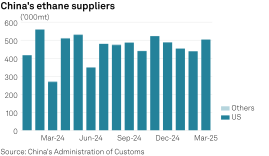
Ethane imports from the US have been exempted from tariffs. Sources with ethane-ethylene plants told Platts on May 12 that the government confirmed the exemption.
China imposes a 1% duty on ethane, propane, and butane imports from overseas, while the additional tariffs on US goods are on top of that.
The country's private ethane-ethylene plants rely entirely on US ethane as feedstock. Sources said the exemption allows these plants to continue operations.
Relief for PDH plants
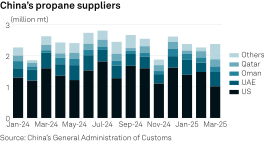
The tariff cuts relieve China's propane dehydrogenation plants, which have struggled with deep losses, according to chemical producers. They added that they will closely monitor the market and price movements to determine if they can break even with the tariff reductions. US propane holds more than 58% of the market share in China's imports of the product.
"It's likely that some plants will postpone their plans of shutting down after the tariff cut," said an analyst.
These PDH plants have faced cracking losses since the second half of 2024, and the situation has not improved since.
Data from domestic information provider JLC showed that average operating rates at China's PDH plants plummeted to just 58% during the week of May 1-7, down from around 60% in April and 72% in March.
Meanwhile, margins for cracking propane into plastics have remained negative, with losses widening to Yuan 570/mt during the same week, a decrease of 3.64% from the week before, according to JLC data.
Market sources said the tariffs on US crude and LNG remain too high to encourage inflows to China.
China's LNG imports from the US -- its fifth-largest supplier in 2024 -- halted completely in March and April due to the tariff dispute, according to shipping data from Energy.
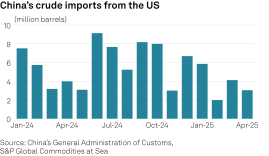
The country likely imported about 3.04 million barrels of crude from the US in April, accounting for 0.9% of its total crude imports in the month, Platts estimated.
"Even if the import tariff on US LNG/crude oil is reduced to 10% or lower in the future, it would still be challenging for US cargoes to flow into the Chinese market. There are ample supplies available in the world," said a trading source at a state-owned oil company.
In the phase 1 trade deal signed in February 2020, China agreed to increase its buying of US energy products.
Positive for oil demand
The larger-than-expected tariff cuts are likely to revive some trade between the world's two largest economies and potentially boost China's oil demand, which has been revised downward due to ongoing trade tensions, oil industry sources and analysts said.
US-China trade and goods shipments have recently plummeted due to retaliatory tariffs, leading to a downgrade in GDP expansion to 3.7% and downward adjustments in oil demand growth to 78,000 b/d in China for 2025, according to analysts at S&P Global Energy. This is down from earlier forecasts of 4.2% and 270,000 b/d made in January.
The news of a breakthrough in negotiations saw crude oil prices rise. At 0939 GMT, the July ICE Brent futures contract was trading $1.94/b higher at $65.85/b. Concerns of a global economic slowdown have weighed on oil prices for several months.
"This marks a substantial cooling of trade tensions between the US and China; however, questions remain for markets as to what the end game will be, as the measure will be operational for 90 days, and what the eventual level of tariffs will be," ING Bank strategists said in a May 12 note.
The current trade dispute echoes the first US-China trade conflict that began in February 2018 under the Trump administration. That dispute lasted two years and involved multiple rounds of retaliatory tariffs before the countries reached the Phase 1 trade deal in February 2020.
The timeline for China's retaliatory tariffs on US imports:
| General | Crude | LNG | Ethane* | Propane, butane* | |
| Feb. 4 | Added 10% and 15% additional tariffs on a list of US goods, effective Feburary 10 | 10% | 15% | 0 | 0 |
| April 4 | Added 34% tariff on all US goods, effective April 10, with a grace period until May 13 for cargoes already in transit. | 44% | 49% | 34% | 34% |
| April 9 | Increased the additional tariff from 34% to 84% on all US goods, effective April 10, with a grace period until May 13 for cargoes already in transit. | 94% | 99% | 84% | 84% |
| April 11 | Further increased the additional tariffs to 125% on all US goods, effective April 12, with a grace period until May 13 for cargoes already in transit. | 135% | 140% | 125% | 125% |
| May 12 | Slash additional tariffs on US goods by 91 percentage points, and suspend 24 percentage points over 90 days, effectively May 14. | 20% | 25% | Exemption | 10% |
*China imposes 1% duty on ethane, propane and butane imports from overseas.
Source: Government statements, sources

Editor: