Maritime & Shipping, Crude Oil, Wet Freight
November 26, 2026
Tanker rates face two-year decline regardless of Middle East conflict: BIMCO
Editor:
HIGHLIGHTS
Freight rates decline through 2028
Crude tanker demand drops 13% in 2026
Fleet grows 13.1% by end of 2028
Tanker freight rates face a prolonged decline through 2027 and 2028, with or without peace in the Middle East or Ukraine, shipping industry body BIMCO said in a Nov. 26 outlook.
Geopolitical disruption has reshaped tanker markets in 2026, as consumers have sought alternative sources of both crude and products to replace Middle East barrels, and as risk premiums and logistical inefficiencies have added to freight rates.
Crude tanker ship demand has fallen 13% year to date, clean product cargo volumes are down 11% year over year, and Middle East exports have dropped 39% — even as "Ship-to-ship transfers in the Gulf of Oman from shuttles transiting the Strait of Hormuz have lifted Persian Gulf exports considerably," BIMCO said in a market outlook.
Amid this, freight rates are high in historical terms. The Platts Global VLCC index for non-scrubber-fitted, non-eco vessels rose 3,350.5% from $34,228/day at the start of 2026 to a record $1,181,046/day on Oct. 9. It has since fallen 27.8% to $852,965/day, as of Nov. 25, but remains 2,392.0% above its opening level this year. Despite the retreat, the latest assessment is 376.1% above the $179,175/day average since the index's launch on March 1, 2024. Platts is part of S&P Global Energy.
The near-term outlook depends on workable crude volumes, as elevated transport costs continue to threaten long-haul arbitrages; it will hinge on Hormuz clearance, routings of upcoming Saudi Red Sea programs, and Atlantic ballast arrivals, analysts at S&P Global Commodities at Sea said Nov. 25.
Two scenarios
BIMCO presented two scenarios: "SoH open," in which the Strait of Hormuz, Red Sea and Russia disruptions resolve gradually during 2027 and fully by 2028, and "SoH closed," in which all three situations remain unchanged throughout the forecast period.
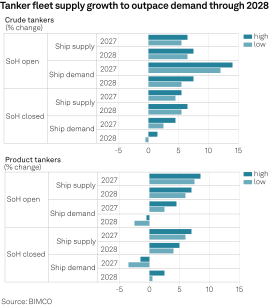
Under 'SoH open,' BIMCO expects dirty tanker freight rates to weaken in 2027 as risk premiums dissipate, before remaining near 2027 levels in 2028, with supply and demand growth forecast to be balanced. Under 'SoH closed,' supply is forecast to outpace demand and BIMCO expects freight rates to weaken during both 2027 and 2028.
"In both scenarios, clean tanker freight rates are expected to fall during both 2027 and 2028, BIMCO said. "As global refinery throughput is expected to grow more slowly than global oil supply, the potential for ship demand growth is limited, and supply growth is predicted to outpace demand growth."
Rates had been affected by expectations that an escalation of the Iran War could be avoided following the Democratic win in the US midterm elections, as well as by an increase in Persian Gulf exports, which reduced Asian demand for Atlantic barrels, BIMCO said.
Lower freight rates will likely negatively affect time charter rates and secondhand vessel values, though newbuilding prices may remain elevated relative to the 10-year average given the scale of the global order book, BIMCO said.
Supply pressure
The crude tanker fleet is expected to grow 13.1% between end-2026 and end-2028. The crude tanker order book has reached a record 137 million dwt — equivalent to 28% of the existing fleet. The product tanker order book stands at 47 million dwt, or 22% of the current fleet, BIMCO said.
Under "SoH open," crude tanker ship demand is forecast to grow 10%-12% in 2027 and 5.5%-7.5% in 2028, supported by an anticipated oil oversupply of 3.8 million barrels/day that could drive inventory restocking and seaborne volume growth, BIMCO said. Under "SoH closed," demand growth is forecast at just 2.5%-4.5% in 2027 and between -0.5% and 1.5% in 2028, below supply growth in both years.
A sharp recent increase in attacks on ships in the Strait of Hormuz and the Persian Gulf adds further uncertainty. Middle East crude exports fell nearly 1 million b/d in the week ended Nov. 17, according to CAS data, as persistent attacks on shipping around the Strait of Hormuz disrupted tanker traffic, reversing part of the region's export recovery even as refined product flows increased sharply.
Nine ship attacks were recorded that week by the UK Maritime Trade Operations. Total ship traffic through the Strait of Hormuz averaged about 20 ships/day during the week, but crude and product tanker transits averaged about 10 ships/day, down from 14 the previous week, CAS data showed.
