Crude Oil, Chemicals, Refined Products, Polymers, LPG
October 27, 2026
INTERVIEW: Uganda's new energy minister eyes infrastructure push beyond first oil

Editor:
HIGHLIGHTS
First oil due in 2026, exports to start in 2027
Third bid round expected to launch imminently
Dangote joins Kenya Pipeline Company as co-owner
Uganda is on the brink of becoming the world's youngest oil producer by the end of this year, with the launch of the contentious East Africa Crude Oil pipeline set to link the country's oilfields to the world market after almost a decade in the making.
However, the long-awaited pipeline suffered new setbacks in the wake of the US-Iran war, while a massive new Kenyan refinery project has overhauled expected trade routes for the country's oil, its energy minister told Platts, part of S&P Global Energy, in an exclusive interview.
Speaking on the sidelines of African Energy Week in Cape Town earlier this month, new energy minister Monica Musenero said that Uganda should achieve first oil from its CNOOC-operated Kingfisher oilfields by the end of 2026, although the first exports will not leave Tanzania until early 2027.
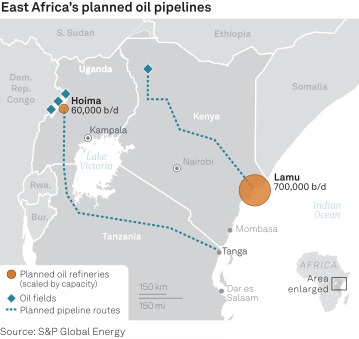
The Ugandan oil project involves two developments, Kingfisher and Tilenga, which are being developed by CNOOC and TotalEnergies, and will rely on the EACOP to shuttle up to 230,000 barrels/day of medium-to-heavy sweet crude to the Tanzanian coast.
However, after years of delays linked to financing and environmental opposition, the pipeline project hit another speedbump when the US-Iran war trapped vital equipment in the Persian Gulf. "We had to airlift," Musenero said, adding that the developers were left with no alternative when parts were left stranded beyond the Strait of Hormuz.
The delay has meant a missed opportunity for Uganda to capitalize on crude prices that have traded above $100/b over the last two months, well above the $60/b it had used as its benchmark.
"I wish I were selling crude now," Musenero said, adding that a long-delayed third licensing round should also be coming soon to encourage new exploration. Discussions are already underway over potential OPEC membership, which the minister sees as a useful partnership for newer producers.
Nevertheless, since assuming the role in June, Musenero, who previously ran the science and technology ministry, has emphasized plans to look beyond the raw material as a future source of growth for the energy sector.
"After about 10 years of crude marketing, Uganda's economy should not be dependent so much on the price of crude, but the value-added things that we are selling," Musenero said, highlighting plans for new refining and logistics capacity to diversify revenues.
In the future, the country could also offer a "green barrel" offset with its forests and wetlands that act as a carbon sink, potentially giving it an edge for climate-conscious lenders, Musenero said.
Downstream plans
As part of its downstream drive, the country is developing a $4-billion refinery in Hoima, which will eventually have the capacity to refine up to 60,000 b/d of crude. With the support of Emirati investor Alpha MBM, Uganda hopes to commission the refinery in roughly 2-4 years, Musenero said.
Beyond that date, the aim is to develop an "oil city" around the country's Kabalenga Industrial Park, she said, which has been earmarked for an integrated petrochemicals facility capable of producing polypropylene and other products.
The Hoima refinery will be given first call on domestic crude produced from the country's Albertine Graben basin, Musenero said, which could reduce the available barrels to be marketed by Vitol to international refiners.
Additionally, new plans by Nigeria's Dangote Group to build a 700,000 b/d refinery in Lamu, Kenya by the end of the decade could keep far more crude within the continent than initially anticipated, overhauling expected trade routes into Asia and beyond.
"When we started discussions and looking at our growth, there was no Lamu. And now there is Lamu as part of the formula," Musenero said, adding the project has created a stronger impetus to avoid long-term contracts and maintain trade flexibility.
Infrastructure play
Uganda has yet to take a final investment decision on a potential stake in the Dangote refinery and sales of its flagship Pearl Sweet crude will be driven by market dynamics regardless of any state interest in the project, Musenero stressed.
However, the refinery plan appears to have driven a new focus on regional trade links for the wider East African market, with potential upside for Uganda as a regional trade hub. For instance, Dangote recently joined the Uganda National Oil Company as a co-owner of Kenya's state-owned pipeline company, which supplies the majority of Uganda's fuel, but has struggled to keep pace with the growing demands of the inland market.
"We are working actively with Kenya to make that pipeline go all the way to Uganda," Musenero said, commenting that extending the network was on her "urgent list" and undergoing feasibility studies. Dangote plans to invest in the network to link it to its Lamu refinery, offering an inland channel for its products, an executive said.
Building on plans from her predecessor, Musanero is also focused on developing two new oil product pipelines from Tanzania and Kenya, which will be capable of transporting motor fuels and LPG, although no FID has been taken. In the capital, Kampala, builders also began constructing new storage in September, which should increase the country's total capacity to 360 million liters by 2028, Musenero said.
Among others, the country's emerging oil sector has already captured the attention of Vitol, which has floated plans for a new $20 billion storage hub in Tanga, Tanzania, where the EACOP ends.
"We were previously labeled landlocked, so unfavorable for investment," the minister said, emphasizing that new investment has shifted attitudes from Middle Eastern, African and American financiers. "Now, it's being looked at more like when you see that map of East Africa, Uganda is at the heart of it," she said.
