Refined Products, Chemicals, Gasoline, Jet Fuel, Diesel-Gasoil, Aromatics
October 16, 2026
West Coast gasoline imports hit five-year high after refineries went dark: CAS

By Zoe Vastakis
Editor:
HIGHLIGHTS
India emerges as third-largest fuel supplier in 2026
Import sources expand from 11 to 15 nations
Mexico receives 65% of regional fuel exports
Nearly a year after Phillips 66 permanently shut its 139,000 b/d Wilmington, California refinery, the US West Coast fuel market has undergone a structural shift in its import sourcing and export patterns, with gasoline imports reaching their highest level in at least five years and the supplier base expanding to 15 countries as the region scrambles to replace lost domestic refining capacity.
The closure of Wilmington in October 2025, followed by Valero's accelerated shutdown of its 145,000 b/d Benicia, California refinery in February 2026 — two months ahead of its originally scheduled April 2026 closure date — removed a combined 284,000 b/d of California refining capacity within a matter of months, triggering a sustained and evolving response in seaborne trade flows into PADD 5.
Imports surge, exports constrict
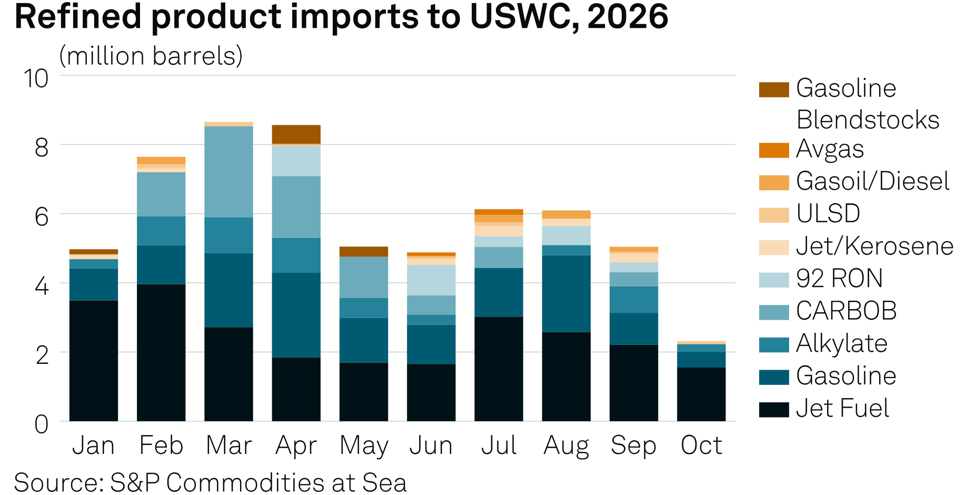
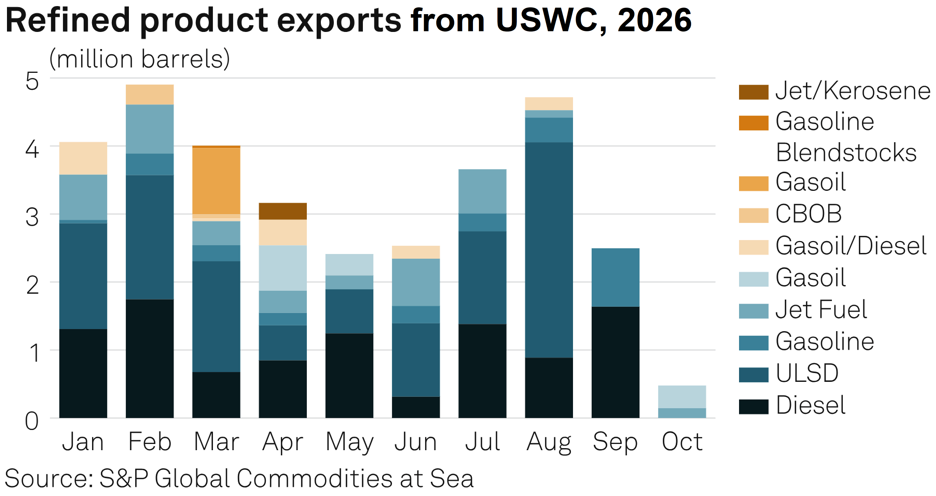
Total refined product imports to the US West Coast reached about 61.1 million barrels between January and October 2026, with jet fuel dominating at roughly 24.7 million barrels, or 40% of the total. Gasoline was the second-largest product at about 14.1 million barrels, followed by CARBOB at 8.45 million barrels and alkylate at 5.28 million barrels. Monthly import volumes peaked in March at 9.70 million barrels and April at 8.95 million barrels, before easing to around 6.1 million barrels in July and August. On the export side, USWC shipments from January through September totaled 32.65 million barrels, with ULSD and diesel accounting for about 67% of that volume.
Gasoline flows shift
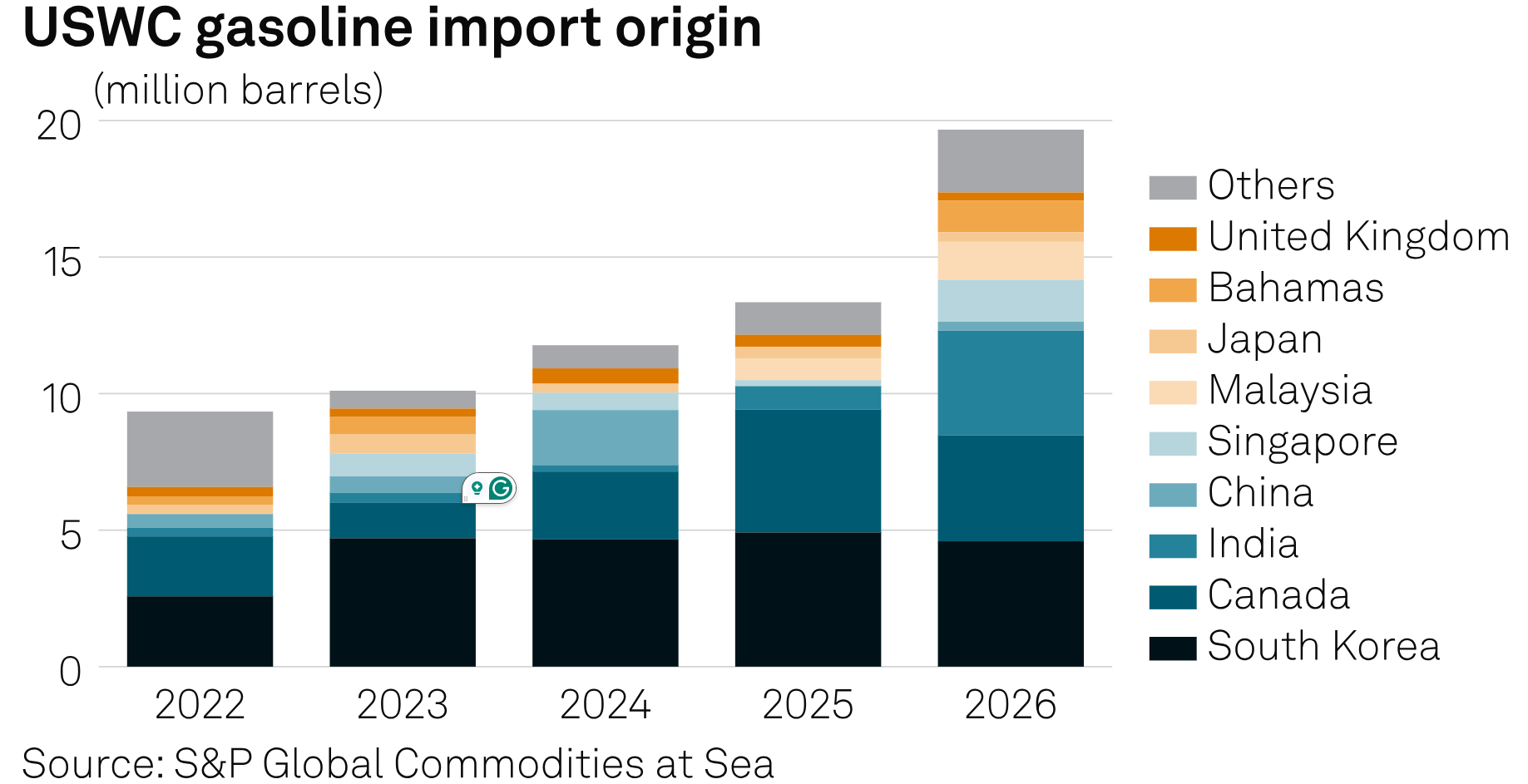
The most significant structural change has been in gasoline imports, which reached 19.07 million barrels in 2026 through the available reporting period — a 54.5% increase from 12.34 million barrels in 2025 and the highest level seen over the last five complete years, with the fourth quarter still to run.
South Korea remained the leading single source, supplying 4.59 million barrels in 2026, though slightly below the 4.92 million barrels recorded in 2025. Canada held its position as the second-largest origin at 3.88 million barrels, down from a surge of 4.50 million barrels in 2025. The most striking development was the emergence of India as a major supplier. Indian gasoline volumes rose to 3.83 million barrels in 2026, around 4.5 times the 852,152 barrels recorded in 2025, placing India just behind Canada and close to South Korea in the supplier rankings. The shift reflects India's growing refining export capacity and its ability to competitively serve arbitrage windows into California.
Europe also returned as a meaningful supplier after a quieter 2023–2025 period. The Netherlands, Belgium, Norway, and the UK together supplied about 1.46 million barrels in 2026, compared with around 441,000 barrels from identified European origins in 2025. The Netherlands alone contributed 637,676 barrels. European supply had previously reached roughly 1.29 million barrels in 2022, making 2026 a resurgence rather than an entirely new development.
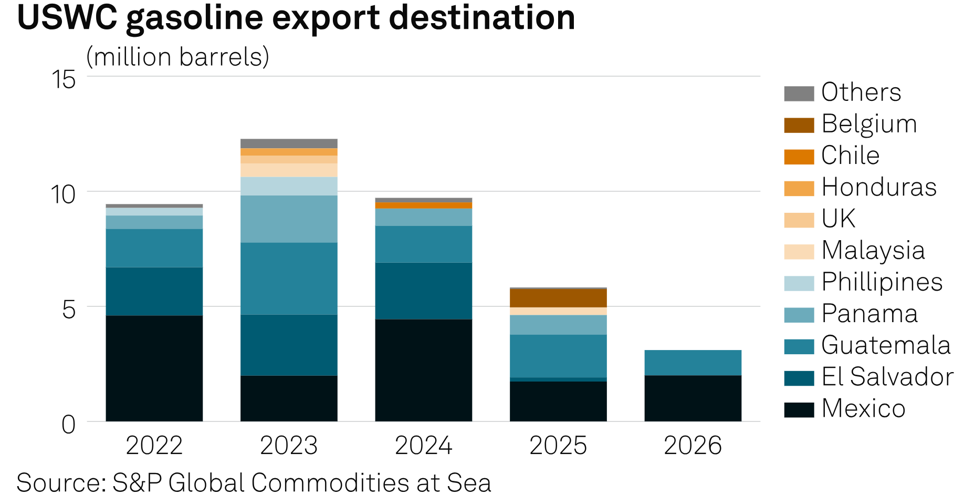
In contrast, gasoline export flows from the US West Coast contracted sharply and became highly concentrated within the last ten months. Reported gasoline shipments in 2026 went only to Mexico and Guatemala, totaling around 3.10 million barrels, with Mexico accounting for roughly 65% of that volume at around 2 million barrels. This marks a significant narrowing from the broader destination mix seen in 2023, when exports reached 11 countries, including Malaysia, the UK, Honduras, South Korea, Canada, and Japan.
The supplier base broadened substantially, with imports arriving from 15 countries in 2026, compared with 11 countries in each year from 2023 through 2025. The "Others" category — which included Trinidad and Tobago, the US Virgin Islands, Senegal, and Norway — grew from 845,381 barrels in 2025 to 2.30 million barrels in 2026.
Increased reliance on finished gasoline
Following Phillips 66's March 2025 announcement that Wilmington would close in October 2025, CARBOB imports rose sharply to 1.65 million barrels in October 2025 and reached a then-period high of 1.98 million barrels in November, consistent with the market beginning to replace Los Angeles-area refining capacity with seaborne supply. Finished gasoline imports also rose, climbing to 1.67 million barrels in November and 1.54 million barrels in December, from 1.03 million barrels in October.
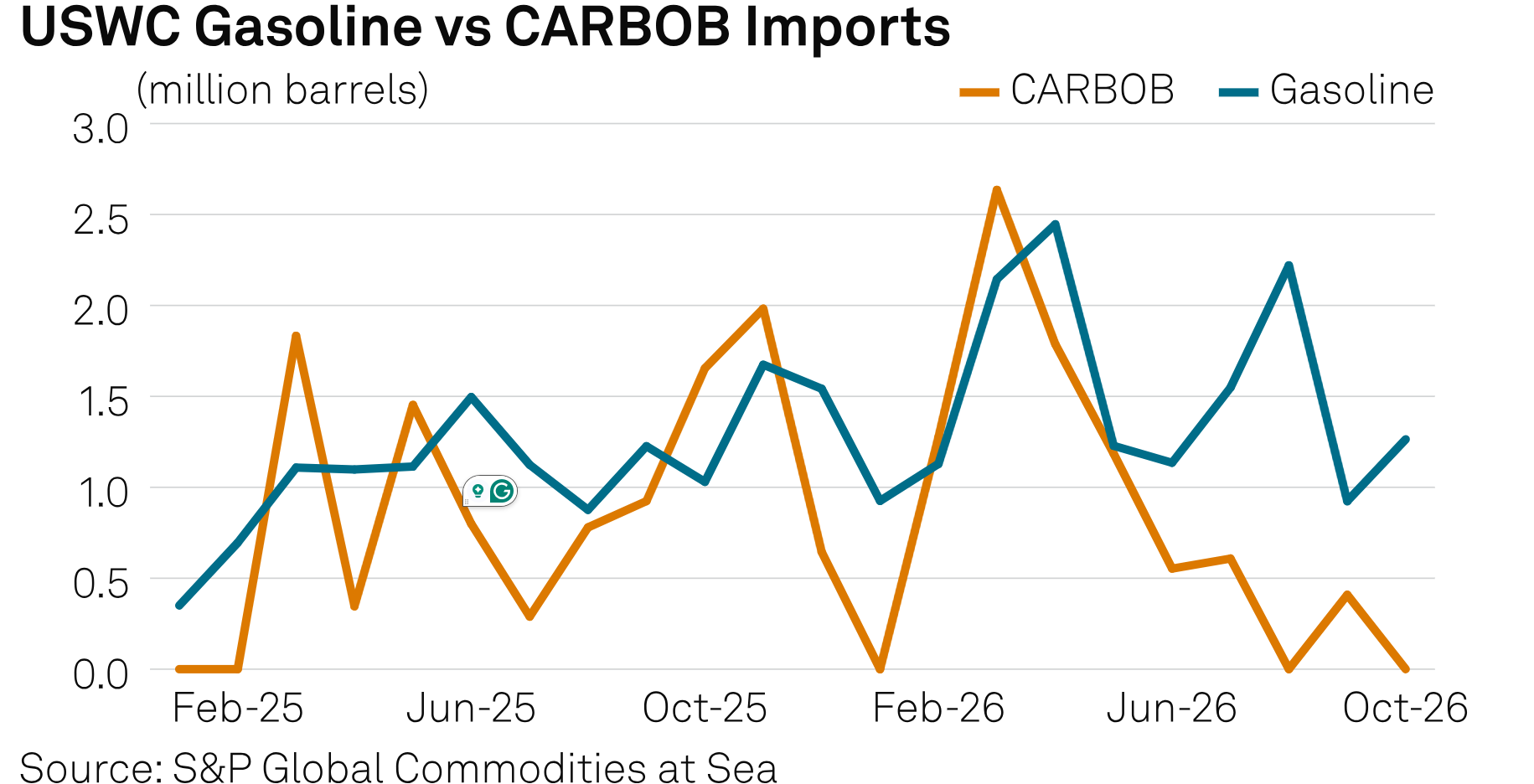
The import response intensified around the Benicia closure. After Valero moved the shutdown forward to February 2026, gasoline imports climbed from 1.13 million barrels in February to 2.14 million barrels in March and 2.45 million barrels in April, while CARBOB rose from 1.28 million barrels in February to 2.63 million barrels in March and 1.79 million barrels in April. March and April 2026 produced the strongest combined gasoline and CARBOB inflows in the available series, though seasonal demand patterns, inventory positioning, refinery maintenance cycles, and arbitrage economics may also have contributed to the timing.
The composition of replacement supply shifted as the year progressed. While CARBOB dominated the initial response to the Wilmington and Benicia closures, finished gasoline imports remained elevated even as CARBOB volumes fell sharply in later months. August 2026 gasoline imports reached 2.22 million barrels while CARBOB imports were zero, indicating a greater reliance on finished gasoline, domestic blending components, or other blendstocks during that period. By October 2026, the market was operating with a higher structural baseline of gasoline imports, though without a consistent one-for-one relationship with CARBOB arrivals.
