Crude Oil, Refined Products
October 15, 2026
South Africa aims to formalize new oil stock policy by year-end: CEF

Editor:
HIGHLIGHTS
State aims to grow oil reserves from 40 days to 60
Private firms could face mandate for 21-day stockpiles: proposal
Refinery closures create 300,000 b/d fuel deficit: SANPC
South Africa aims to make its new strategic oil stocks policy into law by the end of 2026 after proposing a set of measures that would increase its minimum level of reserves to cover 60 days of net imports, Tshepo Mokoka, CEO of the country's state-owned Central Energy Fund, said on the sidelines of Cape Town's annual African Energy Week conference Oct. 14.
After publishing a proposal text of the new oil stocks law in July, the government is awaiting cabinet approval to greenlight the law, following a public consultation process, Mokoka said.
"By the end of this year, the cabinet should make a decision," Mokoka said.
Marking the first major change since the 1970s when the country's stockpiling policy was conceived, the proposed law would raise the government mandate for emergency oil reserves from 40 days of net imports to 60 days. It would also mandate private companies to hold at least 21 days of oil in emergency reserves.
"I think the Middle East crisis has taught us a lot," Godfrey Moagi, CEO of SANPC, said in a speech at the event Oct. 14. "We're going to move to 60 days instead of 40 days, and that is going to be very important to make sure that we secure the energy for this country."
In addition to the higher stockpiling mandate, the government has also proposed changing the composition of its stockpiles to shift away from pure crude reserves. For both public and private reserves counted toward the mandate, at least 30% of inventory should be held in the form of refined products, and storage locations should ideally be moved closer to inland demand centers, according to the government proposal.
South Africa consumes about 27 billion liters of petroleum products every year, and risks a 24 million South African rand ($1.4 million) shock to its economy in the event of a 20% supply shortfall over a two-week period, according to government estimates.
With state-owned reserves concentrated in Saldanha Bay on the country's West Coast, it takes a minimum of 21 days for imports to reach South African ports, and at least another 10 for products to be offloaded and transported inland, according to the estimates.
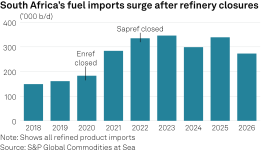
Refining decline
Once the largest refining hub on the African continent, South Africa was a net fuel exporter until 2006.
However, the subsequent closure of its Enref and Sapref refineries has left it with a 300,000 b/d shortfall in oil products, forcing officials to reassess the country's energy security apparatus, Moagi said at the conference.
In 2024, CEF bought the country's shuttered Sapref refinery from BP and Shell, and later announced plansto more than double its capacity. The facility has remained offline since 2022, pending a final investment decision on the hundreds of millions of dollars needed to revive the 62-year-old plant.
"We can't expect every country to build a refinery -- we need to build infrastructure cross-border," Moagi said.
An SANPC executive said Oct. 14, the company was closely watching the expansion of Nigeria's Dangote refinery and "sobering" long-term projections for the sector, which leaves significant uncertainty over the competitiveness of new projects.
South Africa introduced a new 25-year leasing agreement in 2025 at its main import terminal, Durban's Island View Precinct, to replace month-to-month arrangements with international energy companies.
International energy companies have been given five years to refurbish tanks at the terminal or build new ones through leasing, according to an executive at state pipeline operator Transnet.
Amid the Middle East conflict, South Africa has pointed to major stockpilers like China, as well as institutions like the International Energy Agency, with its 90-day net import mandate, to help inform its reserves policy, according to its July proposal.
However, the government will rely on private sector participation to help make meaningful storage buildouts, the proposal said.
"This is a burden the state cannot carry alone, especially given fiscal constraints," the Department of Mineral and Petroleum Resources said in its policy proposal.
The ministry proposed using a cost-recovery framework or another financing mechanism to fund new storage, without providing further details.
