Maritime & Shipping, Refined Products, Coal, Metals & Mining, Wet Freight, Fuel Oil, Ferrous
October 08, 2026
India bunker fuel demand weakens on higher prices
Editor:
HIGHLIGHTS
India's VLSFO prices exceed regional hubs
Kochi supply issues shift orders to Colombo
East Coast ports face operational challenges
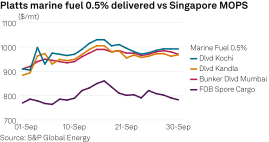
India's bunker fuel demand remained subdued in September and has continued to soften into October, as higher very low sulfur fuel oil prices relative to key regional hubs such as Singapore and Fujairah weighed on inquiries across major ports, market participants said.
"October has started on a dull note, with inquiry remaining very limited," a Dubai-based trader for the Indian market told Platts, part of S&P Global Energy, Oct. 8. "September was relatively quiet, with volumes lower across grades compared with previous months. The first half was moderately active, but weakened significantly in the second half."
"We were previously seeing around five to six inquiries a day on average, but this has now dropped to just one or two," the trader said. "On the West Coast, most inquiries have been seen from Kandla and Mundra, mainly for bulk and container vessels. We have not seen any significant fresh demand on the East Coast recently."
"In September, inquiries were slightly lower than in August," the trader said. "This dip may be attributed to India's VLSFO pricing, which is $100 higher than in Singapore and Fujairah. As a result, we lost some volume in September. On the supply side, we had no issues throughout the month and saw good product availability. The average stem size was 400 metric tons, and the total volume at Kandla Port was around 35,000 mt."
Platts assessed marine fuel oil 0.5% delivered to Mumbai at $972/mt on Oct. 8, up $27/mt month over month. Marine fuel oil 0.5% delivered to Kandla was assessed at $977/mt, up $23/mt over the same period.
Kochi supply disruptions
High sulfur fuel oil demand "was moderate for September, even though there were supply constraints in Kochi," a Gujarat-based trader said.
A source close to Bharat Petroleum Corp. Ltd. (BPCL) said supply in Kochi was "somewhat inconsistent in September, with product on and off throughout the month ... Overall, BPCL's industrial volume in Kochi was around 5,700 mt in September."
Platts assessed marine fuel oil 0.5% delivered to Kochi at $1,001/mt on Oct. 8, up $31/mt month over month, while marine fuel oil 0.5% delivered to Colombo was assessed at $983/mt, up $33/mt over the same period.
East Coast bunker volumes mixed
East Coast bunker activity showed divergent trends in September, with stronger volumes in Chennai and higher HSFO demand in Paradip offset by operational constraints in Haldia and supply tightness at Tuticorin, according to market sources.
"We observed a decline in inquiries for September, primarily due to high prices in India," a Paradip-based supplier said. "Additionally, vessel movements were disrupted by weather issues in the last week of the month. During September, we supplied nearly 9,000 metric tons, with the average stem size ranging from 400 to 500 metric tons. Most of the demand was driven by vessels carrying coal, iron and fertilizers."
"Demand for HSFO was significantly higher than the previous month, when total HSFO volume was 2,000 mt," the Paradip-based supplier said.
At the port of Haldia, supply was unchanged month over month, a Visakhapatnam-based supplier said. "Overall, the port volume was around 7,000 mt due to operational issues, including jetty maintenance, barge availability and tidal conditions," the supplier said.
Supply and demand conditions were favorable, with port volumes reaching about 12,000 mt," a Visakhapatnam-based trader said. Improvements in anchorage supplies in Chennai led to an increase in volumes. Although product availability was somewhat challenging during the first week of the month, supply conditions improved significantly afterward, the trader said.
However, in Tuticorin, supply was tight during the month, with stable inquiries and an overall volume of 3,000-4,000 mt, the Visakhapatnam-based trader said.
In New Mangalore, volumes totaled about 10,000 mt, but there were operational issues, such as barge tightness, as the entire port was operating with a single barge, a local supplier said. However, the supplier said product availability was stable.
