Metals & Mining, Chemicals, Refined Products, Maritime & Shipping, Diesel-Gasoil, Gasoline, Fuel Oil, Wet Freight
October 01, 2026
Rhine water levels fall to new record low, stalling fuel logistics
By Kelly Norways and Aruni Sunil
Editor:
HIGHLIGHTS
Rhine levels drop to record 6 cm below benchmark level
Tanker traffic at a virtual standstill at at Kaub chokepoint
Refineries cut loadings by a third in Germany
Water levels on the Rhine river slumped to fresh record lows for the second time in a week, Oct. 1, the German water authority reported, preventing fuel tanker deliveries from making their way inland and dashing hopes for a rapid rebound in traffic ahead of peak winter demand levels.
After a summer of record temperatures and droughts across Europe, low water levels have become an increasingly serious threat to the continent's busiest river, typically a vital conduit for energy, metals and chemicals to reach inland markets. Earlier this week, a car carrier ship was reported to have run aground at Dusseldorf harbor, while elsewhere on the continent, a slump in Danube river levels recently revealed lost WWII-era shipwrecks and forced power plants to shut down.
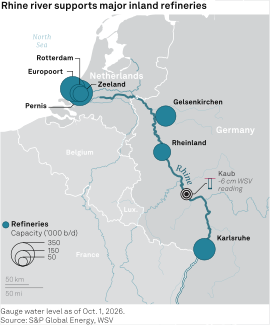
Official readings from the German water authority WSV showed water levels in Kaub, the Rhine's shallowest point, had dropped 6 centimeters below its 113 cm benchmark level, surpassing a previous all-time low of minus 2 cm against the baseline threshold recorded on Sept. 29. The WSV's benchmark rate, or "zero" reading, varies in different segments of the river, subject to water depth.
Falling water levels at the Kaub pinchpoint in Germany follows reports of record low water levels in parts of the lower Rhine, which runs from near Bonn in Germany to the border with the Netherlands. Readings at the Dutch village of Lobith and Cologne in Western Germany hover only slightly above recent all-time lows, recorded Sept 28-30.
The historically low water levels have stopped most tanker traffic from navigating the Upper Rhine, which traverses southern Germany to the neighboring Swiss market, putting extra pressure on already-tight fuel stocks affected by the US-Iran war. Swiss government data showed that heating oil costs hit their highest since 2022 in September, climbing 8% from the previous month's average.
According to data from Spotbarge, a Dutch shipping and bunker monitoring company, only two specialist chemicals barges, Raadsman and Millora managed to transit the Kaub crossing Oct 1, but shipping was otherwise at a standstill. Only a few captains and barge companies are willing to risk the voyage in such extreme conditions, with regular vessels having to wait for WSV levels closer to plus 60-70 cm, or a minimum of 173 cm at Kaub, before attempting to make the voyage.
Refinery exposure
The river acts as an important trade route for several key refineries, notably Shell plc's 190,000 barrels/day Godorf refinery at its Rheinland complex and 316,000 b/d Karlsruhe/Miro plant, as well as the major production hubs on the coast in the Netherlands. According to Spotbarge estimates, loadings from both Shell refineries were down by a third week over week on Sept. 28, keeping pressure on product flows in already-tight markets.
Shell did not immediately respond to a request for comment.
As a rule of thumb, barges typically need to cut their cargo loads by up to 75% when WSV readings drop below 75 cm, keeping product movement limited and pushing up freight rates. The barges that sail the Rhine typically carry volumes of between 2,000 metric tons and 5,000 mt, but those still sailing the shallower segments have been forced to slash loads. Barge rates from Amsterdam-Rotterdam-Antwerp hub to Karlsruhe are currently lingering at to €200/mt, almost ten times their rate in January.
"The majority of barges that are now in the Upper Rhine stay there for loadings from the Miro Refinery for local depot supply, such as Strasbourg and Basel, but also with low tonnage," said Spotbarge CEO Sebastiaan Kosman, noting that trade flows would only be able to return gradually as water levels rise. The WSV forecasts a slow recovery in levels in the coming days, but sees readings staying below 10 cm until Oct. 5.
As peak winter heating oil season approaches, traders expressed concern that lasting disruption could hamstring inland trade, with limited capacity to shift products to rail and pipeline logistics. Traders have already faced challenges rerouting gasoline via pipeline due to Swiss quality restrictions, and have butted up against capacity restrictions on regional rail networks.
Arne Lohmann Rasmussen, chief analyst at Danish energy investment advisory Global Risk Management, estimated that fully replacing Rhine river transportation would take roughly 3,000 extra road tankers daily to manage oil product deliveries alone.
"Low Rhine water levels are the last thing the German economy needs," Rasmussen said. "German industry is already struggling with high energy prices, US tariffs and increasingly tough competition from Asia. A new logistical chokepoint adds higher costs and more uncertainty to an economy already under pressure."
