Crude Oil, Natural Gas
August 19, 2026
Oil majors pile in on Americas projects to plug production gap

Editor:
HIGHLIGHTS
ExxonMobil, Chevron pump record oil and gas volumes in US
Global output down 100,000-300,000 b/d in Q2 across most majors
Firms hoard cash, hold off on higher buybacks amid price uncertainty
The world's major oil companies are sharpening their focus on Americas oil and gas projects and tightening their belts for future price volatility as the Middle East war continues to stifle production.
Global energy producers continued to enjoy a surge in profits in the second quarter of 2026 as the US-Iran conflict continued to disrupt trade through the Strait of Hormuz and rock oil and gas prices.
In April, the Dated Brent crude benchmark hit $144/b, an all-time high, while companies reported Q2 refining margins ranging from $12-$30/b, at least double last year's levels.
BP PLC and Shell PLC both doubled their profits compared to 2025. In the US, ExxonMobil Corp. and Chevron Corp. took home double-digit billion-dollar returns, later criticized by President Donald Trump as "too much money" for a wartime windfall.
But gains were almost entirely driven by price effects, rather than production growth, and companies have exercised caution before banking on a sustained upswing.
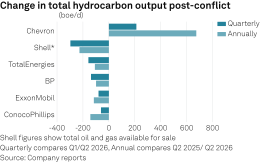
In the latest round of earnings reports, Shell, TotalEnergies SE and BP all reported between 100,000 b/d to 300,000 b/d of quarterly oil and gas production losses in Q2, while only Chevron managed to grow its output. In some cases, producers managed to avoid the full scale of production losses they had initially projected, with ConocoPhillips exceeding its guidance and TotalEnergies reporting its output fell by 150,000 b/d less than it had initially forecast.
Nevertheless, lifting and exporting supplies remains subject to bottlenecks, and future production volumes remain highly uncertain. According to the low end of its Q3 guidance, Shell sees another 144,000 boe/d production loss from its upstream division, compared to a 56,000 boe/d upside.
Bank of America
Most production offsets came from the Americas, a region that has become increasingly important for majors to deliver on growth plans.
Before the conflict began, the Americas were already expected to drive most global supply growth, but production has rapidly scaled. In January, the International Energy Agency projected Americas oil production would grow by 1.5 million in 2026. It has since upgraded its outlook to 1.9 million b/d in growth, and a further 900,000 b/d in 2027.
ExxonMobil grew its non-Middle East production to its highest volume in more than two decades in the second quarter, including a record 2.1 million b/d from the US, while ConocoPhillips also reported record output from the country's Permian Basin. TotalEnergies grew its Americas liquids output by 9% in Q2 compared to Q1, triple the rate it reported last quarter and up from just 1% in Q4 2025.
BP is moving quickly on developing its Bumerangue discovery in offshore Brazil, its largest in 25 years, and it expects the Americas to account for more than 70% of its output from new projects by the end of the decade. TotalEnergies has tied growth plans to ramp ups in Brazil and the US, while Shell has focused on its $16.4 billion acquisition of Canada's ARC Resources, announced in April
Much attention has been directed to Guyana and the Permian Basin for growth. Chevron, meanwhile, has quickly hiked production in Venezuela since the country's former president, Nicolas Maduro, was ousted earlier this year, and wants to grow its output by another 50% before 2029.
A strong Americas focus comes after six months of conflict in the Strait of Hormuz has forced executives to reckon with a potential "new normal" for the oil region, which could be shaped by unpredictable trade flows and extreme volatility. On the other hand, the US-Iran MOU agreed in June demonstrated that production can be quickly recovered, said TotalEnergies CEO Patrick Pouyanne.
Analysis from HSBC in March showed that ExxonMobil, TotalEnergies and Shell were among the companies most exposed to Middle East disruptions, with the region accounting for 15% of their production last year. For ExxonMobil and Shell, most of that output came from Qatar and Oman, while TotalEnergies has more exposure in the UAE.
As the conflict rages on, other focus areas include countries like Iraq and Syria, where companies like ConocoPhillips have eyed a growing role, as well as African producers such as Libya and Angola.
Spending caution
Despite the bumper earnings, IOCs have been slow to disburse extra profits with share buybacks or dividends, focusing instead on cutting costs and paying down debt ahead of further uncertainty.
BP suspended its share buyback program in February to prioritize its balance sheet, while Shell and TotalEnergies have kept their commitments below last year's level. Meanwhile, Chevron reduced its debt by a massive $8 billion in Q2.
At just over $90/b, the Dated Brent crude benchmark is currently pricing more than 35% below its April peak. As a result majors appear to have avoided banking on double-digit prices, evidenced by BP's $80/b Brent forecast for the second half of the year.
Downstream, sentiment is more bullish. TotalEnergies reported margins had surged again to around $35/b in July, while Phillips 66 was among the refiners to project even tighter conditions in Q3.
Amid the volatility, oil trading profits have stayed robust, with Shell, TotalEnergies and BP flagging consistent or higher performance than an already-strong Q1. Nevertheless, companies are alert to higher risks in an unpredictable environment, as demonstrated by the recent (self-described) underperformance of TotalEnergies' gas trading division.
